
'Israel' falling again into death trap in South Lebanon: Israeli media
 5 Min Read
An Israeli military analyst says the so-called "security zone" along southern Lebanon is but another repetition of the same fatal mistakes due to Hezbollah's guerrilla tactics.
-
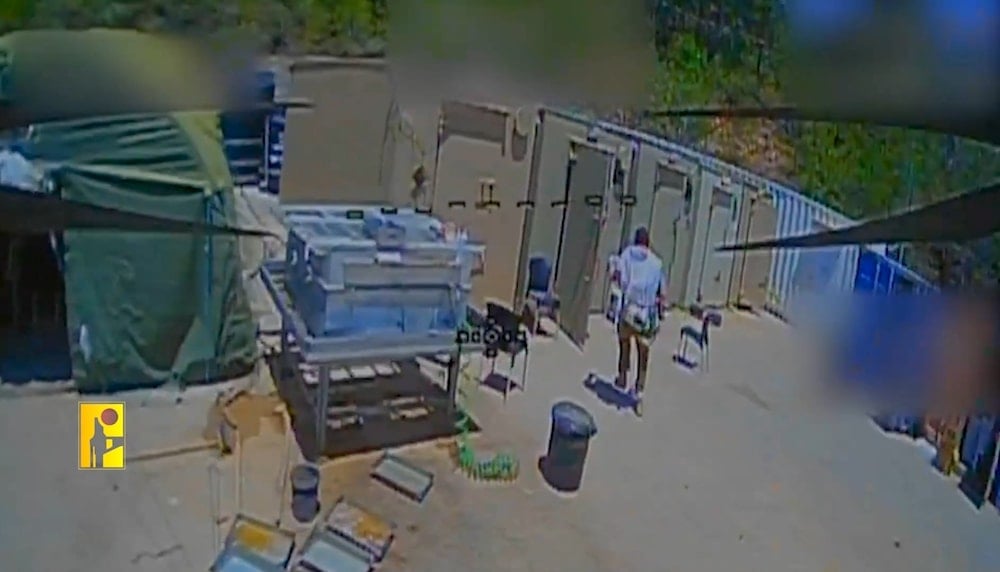
An Israeli soldier seen through the lens of a Hezbollah-operated drone inside a helipad zone in the illegal Israeli settlement of Shlomi, Occupied Palestine, May 9, 2026 (Islamic Resistance Military Media)
Israeli military affairs analyst Alon Ben-David warned that "Israel" is once again falling into the same historical mistakes in South Lebanon, cautioning that the so-called "security zone" has transformed into a "death trap" for Israeli occupation forces.
In details published by Maariv, Ben-David said that “history repeats itself twice: first as tragedy, and then as farce,” adding, “We now find ourselves in the stage of tragedy, and it is a tragedy that is intensifying because those leading this war, senior military commanders, are graduates of the period of folly in Lebanon during the 1990s.”
He pointed to an incursion involving an Israeli force composed of two special units this week in the Litani area, where Hezbollah fighters tracked the unit, precisely analyzed its movements, planted an explosive device, and detonated it while observing the force, resulting in the injury of four occupation soldiers.
This scene, Ben-David said, “is a replica of the guerrilla warfare Hezbollah waged against the Israeli army in southern Lebanon during the years of the security zone (1985–2000).”
The return to guerrilla warfare
Over the course of 15 years, he further noted, “Hezbollah sharpened its influence and capabilities at the expense of Israeli soldiers stationed in Lebanon, developing and learning through daily contact with them, transforming from a small organization into a seasoned guerrilla army. After the withdrawal from Lebanon in 2000, it rebuilt itself into a real army in every sense of the word,” according to Ben-David.
Today, Hezbollah has returned to guerrilla warfare patterns that do not require large forces, but rely on continuous attrition against thousands of Israeli targets within the "security zone", he said, highlighting that the military tactic comes despite sustained aggression and the 2024 war.
Ben-David stressed that the core concept, despite technological advances, remains unchanged: identifying the enemy’s weaknesses and striking them, not for military decision-making, but for exhaustion and attrition.
He further noted that “this is the situation today as well. Every day, Israel receives reminders that the new security belt cannot provide protection for northern residents, not from rocket fire or drones, and contrary to what was declared, it does not even place them beyond the range of anti-tank guided missiles.”
The threat of Hezbollah's drones
He added that fiber-optic guided explosive drones align closely with this doctrine, as they create the impression of a personal and targeted strike rather than an indiscriminate attack, suggesting a system that identifies, selects, and pursues its target.
He also referred to footage from Ukraine showing soldiers pleading for their lives in front of drones, saying there is hope such scenes will not be repeated in this context, while noting that Ukraine has so far failed to develop a comprehensive solution to the drone threat despite years of war.
Meanwhile, he said the Israeli security and military establishment is deploying a wide range of technologies in what he described as a new operational environment in Lebanon, where multiple detection, interception, and protection systems are being field-tested under real combat conditions.
These include protective netting for fortifications and vehicles, precision engagement systems such as Smart Shooter, fragmentation munitions, net-launching drones, barbed-wire systems designed to sever or burn fiber-optic cables used by drones, laser-based defenses, and the Iron Dome system.
However, he stressed that the main challenge remains early detection of incoming drones, since timely identification significantly increases the chances of interception or protection. To address this, a broad array of sensors has been deployed, including radar systems alongside optical and acoustic detection technologies.
Until such a solution is found, he said, “the army, driven by frustration, is turning to older conventional solutions,” while “Israeli forces remain completely exposed to the heights of Talat al-Taher overlooking the Litani bend area,” according to Ben-David.
Read more: Hezbollah unveils Ababil FPVs deployed in South Lebanon operations
'Stopping the bleeding in the north'
Regarding a ceasefire, Ben-David noted claims by analysts that the military is restrained due to an agreement imposed by the United States, while “the truth is that the army has no targets whose destruction would stop the fighting, even if all military options were opened.”
“There is no way to fully neutralize Hezbollah unless occupying Beirut and the Beqaa Valley is required,” he said, though he pointed to "a rare opportunity in the presence of a firm and determined Lebanese government willing to confront Hezbollah.”
In this context, he stressed that the necessity for any agreement lies first and foremost in “stopping the bleeding in the north, and not only there,” warning that anyone who believes "Israel" can maintain a security belt in Lebanon with eight brigade combat teams, while also holding a security zone in Syria, a buffer in Gaza, securing the Jordan border, and protecting 30 additional illegal settlements in the West Bank, “must urgently reconsider their calculations.”
He concluded that “the ground forces are suffering from severe exhaustion, even if the Chief of Staff does not dare state this clearly to his superiors. The army is tired, discipline is deteriorating, and professional standards are eroding amid the absence of training and structured military routines.”
Read more: 882 Israeli injuries from northern front, Lebanon


