
Hezbollah's FPV drones expose Israeli military crisis: Israeli media
 4 Min Read
Haaretz reports mounting Israeli military frustration as Hezbollah FPV drones inflict casualties and expose operational failures.
-
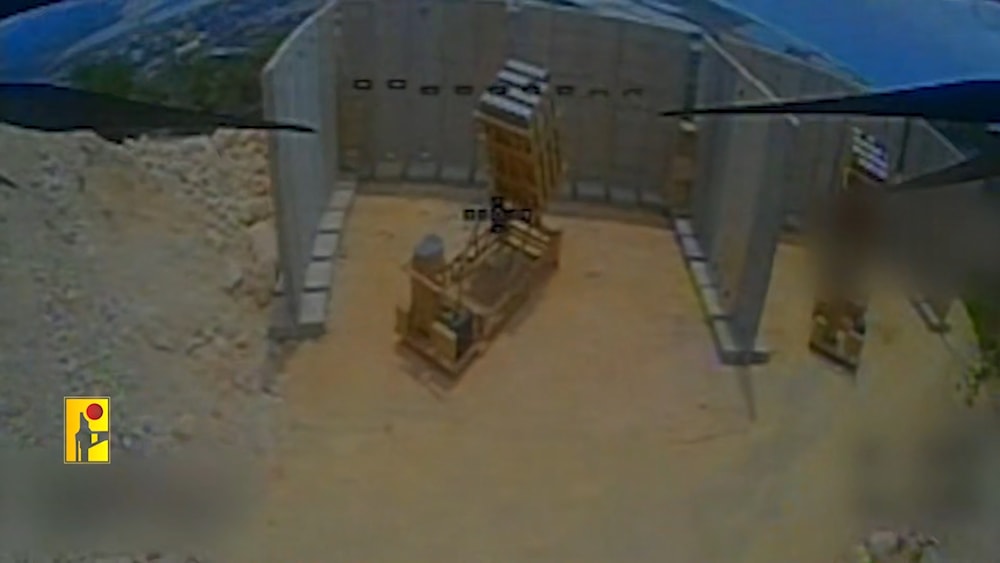
An Israeli Iron Dome battery can be seen through the lens of a Hezbollah-operated FPV drone, in Jal al-Allam site, Palestinian-Lebanese border, May 19, 2026 (Islamic Resistance Military Media)
Israeli military commanders and settlers in the north are experiencing deep frustration and anger over military and political stagnation in the Lebanon front, amid continued confrontations with Hezbollah along the border.
Israeli newspaper Haaretz reported that the Israeli military was “marking time on a secondary front,” unable to advance or impose a new security reality, while Hezbollah continued to dictate the pace of the fighting.
The newspaper cited military sources saying that explosive FPV drones operated by Hezbollah using fiber-optic systems had become the leading cause of injuries among Israeli troops, with the military unable to find technological or electronic solutions to intercept them.
Lack of operational discipline contributing to severe casualties
Investigations into recent incidents reportedly found that a lack of operational discipline and failure to follow protection protocols had contributed to severe casualties, including the serious injury of Col. Meir Biderman, commander of the Israeli army’s 401st Armored Brigade.
Haaretz also reported that reserve paratrooper officer Maj. Itamar Speyer was killed by a Hezbollah fighter in southern Lebanon. During his regular service, Speyer had served in the elite Maglan unit. The newspaper said that “there is a very thin layer of soldiers still carrying the burden of the war and paying the highest price.”
In another incident detailed by the newspaper, Capt. Maoz Yisrael Rekanati, a platoon commander in the Golani Brigade, was killed by an FPV drone launched by Hezbollah while securing a field tour by Brig. Gen. Yiftach Norkin, commander of the 36th Division, near the Litani River.
According to Haaretz, the tour was conducted during daylight hours despite the risks posed by Hezbollah drones, even as the Israeli military had reportedly restricted movements in the area to nighttime because of fears of drone attacks.
Commenting on the incident, reserve Col. Hanoch Dauba said that “the story goes beyond a mistake in the timing of a field tour,” stressing that the military “does not possess real operational control over the area.”
Hezbollah setting pace of battle
“There is presence and destruction of infrastructure,” Dauba said, “but the enemy we were told had suffered a crushing blow is still the one dictating the pace of operations and the conditions of the battle.”
Amid the absence of a clear political vision, field commanders told Haaretz that their primary mission had become “bringing the soldiers home safely,” while the threat from the Lebanon front persisted.
Reserve Maj. Gen. Tamir Hayman said the goal of “dismantling Hezbollah” as unattainable, saying the military was incapable of occupying Lebanon or enforcing Hezbollah’s disarmament, “especially in light of the severe manpower crisis.”
The newspaper added that the Israeli military chief of staff had raised “ten red flags” warning about the state of manpower within the army.
IOF troops under constant state of attrition, confusion
In further acknowledgment of the Israeli military’s predicament in southern Lebanon, Dauba said troops were living in a state of constant attrition and confusion under Hezbollah operations, with the battlefield reality becoming a “reproduction” of the period before "Israel’s" withdrawal from southern Lebanon in 2000, when troops had become “ducks in a shooting range.”
“This reality brings back memories of the security belt in the 1990s,” Dauba said in sharply critical remarks. “It is not a picture of victory, but evidence of erosion, stagnation, and the deep gap between the leadership’s declarations and the operational reality.”
Dauba also criticized senior military leadership, saying that continued reliance on “clearing operations and the destruction of homes” after two and a half years of fighting in Gaza and Lebanon amounted to a “professional and institutional disgrace.” He said the role of senior commanders was not only to send soldiers into battle, but also to study the enemy and adapt operational methods accordingly.
He further revealed a “toxic climate” within the Israeli military, where professional questioning by officers was portrayed as “weakness,” while operational caution was classified as “a lack of offensive spirit.”
Dauba said the absence of clear political and military objectives had turned fighters on the ground into fuel for a “stalled war,” amid what he described as the absence of genuine professional debate over the usefulness of the operations, criticism that he said was “rarely heard” in Israeli media, which continued to surround the military with “an aura of sanctity” despite its failures.


