
How 'Israel's' 'security belt' turned into a trap by Hezbollah's FPVs
 4 Min Read
Southern Lebanon emerges as a renewed attrition battlefield for “Israel", as FPV fiber optic drones intensify casualties and challenge electronic warfare systems.
-
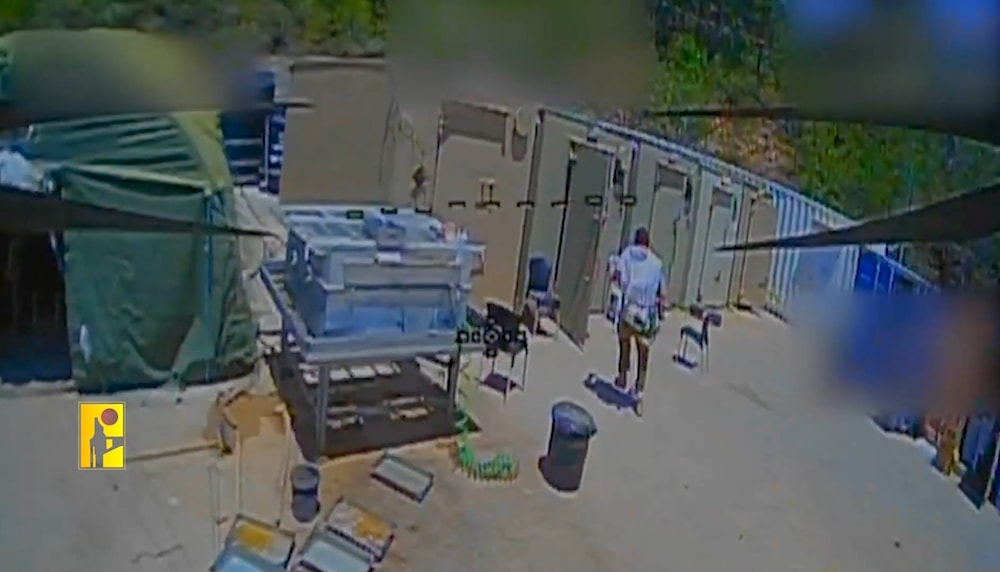
An Israeli soldier flees towards a shelter in a helipad zone seen through the lens of a Hezbollah-operated FPV drone in the Israeli settlement of Shlomi, occupied Palestine, May 9, 2026 (Islamic Resistance Military Media)
Southern Lebanon has once again become an Israeli quagmire, not through Kornet missiles, but through First-Person View Fiber Optic Drones that Israeli electronic warfare cannot stop, forcing the Israeli army into defensive improvisation as injuries climb past 1,000 even under a "ceasefire under fire," Al Mayadeen's Israeli Affairs Department revealed.
When the Israeli army launched its war on Lebanon, it was not merely a military campaign against Hezbollah’s infrastructure. It carried a declared strategic objective: to push back the threat of anti-tank missiles from the border front and northern settlements and to reshape a "security belt" that would neutralize "targeting and danger."
But battlefield realities have proven otherwise. The army, which sought to escape the reality of attrition, has crashed back into it, faced this time with FPV drones instead of Kornets, with the former posing a daily threat, haunting Israeli forces and their movements.
This shift is not merely tactical. It incorporates technology and a battle of wits, as Israeli media, experts, and officials have admitted that advanced electronic warfare systems are helpless against low-cost, precision drones, especially those operated by fiber optics, which are immune to jamming.
Silent wall behind bleeding numbers
This battlefield evolution quickly translated into rising human losses, forcing the military establishment to quietly update its figures without fanfare.
While the army kept the same date for its data update, the number of wounded on the northern front climbed in leaps: from 735 to 910, and further up to 1,015 injuries, among them 57 serious and 122 moderate cases. These are damning indicators of the ongoing human bleed, even under what is called a "ceasefire", or what Israeli media now refers to as a “ceasefire under fire.”
This threat is no longer confined to Lebanese border villages. It has deepened the Israeli army’s predicament inside its own positions in occupied areas such as Menara, Margaliot, and Ras al-Naqoura.
This attrition was starkly illustrated in the town of Deir Saryan, where the 12th Battalion of the elite Golani Brigade lost an officer and a soldier within 24 hours after the force remained trapped under fire for hours due to Hezbollah’s repeated surveillance capabilities. Soldier Alexander Glovanov was also killed after an FPV drone struck a position inside the settlement of Menara.
Faced with this deadlock, the Israeli army finds itself in a complex military environment eerily reminiscent of the old Lebanese quagmire: relatively static forces, a permanent presence on the front line, and a persistent, highly effective aerial threat.
More dangerous still is the growing sense of frustration over the lack of radical solutions. Israeli responses so far remain improvised, including urgently importing fragmentation ammunition and installing protective netting over vehicles and buildings, none of which have stopped the toll of dead and wounded.
Spiderweb paradox
Southern Lebanon is reimposing itself on Israeli consciousness, not as a "buffer zone" providing security, but as a permanent attrition battlefield, recalling the experience of the former "security belt" "Israel" was expelled from, only to find itself returning to it but with lower-cost, deadlier technological tools.
Here lies the most symbolic irony. The narrative that "Israel" long tried to erase since the 2006 Battle of Bint Jbeil has now returned to haunt it in reality and practice. An irony perfectly encapsulated by the bitter sarcasm of political analyst Ariel Kahana, who remarked, “Remember the one who called us a spiderweb? Well, with the help of spiderweb-like nets, the Israeli army is reducing the damage caused by Hezbollah’s explosive drones.”
The army’s need to deploy nets covering the equivalent of dozens of football fields, with additional requests for hundreds of thousands more square meters, to protect its vehicles tells the whole story.
While "Israel" sought to build a solid "security belt", it finds itself weaving defensive “spiderwebs” above its soldiers’ heads to keep them safe.
Meanwhile, the south continues writing its chapters of attrition, and the land keeps swallowing the illusions of power and its limits.


