
'Israel' lacks defense against Hezbollah FPV drones: Israeli expert
 3 Min Read
Hezbollah’s use of FPV explosive drones exposes gaps in "Israel’s" detection systems, with experts warning that interception capabilities remain limited.
-
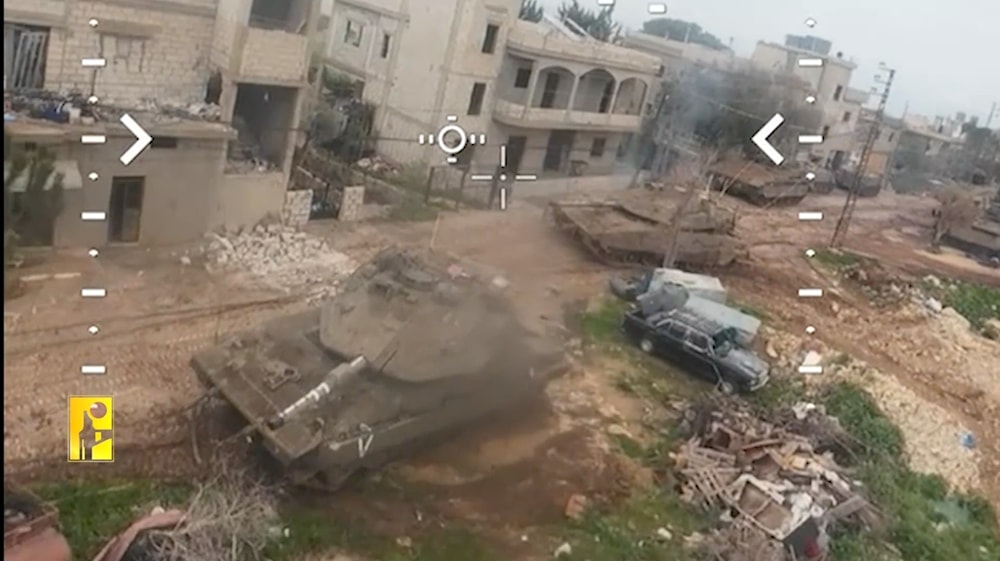
An Israeli Merkava tank can be seen through the lens of a Hezbollah-operated FPV drone in Aynatha, southern Lebanon, May 13, 2026. (Islamic Resistance Military Media)
“Israel” still lacks a comprehensive solution to counter the threat posed by explosive-laden drones, amid growing concern over their increasing use by Hezbollah, an Israeli expert has acknowledged.
Strategic advisor for military industries and technology Shlomo Peretz said in an interview with Israeli Channel 14 that the core problem lies in the inability to detect the drones early enough, resulting in many cases where warning sirens are not activated.
“The fundamental issue is the inability to identify these aircraft in advance,” Peretz said, adding that settlers in northern border areas, and even around Lake Tiberias, “often do not even know they are supposed to head to shelters” because no alerts are issued.
'Israel' attempts to address FPV threat, still stuck in place
Peretz explained that Israeli authorities are attempting to address the threat through two parallel tracks: defensive measures adopted by settlers and soldiers, and efforts to detect the drones immediately after launch.
He noted that the groups operating the drones “hide inside forests and enclosed areas,” making aerial detection difficult in many cases.
The Israeli expert acknowledged that “Israel” remains “almost at the same point” in confronting the threat, despite ongoing efforts to develop countermeasures.
According to Peretz, three different technologies are currently undergoing intensive testing in an attempt to develop systems capable of intercepting the drones before they reach their targets.
FPV drones prove formidable foes to Israeli forces
The comments come amid an escalation in the use of first-person view drones and loitering munitions by Hezbollah on the northern front, with Israeli officials repeatedly admitting difficulties in detecting and intercepting them.
Israeli and Western reports have increasingly described FPV drones as a “new threat” facing the Israeli military, particularly because of their ability to evade radar detection and electronic jamming systems.
Reports have also indicated that Hezbollah has intensified the use of low-cost FPV drones equipped with advanced technologies, including fiber-optic-guided systems that are difficult to disrupt using conventional electronic warfare measures.
Israeli analyses have further suggested that such drones could serve as a partial alternative, or an effective complement, to anti-tank missiles. Compared to heavier weapons systems, the drones are considered cheaper, more flexible, and less dependent on complex launch infrastructure vulnerable to targeting.
Their primary limitation, analysts noted, is their relatively small explosive payload. However, Israeli commentators argue that the systems still provide Hezbollah with the ability to sustain operational pressure at a higher tempo while reducing logistical risks associated with heavier weaponry.


