
Metula Chief: No ceasefire, we live under constant fire
 5 Min Read
The head of "Israel’s" Metula council sharply criticized the government’s handling of the war on Lebanon, questioning how destroying more Lebanese villages could possibly deliver victory.
-
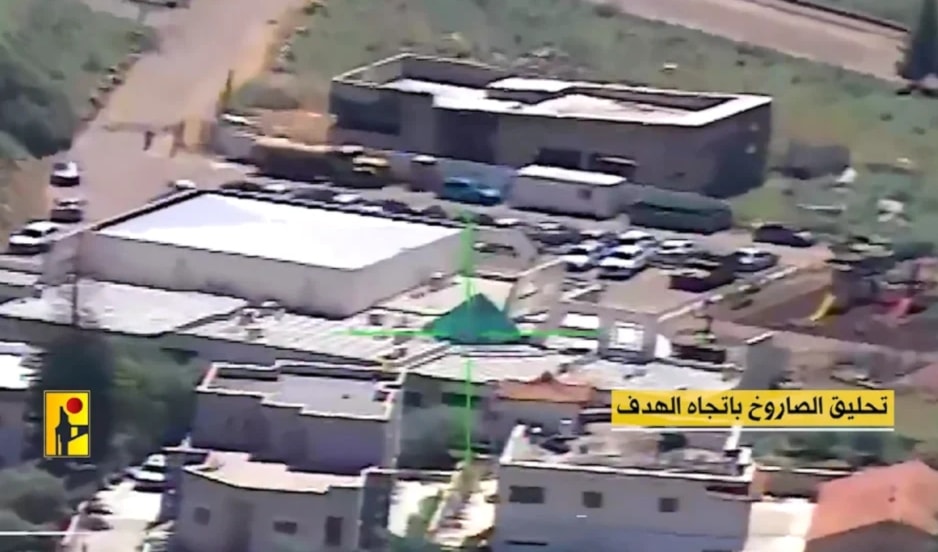
The Islamic Resistance in Lebanon - Hezbollah targets the Israeli 146th Division's headquarters in Ain al-Aramsheh, northern occupied Palestine, April 17, 2024. (Military Media)
David Azoulay, head of the Metula council and a member of the Yisrael Beytenu party, said in an interview with "Israel’s" Channel 12 on Wednesday that the course adopted by the Israeli military in southern Lebanon has reached a stage of exhaustion.
Azoulay questioned whether it is possible to continue the incursion into Lebanese territory, asking “how many more villages can be destroyed, all the way to the Litani River,” adding that “this is not the solution.”
In his remarks, he described the situation in the occupied north of Palestine as “abnormal,” referring to “continuous fire instead of a ceasefire.”
He also pointed to an incident in which an explosive drone fell in one of Metula’s neighborhoods, saying it “led to a halt in development work in the area and the withdrawal of contractors,” adding that “the current situation does not allow for planning or stability, and life is being managed day by day amid insecurity.”
The head of the Metula council further stated that “there are no parties one can communicate with to understand what is happening,” arguing that “some information reaches them via US President Donald Trump rather than the Israeli government.”
He said the current stalemate is obstructing any progress, noting that “the paralysis began around February 20, leading to the suspension of reconstruction projects and worsening instability, including uncertainty over the opening of the next school year.”
In this context, an Israeli Channel 12 correspondent reported that “life for northern settlers has turned into hell,” while “no one knows what the army’s mission in Lebanon is.”
'What are we doing there?': Israeli media question war on Lebanon
The Israeli army has no clear mission in Lebanon, Israeli media reported on Tuesday, lamenting how "Israel" has fallen into a “strategic trap", as questions mount over the purpose of the ongoing war and the lack of any exit strategy.
In a broadcast on Israeli Channel 12, a correspondent reported that falling fragments from interceptors, launched from inside "Israel" toward Lebanon to protect troops, struck a unit in the northern illegal settlement of Kiryat Shmona.
According to the report, the fragments “almost completely destroyed” part of the house just minutes before three children from the same neighborhood were due to pass by on their way to school.
The correspondent questioned why the incident had received minimal media coverage. "Did we hear about this event? Barely a brief report in the middle of the night, one or two reports at most,” he said.
He added, “Imagine if this had not happened in Kiryat Shmona, but in Tel Aviv instead. We would have seen news bulletins explode with the story, and it would have topped the entire Israeli national agenda."
Directly addressing the Israeli Security Minister, the correspondent said, "Life on the northern border has turned into a real hell, including last night, when interceptions and gunfire were carried out from inside Israel toward Lebanon."
He further demanded clarity, asking, “How long will we stay in Lebanon? What are we doing there? We only want an answer about our mission there.”
'Israel' walked into a trap
The military’s strategic aims in Lebanon remain unclear, according to Liel Shoval, military affairs correspondent for the newspaper Israel Hayom. “No one really knows the answer to that question,” Shoval said, referring to the nature of "Israel's" "mission" in Lebanon.
She explained that current preparations suggest a “long-term stay” inside Lebanese territory. “At first it was said that Hezbollah had fallen into a strategic trap, but in the end it turned out that Israel is the one that fell into that trap,” she stated.
Shoval noted that Israeli forces are currently operating between eight and ten kilometers from the border. A retreat, she warned, “would be interpreted as a defeat, and Israel will not do that.”
No agreement, no retreat
Channel 12’s northern correspondent responded directly to Shoval’s assessment, suggesting a withdrawal could occur only under specific conditions. “We will do that when there is a ceasefire agreement in Lebanon tomorrow,” he said. “Then, certainly, we will not remain eight kilometers from the border. That’s impossible.”
He added that "Israel" may need to make fateful decisions regarding the lives of civilians in both southern Lebanon and northern "Israel", rather than waiting for the broader conflict with Iran to conclude.
“Maybe we need to make fateful decisions today concerning the lives of southern Lebanon’s residents and the lives of the north’s residents, and not wait for the war with Iran to end in two weeks, two months, or even two years, and only then decide what we will do in Lebanon separately from Iran,” he said.
However, Shoval concluded that without any agreement in place, a unilateral withdrawal remains untenable. "As long as there is no agreement, you cannot admit defeat and pull back," she said.


