
'Israel' notified US before attacks on Beirut's Southern Suburb: Axios
 3 Min Read
"Israel" informed the Trump administration before bombing Beirut's Southern Suburb on Sunday, according to Axios, citing a US official and two other sources.
-
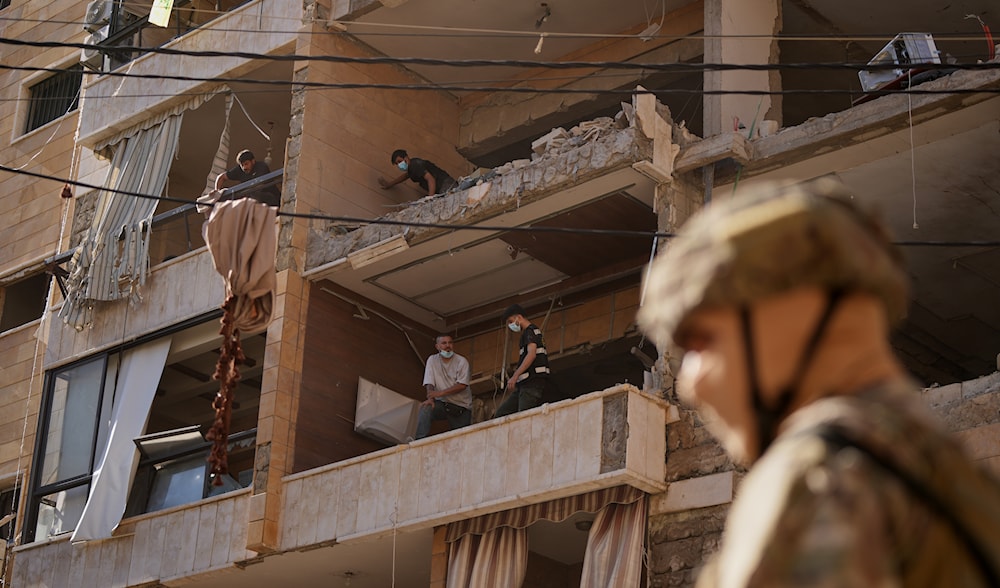
People check destroyed apartments that were bombed by the IOF in Tahwitat al-Ghadir, Beirut's Southern Suburb, Lebanon, Sunday, June 7, 2026 (AP)
"Israel" informed the Trump administration before launching an attack on Beirut's Southern Suburb (Dahieh) on Sunday, Axios reported, citing a US official and two other sources. Israeli state broadcaster Kan also reported that Washington had been notified ahead of the aggression.
According to Axios' sources, the Israelis communicated to the Trump administration that the aggression was a response to the Lebanese Resistance's continued operations against northern Israeli settlements, alleging that these operations violated the ceasefire signed between "Israel" and the Lebanese government; an agreement that grants "Israel" the right to occupy Lebanese land and carry out attacks inside Lebanon, while demanding the Resistance refrain from retaliating.
The sources added that "Israel" made it clear that it would continue targeting Dahieh each time Hezbollah launches operations against northern settlements.
Earlier on Sunday, Israeli warplanes bombed a residential building in the Mrjayeh–Tahwitat al-Ghadir area of Beirut's Southern Suburb, killing two citizens and injuring 11 others in a preliminary toll, according to the National News Agency (NNA). Israeli Prime Minister Benjamin Netanyahu and Security Minister Israel Katz announced the strikes as they were underway.
#WATCH | Al Mayadeen's correspondent: Injuries reported following the aggression on #Beirut's Southern Suburb#LebanonUnderAttack #Lebanon pic.twitter.com/pgs3jTenih
— Al Mayadeen English (@MayadeenEnglish) June 7, 2026
Ceasefire framework
The strike follows a June 2–3 trilateral meeting in Washington between US, Lebanese, and Israeli representatives.
The US State Department published a joint statement on June 4 outlining a framework aimed at a ceasefire and border security arrangements, under which the Lebanese government and the Israeli occupation agreed in principle to a ceasefire arrangement.
The agreement has faced widespread rejection across Lebanese sects, political parties, and officials. The Islamic Resistance in Lebanon has continued its operations against Israeli occupation forces in retaliation for ongoing Israeli attacks.
Iran warns of response
Meanwhile, the Islamic Republic of Iran has linked developments in Lebanon to the ceasefire agreement in Iran, with Iranian Foreign Minister Abbas Araghchi condemning violations of the ceasefire in Beirut as acts of aggression.
Araghchi said Iran had informed all parties that "if they attack Beirut, we will not tolerate it," adding that the course of the conflict would ultimately be determined by the Resistance's ability to respond.
He also reiterated Tehran's position that Iran had been fully prepared to strike "Israel" if Beirut and its Southern Suburb had come under attack, referring to recent Israeli threats against the area issued on June 1.
Following the June 1 threats against Dahieh, Iranian Deputy Foreign Minister Kazem Gharibabadi said US President Donald Trump's claim that he had prevented Israeli Prime Minister Benjamin Netanyahu from launching an attack on Beirut amounted to an acknowledgment of Washington's direct role in the ongoing aggression.


