
'Israel's' 'greatest friend': Lindsey Graham's war-driven legacy
 12 Min Read
From Iraq to Gaza and Iran, Lindsey Graham’s death has revived debate over the wars, interventions, and alliances that defined his deeply polarizing political legacy.
-
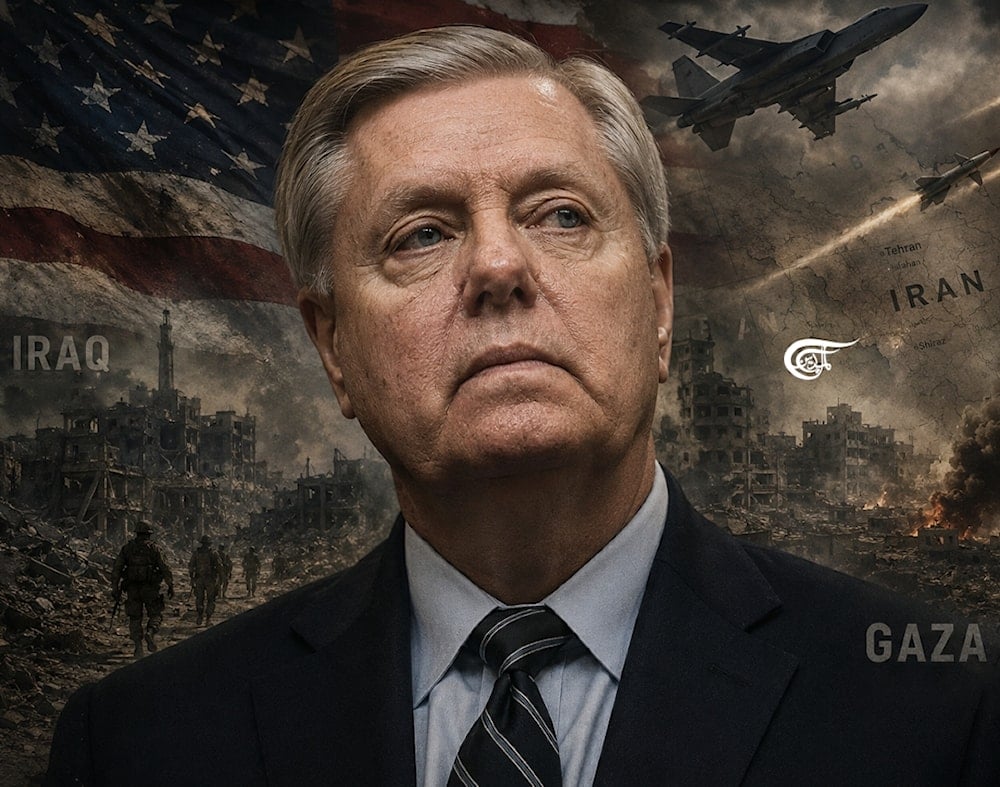
The US senator who left behind a divisive legacy (Illustrated for Al Mayadeen English
The chorus of tributes following the death of US Senator Lindsey Graham reflected the close alliances he cultivated throughout his decades-long political career, particularly with the Israeli occupation and supporters of an interventionist US foreign policy.
US President Donald Trump called Graham “one of the greatest people and Senators” he had ever known and praised him as a “true American Patriot.” Across occupied Palestine, Israeli leaders from both the government and opposition mourned one of the occupation’s most committed supporters in Washington.
Staunch 'Israel' backer
Israeli Prime Minister Benjamin Netanyahu said Graham understood that the security of the United States and “Israel” was “inseparable".
“Israel has lost one of its greatest friends. America has lost a great patriot. I have lost a beloved friend,” Netanyahu said.
Israeli Police Minister Itamar Ben-Gvir echoed him, declaring, “Today, Israel has lost one of its greatest friends.”
Israeli Minister of War Israel Katz described Graham as “a true friend of the State of Israel and one of its strongest and most steadfast supporters.”
Former Israeli Prime Minister Naftali Bennett also mourned Graham, saying, “I am heartbroken to hear of the passing of my friend Senator Lindsey Graham.”
Polarizing political legacy
The near-unified reaction reflected Graham’s decades of support for the occupation, US military assistance to “Israel” and successive Israeli wars.
Yet his death also renewed debate over a deeply polarizing political legacy shaped by his support for military intervention, economic sanctions, regime-change policies and prolonged US deployments abroad.
To his supporters, Graham represented a forceful or “muscular” approach to US foreign policy and an unwavering commitment to Washington’s allies.
His critics viewed the same record very differently. Some commentators and social media users described him as a “voice of American terrorism,” pointing to his support for the invasion of Iraq, military interventions in Libya and Syria, threats against Iran, and sweeping backing for the Israeli war on Gaza.
Online reactions highlight Graham’s divisive legacy
While officials in Washington and the Israeli occupation offered glowing tributes, reactions online reflected the deep anger generated by Graham’s decades of support for war and military intervention.
Commentators circulated his past statements on Gaza, Iran, Iraq and Ukraine, with some describing him as a leading representative of Washington’s permanent-war establishment.
Turkish journalist Ragip Soylu responded to Ben-Gvir’s tribute by writing that it offered “a good reason not to mourn” Graham. Other users recalled Graham’s repeated calls for military escalation and shared footage in which he praised the continuation of the Ukraine war with US weapons and funding.
A good reason not to mourn for Graham, below ⬇️ https://t.co/dywHw4wqA5
— Ragıp Soylu (@ragipsoylu) July 12, 2026
Muslim American scholar Omar Suleiman, meanwhile, highlighted Graham’s statements urging “Israel” to “level” Gaza and to do there what the United States had done in wartime Tokyo and Berlin.
In other news, Lindsey Graham is dead.
— Dr. Omar Suleiman (@omarsuleiman) July 12, 2026
“I am with Israel. Do whatever the hell you have to do…”
“Level the place.”
“Do in Gaza what we did in Tokyo and Berlin”
Bye Lindsey. May you live an eternity in ruins for the ruins you helped create in Gaza. Ameen pic.twitter.com/e0htUMmLGi
Israeli analyst Shaiel Ben-Ephraim noted that Israeli media were mourning a figure they described as one of “Israel’s greatest supporters in Congress,” illustrating the exceptional importance attached to Graham by the occupation’s political and media establishment.
Israeli media is in mourning. They are calling “one of Israel’s greatest supporters in Congress” and “friend of Israel.” They know they will never have another true believer like him in the future. Yet another sign of the end of the Israeli-American alliance. pic.twitter.com/MHp7UpBnBx
— Shaiel Ben-Ephraim (@academic_la) July 12, 2026
Separately, the sudden announcement prompted unverified speculation online. Conservative activist Laura Loomer raised the possibility of poisoning or other foul play, citing Graham’s public appearance in Ukraine shortly before his death and an alleged Iranian threat. No evidence has been made public to support either claim.
Graham’s office said only that he died following a “brief and sudden illness,” while no official cause had been announced.
5 days ago, the IRGC publicly called for Senator Lindsey Graham to be assassinated. He was traveling abroad to a war zone the last few days to try to end the war between Ukraine and Russia.
— Laura Loomer (@LauraLoomer) July 12, 2026
He’s been home for less than one day, and tonight, his staff said he passed away from a… pic.twitter.com/VQYxHU37kt
The reactions showed that, while allies remembered Graham as a loyal friend and forceful defender of US interests, many critics viewed his legacy through the wars, destruction, and civilian suffering associated with the policies he championed.
A career shaped by military intervention
Graham served in the US House of Representatives between 1995 and 2003 before entering the Senate.
He was also a military lawyer and a colonel in the US Air Force Reserve, a background that strongly influenced his political identity and foreign-policy positions.
Throughout his career, Graham promoted higher military expenditure, continued overseas deployments, and a broad interpretation of US power abroad.
Alongside the late Republican Senator John McCain and former Senator Joe Lieberman, Graham formed part of a group known in Washington as the “Three Amigos".
The three lawmakers regularly traveled abroad and advocated sanctions, arms deliveries, and a more assertive US role in international conflicts.
Even shortly before his death, Graham had returned from Ukraine, where he continued to support weapons deliveries and sweeping sanctions intended to increase pressure on Russia.
His approach to foreign policy, however, became most prominent during the US-led wars in Afghanistan and Iraq.
This was Lindsey Graham less than 48 hours ago.
— MESHKAT (@ProjectmeshkatE) July 12, 2026
He walked like he owned the ground he stepped on. Full of pride, full of ego.
Today, he's on his knees begging God for forgiveness.
Indeed, God is Almighty. pic.twitter.com/oGtTzXa0EC
Iraq and the costs of intervention
As a member of the House of Representatives, Graham supported the October 2002 authorization that allowed the administration of George W. Bush to invade Iraq.
Washington justified the invasion through claims that the government of Saddam Hussein possessed weapons of mass destruction and maintained links to al-Qaeda. Those alleged weapons were never found, while the invasion and occupation devastated Iraq, killed hundreds of thousands of people, displaced millions, and dismantled much of the country’s infrastructure and state institutions.
When the invasion began in March 2003, Graham presented military force as unavoidable.
“Now that hostilities have begun, it is time for the nation to come together,” he said, arguing that disagreements over the decision should give way to support for the US military campaign.
Graham continued defending the occupation after its original justifications had collapsed.
Opponent of US withdrawal
In 2007, he opposed proposals to establish a timetable for withdrawing US troops and strongly supported Bush’s military “surge", which deployed tens of thousands of additional troops to Iraq.
He described withdrawal as surrender and argued that imposing a deadline would strengthen Washington’s opponents. Graham later portrayed the troop surge as a major success.
Critics of the war, however, said that such assessments overlooked the mass civilian casualties, torture, displacement, and sectarian fragmentation produced during the invasion and occupation.
When US forces formally withdrew in 2011, Graham opposed the decision. He subsequently blamed the withdrawal, rather than the invasion and the subsequent dismantling of the Iraqi state, for much of the instability that followed.
Observers therefore viewed his position on Iraq as representative of a wider interventionist tendency in Washington: acknowledging tactical mistakes while continuing to defend the underlying decision to invade and occupy the country.
Libya, Syria, and Afghanistan
Graham carried a similar interventionist outlook into Libya.
In 2011, he strongly supported the NATO military campaign that contributed to the overthrow of Muammar Gaddafi.
Libya subsequently entered years of political fragmentation, militia violence, competing governments, and foreign intervention.
Not enough force in Libya
Graham nevertheless argued that Washington had not used sufficient military force during the campaign.
In a joint statement with McCain, he said the operation’s success had been delayed by the failure of the United States to employ the “full weight of our airpower.”
He also argued that Gaddafi’s fall should send a message to former Syrian President Bashar al-Assad, whose government Graham predicted would soon be placed “on the ash heap of history.”
'No-drive, no-fly zone' in Syria
Graham later called for arming anti-government groups in Syria and supported establishing a “no-drive, no-fly zone” modeled on the operation in Libya.
Analysts noted that implementing such a zone would have required foreign forces to strike Syrian aircraft, air-defense systems, and other military infrastructure, potentially risking direct confrontation with Syria and its allies.
Opponent of withdrawal from Afghanistan
In Afghanistan, Graham repeatedly opposed ending the nearly two-decade US military presence.
When President Joe Biden announced the withdrawal of US forces in 2021, Graham warned that leaving the country could create conditions for “another 9/11.”
He instead favored maintaining a smaller, long-term US and NATO force for alleged "counterterrorism operations".
Supporters described the proposal as a necessary security measure. Critics argued that it amounted to continuing an open-ended foreign military deployment after nearly 20 years of war.
Iran and the language of ‘strength and pain’
Iran was among the countries most frequently targeted in Graham’s public statements.
For years, he supported economic sanctions, military pressure, and potential attacks on Iranian nuclear, military, and energy infrastructure.
He repeatedly argued that diplomatic efforts had to be backed by the credible threat of force.
Following the downing of a US surveillance drone in 2019, Graham declared that “the only thing Iran and every other thuggish regime understands is strength and pain.”
Eyeing Iran's civilian assets
He urged Washington to consider targeting Iranian naval assets and oil refineries, which he described as the country’s “economic lifeblood".
After the US assassination of General Qassem Soleimani in Baghdad in January 2020, Graham praised the operation and again raised the possibility of striking Iran’s oil infrastructure.
His calls for intensified pressure continued during the Israeli war on Gaza.
Graham placed responsibility for regional Resistance operations on Tehran and called for Iranian refineries to be placed on a potential US target list.
In 2024, he claimed that threatening Iran could help pressure the Palestinian Resistance into releasing Israeli captives, once again proposing attacks on the country’s oil facilities.
He also encouraged Netanyahu to “do what you have to do” concerning Iran’s nuclear program and later urged the Trump administration to support direct military action against Iranian nuclear facilities.
Lindsey Graham'ın, İran'ın ABD saldırılarına karşı başarılı bir şekilde kendini savunmasının ardından yaşadığı öfke:"İran rejimi ölüm sırasında. Onları yerle bir edecek şekilde bombalayacağız."
— IRNA Türkçe (@Irna_Turkish) July 12, 2026
Graham bugün öldü. pic.twitter.com/wOjbOeEgzl
Iran and its allies consistently described such statements as threats against the country’s sovereignty and civilian economy.
Critics in the United States also warned that striking Iranian nuclear or energy infrastructure could ignite a far wider regional war.
Graham’s final months remained marked by the same confrontational approach. He supported US and Israeli military action against Iran and backed measures that appeared aimed not only at constraining Tehran’s military capabilities, but also at producing political change inside the country.
Gaza and the call to ‘level the place’
Graham’s statements during the Israeli war on Gaza became among the most controversial of his career.
Shortly after the war began in October 2023, Graham described the confrontation as a “religious war” and urged the occupation to take whatever measures it considered necessary.
“I am with Israel. Do whatever the hell you have to do to defend yourself. Level the place,” he declared.
Palestinian advocates and human rights campaigners condemned the statement, arguing that it appeared to endorse the large-scale destruction of Gaza, where more than two million Palestinians were living under Israeli siege.
Calls to nuke Gaza
As the Palestinian death toll rose and Washington faced pressure to limit the transfer of heavy weapons to “Israel", Graham invoked the US atomic bombings of Hiroshima and Nagasaki.
“Why was it OK for America to drop two nuclear bombs on Hiroshima and Nagasaki to end their existential threat war?” Graham asked in May 2024.
“To Israel, do whatever you have to do to survive as a Jewish state,” he added, calling on Washington to provide the occupation with the weapons it requested.
This is @LindseyGrahamSC. He's advocated for nuking Gaza, wanted to end Islam, wanted Iran to be invaded and justified the atomic bombings of Hiroshima and Nagasaki as well.
— gimo 🔻 (@gimoxtweets) July 12, 2026
Only Kuffar, Zionists and Emiratis, all of whom are ultimately the same thing, are mourning his death. https://t.co/pdTrD6tpJ7 pic.twitter.com/DSh3Yayq4J
His critics argued that the comparison downplayed Palestinian civilian deaths and presented virtually unlimited military force as acceptable.
Graham rejected accusations that “Israel” was committing genocide in Gaza, opposed restrictions on US weapons deliveries, and attacked the International Criminal Court over its pursuit of Israeli officials.
When the ICC moved against Netanyahu and former Israeli Minister of War Yoav Gallant, Graham backed legislation targeting the court and warned US allies against cooperating with it.
Lindsey Graham will be remembered as one of the ugliest American figures to champion the genocide of the Palestinian people and deny them their right to life and dignity.
— Ramy Abdu| رامي عبده (@RamAbdu) July 12, 2026
“To any ally—Canada, Britain, Germany, France—if you try to help the ICC, we’re going to sanction you. We… pic.twitter.com/AKW4wJk4fy
Legal experts and rights groups said such threats risked weakening international institutions and establishing a double standard in which international law was supported against Washington’s adversaries but rejected when applied to US allies.
A legacy reflected in those who mourned him
Trump called Graham a “true American Patriot,” while Israeli leaders mourned one of the occupation’s most dependable allies in Washington.
Graham supported the invasion of Iraq, called for greater US airpower over Libya, backed arming anti-government groups in Syria, opposed a full withdrawal from Afghanistan, threatened Iranian energy infrastructure, and urged “Israel” to “level” Gaza.
His supporters viewed that record as evidence of loyalty, resolve, and consistency. Critics, however, questioned what such patriotism meant when foreign wars, military assistance, and support for “Israel” remained so central to his political career.
That contradiction resurfaced in a widely shared 2024 clip in which Graham shifted from discussing relief for Hurricane Helene victims to emphasizing continued US support for “Israel", prompting one user to accuse him of dismissing Americans affected by the disaster.
Never forget when Senator Lindsey Graham dismissed hurricane victims to talk about israel
— Jvnior (@Jvnior) July 12, 2026
Holy shit… they’ll never be able to replace him! pic.twitter.com/D9YuXX9H3m
For critics, the exchange captured a wider pattern in which overseas wars and the demands of US allies were repeatedly presented as American priorities.
The officials who mourned Graham most strongly therefore also offered one of the clearest indications of the alliances and policies that defined his polarizing legacy.
Read more: Graham mourned in 'Israel', denounced globally over war record


