
US wars fail due to flawed strategy, unclear objectives: Politico
 4 Min Read
A Politico analysis sheds light on the reasons behind repeated US military failures from Vietnam to Iran.
-
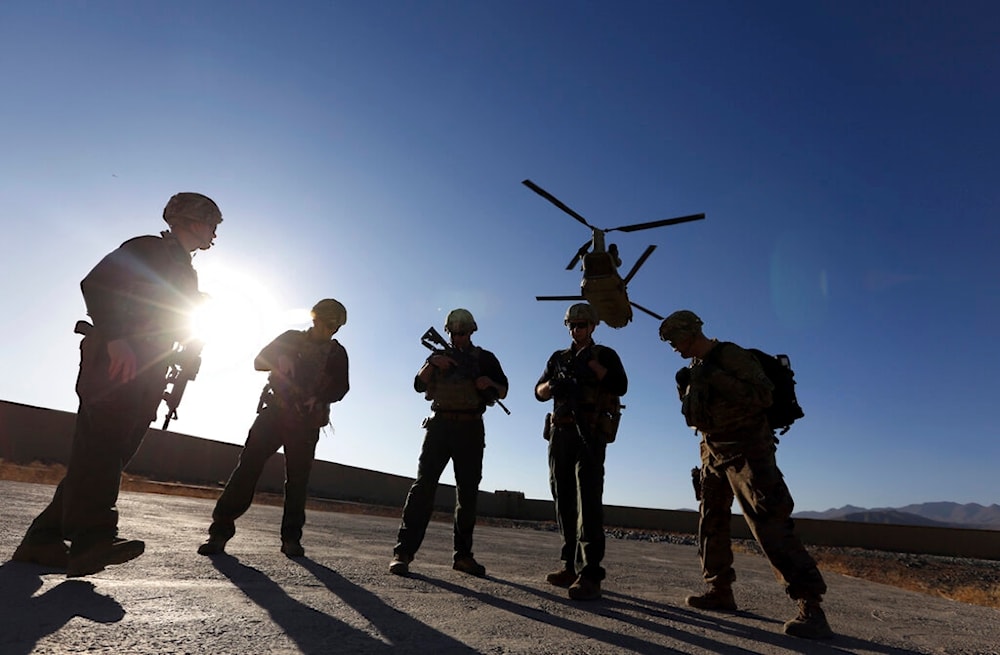
In this Nov. 30, 2017, file photo, American soldiers wait on the tarmac in Logar province, Afghanistan (AP, File)
Repeated US-led military interventions over recent decades have failed not because of a lack of military capability, but because of deeper structural flaws in Washington’s approach to war and global power projection, a Politico analysis published on Tuesday stated.
The article, written by former US ambassador to NATO Ivo Daalder, argued that despite commanding the most powerful military apparatus in modern history, Washington has repeatedly failed to impose durable political outcomes through wars and interventions spanning Vietnam, Afghanistan, Iraq, and the ongoing US-led war against Iran.
According to the analysis, the 1991 Gulf War remains one of the few US military operations widely viewed as successful because its objectives were narrowly defined and limited to forcing Iraqi troops out of Kuwait rather than attempting large-scale political transformation or regime change.
Military supremacy without political legitimacy
The piece drew on the theories of Carl von Clausewitz, who viewed war as a continuation of politics through other means rather than an independent objective detached from political strategy.
It argued that successive US administrations have repeatedly treated military force as a primary instrument of geopolitical management, launching wars and bombing campaigns without coherent long-term political strategies or realistic plans for what follows military escalation.
“The U.S. keeps losing not because its military is weak but because it keeps choosing its instruments before defining its objectives,” the analysis stated.
The article further argued that Washington has consistently assumed overwhelming force and large-scale destruction would compel adversaries to surrender politically, citing campaigns such as “Rolling Thunder” in Vietnam, “Shock and Awe” in Iraq, and the recent US-Israeli military aggression against Iran.
“It never does,” the analysis asserted.
Criticism of regime change wars
The Politico analysis maintained that US wars are frequently tied to expansive ambitions such as "regime change", "democratization", and the "restructuring" of entire societies through military coercion.
It contrasted the approach of former US President George H. W. Bush during the Gulf War with the later invasion and occupation of Iraq under George W. Bush.
According to the article, George H. W. Bush resisted pressure to advance toward Baghdad after Kuwait was liberated, preserving coalition unity and limiting the scope of the war.
By contrast, the 2003 invasion and occupation of Iraq was portrayed as a catastrophic turning point that dismantled Iraqi state institutions, fueled regional instability, and ultimately strengthened Iran’s regional influence despite Washington’s stated objectives.
The analysis also argued that US officials repeatedly underestimated the resolve of forces confronting American military power, including the Vietcong, the Taliban, Iraqi resistance groups, and Iranian revolutionary structures.
“America may have the force, but the other side has the will,” the article stated.
The analysis argued that movements confronting US military power often draw resilience from national liberation narratives, territorial defense, or resistance to foreign domination, factors Washington repeatedly underestimates.
War on Iran portrayed as latest strategic failure
The piece characterized the current US-led war on Iran as the latest example of Washington entering military confrontation without a coherent long-term political strategy.
It criticized assumptions that decapitation-style strategies aimed at destabilizing Iran’s political leadership or overwhelming military pressure could rapidly produce political change inside the country.
According to the analysis, US and Israeli policymakers failed to develop contingency plans for possible escalation scenarios, including disruptions in the Strait of Hormuz, one of the world’s most strategically important shipping corridors.
The article also referenced reports suggesting some policymakers hoped military escalation could trigger internal political shifts in Tehran, while arguing that no viable framework existed for managing such an outcome or its regional consequences.
Return to older military doctrine urged
The analysis concluded by recommending a return to principles associated with former Defense Secretary Caspar Weinberger and former Joint Chiefs Chairman Colin Powell.
Those principles, commonly referred to as the Weinberger-Powell doctrine, emphasize clearly defined objectives, domestic and international support, overwhelming force tied to limited goals, and a clear exit strategy before entering war.
“It isn’t pacifism, it’s strategic logic,” the article stated.
The analysis ultimately suggested that Washington’s repeated military setbacks stem less from battlefield weakness than from a persistent belief that overwhelming force can remake societies, impose political outcomes, and break resistance movements through coercion alone.
Read more: Neocons see America’s war on Iran is draining power, money, prestige


