
'Israel's' destruction deepens across southern Lebanon
 6 Min Read
A Financial Times investigation documents widespread destruction in southern Lebanon, from homes and farmland to water systems and healthcare facilities.
-
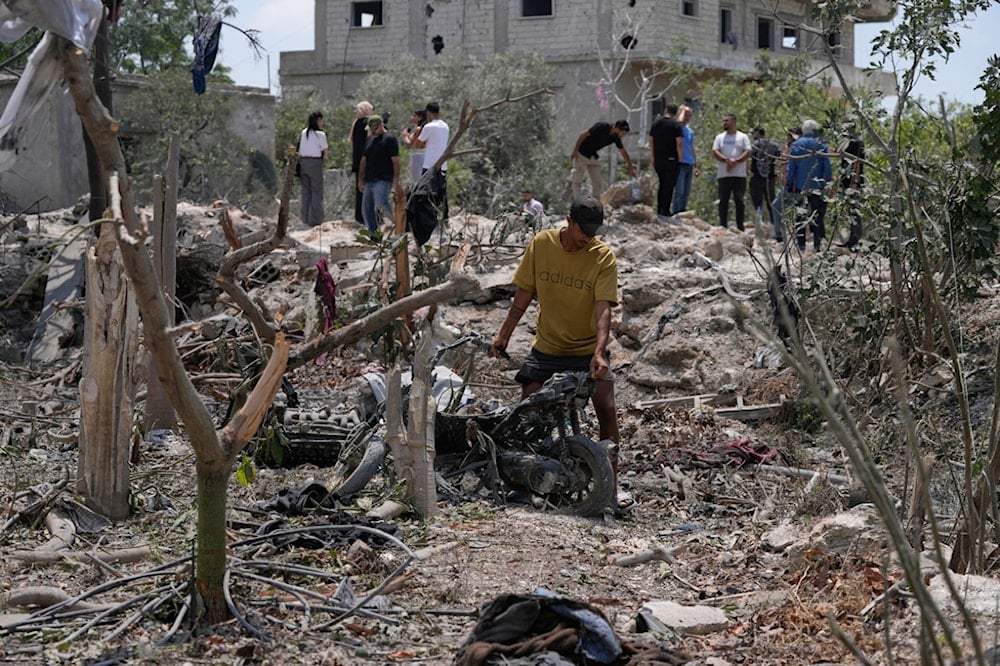
A man removes a damaged scooter from the debris of a destroyed house that was targeted by an Israeli airstrike in the village of Burj al-Shamali, southern Lebanon, Thursday, Aug. 6, 2026. (AP Photo/Mohammed Zaatari)
A Financial Times investigation with Lighthouse Reports has documented widespread destruction across southern Lebanon occupied by Israeli forces, including the demolition of homes, damage to water and energy infrastructure, destruction of farmland, and attacks affecting healthcare and cultural heritage sites.
The investigation, based on satellite imagery, open-source data and verified footage, found that much of the destruction occurred after an imposed Lebanon-"Israel" ceasefire on April 17, when Israeli occupation forces had already established control over numerous evacuated communities.
The findings come as Israeli forces maintain positions inside Lebanese territory and continue to restrict the return of residents to areas along the border.
Israeli forces destroy homes and infrastructure
The Financial Times investigation identified evidence of controlled demolitions, airstrikes and bulldozing operations across dozens of southern Lebanese communities.
Lebanon's National Council for Scientific Research (CNRS) estimates that nearly 85,000 housing units have been damaged or destroyed across the south. The figure is likely incomplete because between 20% and 30% of buildings have not yet been assessed amid continuing Israeli attacks.
Satellite analysis of Khiam, Taybeh, Bint Jbeil and Haddatha found destruction extending beyond individual structures and town centers, with large sections of some municipalities cleared.
Israeli War Minister Israel Katz previously stated that 24 Lebanese villages had been destroyed and claimed that up to 20,000 homes had been demolished.
“Twenty-four Lebanese villages, hundreds of years old, we destroyed all the buildings,” Katz said. “Not house by house, but entire villages.”
"Israel" has tried to frame the destruction as part of efforts to dismantle Hezbollah infrastructure and prevent the Resistance movement from rebuilding positions near the border.
However, the multiple investigations and on-the-ground footage show that the Israeli destructive targeting of southern Lebanon targets infrastructure essential to civilian life.
This method of shifting blame and justifying war crimes has been done time and again by the Israeli occupation; for example, the situation surrounding the Al-Shifa Hospital in Gaza, where "Israel" stated that the medical facility was hiding Hamas tunnels, a claim which was proved false after IOF personnel violently emptied the hospital and entered it only to find no tunnels.
Read more: Israeli occupation carries out blasts, shelling in southern Lebanon
Water, agriculture and healthcare affected
At least 2,500 kilometers of water infrastructure have been damaged or destroyed, according to figures from Lebanese authorities and the CNRS. The infrastructure includes pipelines and boreholes supplying homes and businesses.
Bridges crossing the Litani River have also been bombed by Israeli warplanes, with only two reportedly partially repaired.
Lebanon's Agriculture Ministry estimates that more than 20% of southern Lebanon's farmland and forests have been destroyed by Israeli aggression. The region's olive groves have suffered particularly extensive damage, threatening an agricultural sector that accounts for approximately 40% of Lebanon's national olive harvest.
Lebanese authorities and rights groups have also documented the use of white phosphorus in populated and agricultural areas.
Circulating footage shows Israeli artillery shelling using white phosphorus munitions targeting the southern Lebanese town of Zawtar. pic.twitter.com/Z9LPWUTFf5
— Al Mayadeen English (@MayadeenEnglish) May 1, 2026
Lebanon's Environment Ministry has additionally stated that "Israel" sprayed herbicides over approximately 2,000 hectares of agricultural land during the past three years, with the damage serving as ecocide.
Healthcare infrastructure has also been heavily affected, with Lebanon's Health Ministry saying 135 healthcare professionals were martyred while on duty. Insecurity Insight documented more than 30 incidents involving attacks on healthcare, while the Financial Times and Lighthouse Reports verified and geolocated footage from 10 of those incidents.
"Israel" once again tried to justify its blatant targeting of healthcare workers and facilities by stating that Hezbollah uses medical sites and ambulances for military purposes. The Financial Times reported that Israeli authorities have not routinely provided evidence supporting specific allegations.
Legal questions emerge over destruction
The scale of the destruction has prompted legal experts to question whether Israel's actions can be justified under the laws governing military occupation.
Janina Dill, an Oxford University expert on the law and ethics of war, told the Financial Times that areas under Israeli control would be subject to the more restrictive rules applicable to occupation.
Under those rules, civilian property may be destroyed only when required by “imperative military necessity.”
Dill questioned whether a generalized claim that Hizbollah could return to civilian structures would satisfy that standard.
“It’s deeply implausible that imperative military necessity applies to every house in a particular village,” she said.
Amnesty International also warned that the destruction could prevent displaced Lebanese from returning to their communities.
Kristine Beckerle, a deputy director at Amnesty International, said the campaign was creating conditions that make the south increasingly difficult for civilians to inhabit.
“If you raze everything to the ground, critical infrastructure and healthcare, if you scorch the earth, you are creating effective wastelands that are unliveable and making it very difficult for people to return to southern Lebanon,” Beckerle said.
Read more: UNIFIL documents 552 Israeli violations in South Lebanon in 3 days
Israeli military presence expands
The destruction is taking place alongside an Israeli military presence extending into southern Lebanon.
"Israel" refers to the area under its control as a “security zone,” with the boundary commonly described as the “yellow line.” The zone covers approximately 6% of Lebanese territory and extends roughly 10 kilometers inland from the informal border.
Historically, "Israel" sets up these security/buffer zones as prerequisites for occupation across its various wars on neighboring states.
According to the CNRS, 62 villages and farms fall within the area, with approximately 270,000 residents unable to return.
IOF outposts have expanded inside the zone, while residents have continued to face evacuation orders.
The Financial Times reported that Israeli flags and Hebrew signs have appeared in the area and that Israeli forces have continued demolitions even during periods of reduced fighting.
Read more: IOF obstruct Lebanese Army entry into al-Mansouri, wound soldier


