
HRW verifies 'Israel' using white phosphorus in South Lebanon
 4 Min Read
Human Rights Watch says "Israel" deployed artillery-fired white phosphorus munitions over homes in Yohmor, southern Lebanon, raising concerns over civilian harm.
-
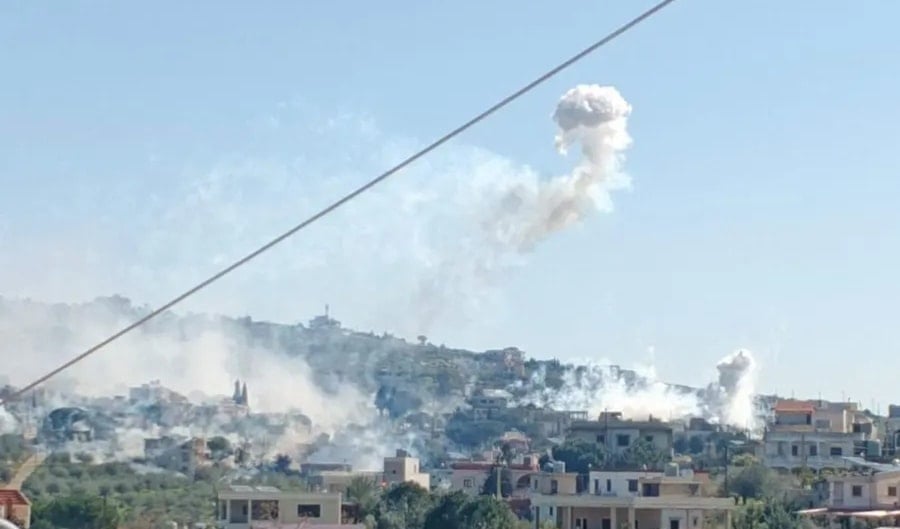
At least two artillery-delivered white phosphorus munitions being airburst over a residential neighborhood in the town of Yohmor, in southern Lebanon, March 3, 2026. (Social media)
The Israeli military deployed artillery-fired white phosphorus munitions over residential areas in the southern Lebanese town of Yohmor, Human Rights Watch (HRW) said on Monday.
The human rights organization verified and geolocated seven images showing airburst white phosphorus munitions over homes, as well as civil defense workers responding to fires in at least two houses and one vehicle.
Ramzi Kaiss, Lebanon researcher at HRW, described the incident as “extremely alarming” and warned that “the incendiary effects of white phosphorus can cause death or cruel injuries that result in lifelong suffering.”
HRW confirmed that images posted on social media on the morning of March 3 show at least two artillery-delivered white phosphorus munitions detonating over residential neighborhoods. The distinctive smoke clouds observed were consistent with those produced by M825-series 155mm artillery projectiles containing white phosphorus.
Earlier that day, at 5:27 AM, Israeli military spokesperson Avichay Adraee issued displacement threats for Yohmor and 50 nearby villages, instructing residents to move at least 1,000 meters from the villages to open land. Adraee repeated the threat directive at 12:12 p.m. HRW has not independently confirmed whether civilians were present or injured during the attacks.
Photographs shared on Facebook by the Civil Defense Team of the Islamic Health Committee, show workers extinguishing fires on rooftops and in a car, with smoke rising from a residential balcony.
The geolocated sites were within 160 meters of the observed airbursts. HRW’s analysis indicates the fires were likely caused by white phosphorus munitions, suggesting the weapons were deployed unlawfully in areas with civilian concentrations.
Banned by international law, used by 'Israel' regularly
White phosphorus is a chemical substance used in artillery shells, bombs, and rockets that ignites upon contact with oxygen, capable of setting homes, agricultural areas, and other civilian objects on fire.
Under international humanitarian law, the use of airburst white phosphorus in populated areas is considered unlawfully indiscriminate, as it fails to meet the requirement to take all feasible precautions to avoid civilian harm.
Human Rights Watch said "Israel’s" use of white phosphorus in southern Lebanon underscores the need for stronger international regulations on incendiary weapons.
Currently, Protocol III of the Convention on Conventional Weapons is the only legally binding instrument specifically dedicated to incendiary weapons, and "Israel" is not a party to this protocol.
Protocol III governs weapons “primarily designed” to cause fires or burns, but excludes certain multipurpose munitions with incendiary effects, including white phosphorus. It also imposes weaker restrictions on ground-launched incendiary weapons, like those used in Lebanon, than on airdropped incendiary weapons, despite both causing similar severe injuries.
'Israel' and White Phosphorus: a brief history of ecocide
"Israel" has repeatedly used white phosphorus in southern Lebanon, raising serious humanitarian and environmental concerns. During the 2006 Lebanon War, "Israel" fired white phosphorus shells over towns including Qana and Marjayoun, causing widespread fires and civilian injuries.
The consequences of such attacks extend beyond immediate civilian harm. White phosphorus can ignite homes, farmland, and forests, destroying crops and contaminating soil. In 2008, fires caused by unexploded white phosphorus shells in southern Lebanon forced evacuations and left long-lasting burn marks on agricultural land.
Environmental experts warn that repeated use of incendiary weapons leads to soil degradation and water contamination, affecting entire ecosystems. Studies after the 2006 war showed persistent pollution in Lebanese rivers and fields near attack zones, making recovery slow and costly.
Such environmental destruction has sparked calls to consider these acts under the concept of ecocide, defined as extensive damage to, destruction of, or loss of ecosystems. International law remains limited, but HRW and other organizations argue that deliberate use of white phosphorus in civilian areas should fall under ecocide scrutiny.


