
'Israel would not exist today' without me, will 'do as I say': Trump
 3 Min Read
Trump says yet again that "Israel" would not exist without US backing and would "do as I say," while defending the Iran agreement.
-
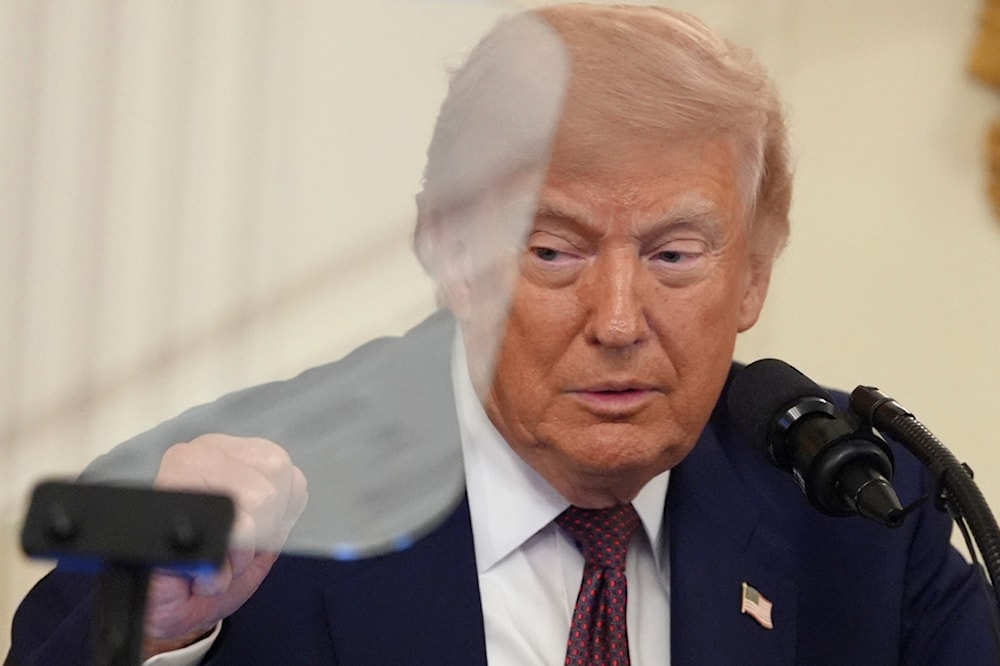
US President Donald Trump speaks during a Medal of Honor ceremony in the East Room of the White House, Thursday, June 18, 2026, in Washington (AP)
US President Donald Trump openly acknowledged that Washington exercises decisive influence over "Israel", declaring that it would not have survived without US backing and claiming the occupation ultimately follows his directives.
Speaking in an interview on The Axios Show on Thursday, Trump portrayed himself as the central authority behind "Israel's" military and political conduct following the recent US-Israeli war on Iran.
"If it weren't for me, Israel would not exist today," Trump said, adding that "Israel" has "a lot of respect for me" and "will do as I say."
Trump also described his relationship with Prime Minister Benjamin Netanyahu as "good, but we have to keep him a little bit sane," suggesting that Washington retains ultimate leverage over the occupation's leadership.
🇮🇱 President Trump tells @MarcACaputo on the next episode of The Axios Show that if it weren't for him, "Israel would have been eviscerated." pic.twitter.com/wgU93eSIb9
— Axios (@axios) June 19, 2026
Remarks reinforce claims of US control over occupation
Trump's comments amount to one of the clearest public acknowledgments by a sitting US president that the occupation's strategic decisions remain closely tied to Washington's political and military support.
His remarks come after months of direct US involvement in the war on Iran, during which American forces participated alongside the occupation in military operations before Washington ultimately pursued an agreement with Tehran amid growing economic pressures and regional escalation.
Throughout the interview, Trump repeatedly framed global affairs in terms of American dominance, saying G7 leaders accepted him as "the boss" while asserting that he had discovered "no limits" to presidential authority.
"I've found there are no limits," Trump said when discussing his powers following the war.
New book details Trump's view of global power
Trump's comments coincide with the upcoming release of Regime Change, a book by Maggie Haberman and Jonathan Swan, which describes his private reflections on political power.
According to the authors, Trump presented them with a document claiming he wielded greater authority than historical rulers, including Attila the Hun, Genghis Khan, Napoleon Bonaparte, Joseph Stalin, Mao Zedong and Adolf Hitler.
Trump argued that modern American presidents possess capabilities unavailable to earlier rulers.
"They didn't have airplanes, right? You couldn't travel around," he said before adding, "Napoleon".
The authors wrote that Trump appeared at ease placing himself alongside rulers who transformed the world through conquest and coercion.
Iran agreement exposes divisions in Washington
Trump also defended the US agreement with Iran despite mounting criticism from Republican hawks who argued Washington had failed to secure the objectives it declared at the outset of the war.
Rejecting those criticisms, Trump insisted the agreement amounted to "unconditional surrender" and "regime change".
"Some guys that I used to respect, I don't respect anymore. They're hardliners," he said.
Despite repeatedly describing presidential authority as virtually unlimited, Trump acknowledged that economic considerations ultimately forced Washington to avoid a prolonged regional war.
"I have one primary wish as president ... I never want to be the late, great Herbert Hoover," he said, arguing that extending the war could have triggered a worldwide economic depression.
His remarks come as US officials continue defending the agreement with Tehran after the military campaign failed to produce the decisive strategic outcome many hawks in Washington and the Zionist entity had sought.
Read more: Escalation to capitulation: What the MoU means for Iran, region


