
US lawmakers split over Trump-backed Iran agreement
 4 Min Read
The US-Iran MoU critics denounce its economic concessions, while supporters argue it would help end hostilities and stabilize the region.
-
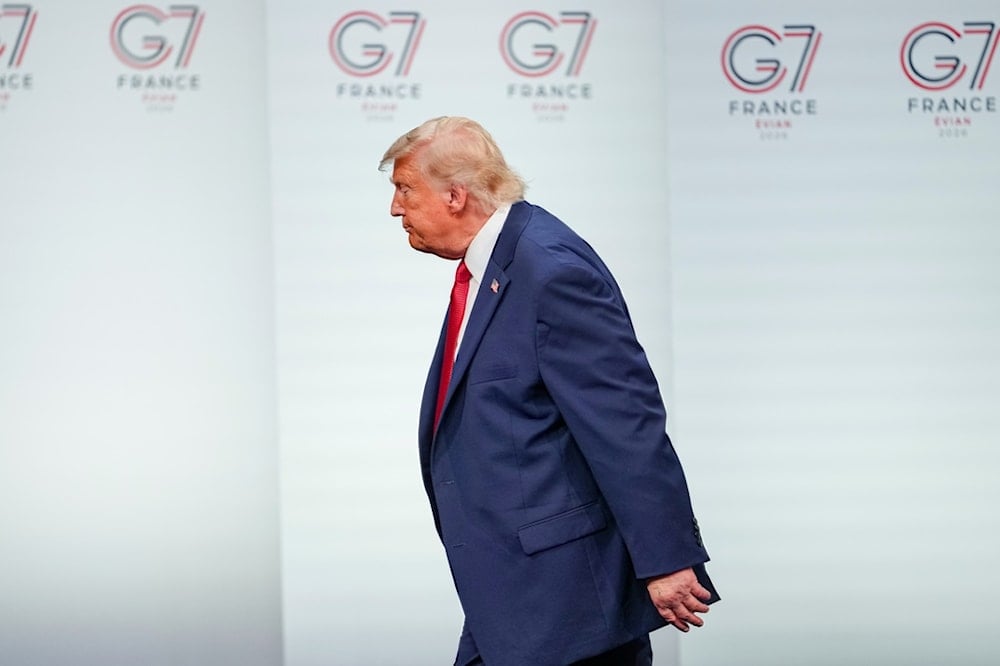
US President Donald Trump leaves the stage after a media conference at the end of the G7 summit in Evian-les-Bains, France, Wednesday, June 17, 2026 (AP)
Political divisions deepened in Washington on Wednesday after the Trump administration circulated the text of its proposed interim agreement with Iran, prompting sharp reactions from both Republicans and Democrats over what many described as sweeping economic concessions to Tehran.
The memorandum of understanding seeks to formally end the war on Iran, ease sanctions on Tehran, establish a proposed $300 billion economic development fund, and begin reopening the Strait of Hormuz within 30 days. The framework also calls for an end to attacks on Lebanon and commits Iran to facilitating the safe passage of commercial vessels while the United States lifts its blockade of the strategic waterway.
'Reagan rolling over in his grave'
While US President Donald Trump has argued the agreement would bring "peace and security" to the Middle East, the proposal has drawn criticism from lawmakers across the political spectrum.
Bill Cassidy was among the agreement's strongest Republican critics.
"Reagan is rolling over in his grave. Iran's nuclear ambitions were not curbed, and they have learned that threatening the Strait of Hormuz works and will undoubtedly leverage it in the future," Cassidy wrote on X.
Reagan is rolling over in his grave. Iran’s nuclear ambitions were not curbed, and they have learned that threatening the Strait of Hormuz works and will undoubtedly leverage it in the future. Now, Iran gets to build brand-new infrastructure under this deal.
— U.S. Senator Bill Cassidy, M.D. (@SenBillCassidy) June 17, 2026
Before the war, the…
Democratic Senator Adam Schiff also condemned the framework, arguing that it heavily favors Tehran.
"Iran gets sanctions relief, the release of frozen funds, the ability to export oil, and a $300 billion reconstruction fund. The U.S. gets a reiteration of the vague promise Iran won't develop a nuke. Hard to imagine a more thorough capitulation," Schiff wrote on X.
Wow.
— Senator Adam Schiff (@SenAdamSchiff) June 17, 2026
Iran gets sanctions relief, the release of frozen funds, the ability to export oil, and a $300 billion reconstruction fund.
The U.S. gets a reiteration of the vague promise Iran won’t develop a nuke.
Hard to imagine a more thorough capitulation. https://t.co/dQgMW5hgLf
Other lawmakers voiced reservations over the agreement. Democratic Senator Chris Murphy acknowledged that ending the conflict was a positive outcome but questioned the terms of the deal.
"An end to this disastrous war is a good thing - no matter the humiliating terms," Murphy wrote on X, arguing that the framework provides Iran with sanctions relief, access to frozen assets, and reconstruction funding without placing meaningful limits on its missile program, drone capabilities, or regional allies.
The utter failure of this war - and the surrender document Trump just signed - was completely predictable. This war was unwinnable and that's why so many of us opposed it from the start. pic.twitter.com/eSDNZQjidE
— Chris Murphy 🟧 (@ChrisMurphyCT) June 17, 2026
Meanwhile, Republican Senator Ted Cruz criticized the agreement as repetitive of what he described as the failures of the 2015 Iran nuclear deal, arguing that it rewards Tehran without permanently dismantling its nuclear capabilities.
The Obama Iran nuclear deal was designed to give Iran nuclear weapons, so to say that President Trump's efforts are just like Obama's is absurd.
— Ted Cruz (@tedcruz) June 17, 2026
I do want to urge the president not to give up the victory; we have destroyed their military, and we should not fund the rebuild.… pic.twitter.com/DqUnJBR83Q
Senator Thom Tillis also questioned the proposed $300 billion development fund and called for greater congressional scrutiny before the agreement moves forward.
New: GOP Sen. Thom Tillis told me it’s “concerning” admin is considering a $300 billion fund for Iran.
— Mychael Schnell (@mychaelschnell) June 17, 2026
He also said the US is “equivocating” on some goals from the beginning of the conflict.
And he called Trump directing Clayton not to appear an “unforced error.” @MSNOWNews pic.twitter.com/P4dfbLeNdY
Economic fund and frozen assets fuel controversy
The proposed economic fund, expected to rely on private investment rather than direct government financing, has emerged as one of the most contentious aspects of the framework.
Speaking during the Group of Seven summit in France, Trump defended the return of Iranian assets frozen under US sanctions.
"We have taken their money. It's not our money," Trump told reporters. "It's their money, and we froze it. At a certain point in time I guess we have to give it back."
He added that permanently withholding the assets could weaken international confidence in the US dollar.
🇺🇸 President Trump open to nuclear enrichment for Iran: "It's a little hard when other people have it, other adjoining states have it & you're not letting them have it for purposes of electricity & things like that. You have to use a little common sense." pic.twitter.com/GjjlnW4jgF
— Drop Site (@DropSiteNews) June 17, 2026
Supporters argue agreement serves US interests
Not all Republicans opposed the initiative. Senator Lindsey Graham said the agreement could advance US strategic interests.
"After this discussion, it is my opinion that signing the MOU [memorandum of understanding] will be beneficial to the United States, in as much as the Strait of Hormuz will begin to open, and the hostilities with Iran will stop," Graham wrote on X.
I just had a very lengthy and productive discussion with @SEPeaceMissions @SteveWitkoff about the state of play regarding Iran.
— Lindsey Graham (@LindseyGrahamSC) June 17, 2026
After this discussion, it is my opinion that signing the MOU will be beneficial to the United States, in as much as the Strait of Hormuz will begin to…
Obama compares framework to 2015 nuclear accord
Former president Barack Obama also commented on the proposed framework ahead of the release of its text, saying it was "doubtful" that any new agreement would significantly improve upon the Joint Comprehensive Plan of Action reached during his administration.
Trump withdrew the United States from that agreement in 2018, arguing at the time that it was a "horrible" and one-sided accord that failed to deliver lasting peace or stability.
Read more: Sharif hails commitment as 'historic' US-Iran MoU is signed


