
G7 split emerges over timeline for reopening Strait of Hormuz
 4 Min Read
Differences have surfaced among G7 states over the timeline for reopening the Strait of Hormuz, despite a US-Iran understanding aimed at restoring maritime traffic.
-
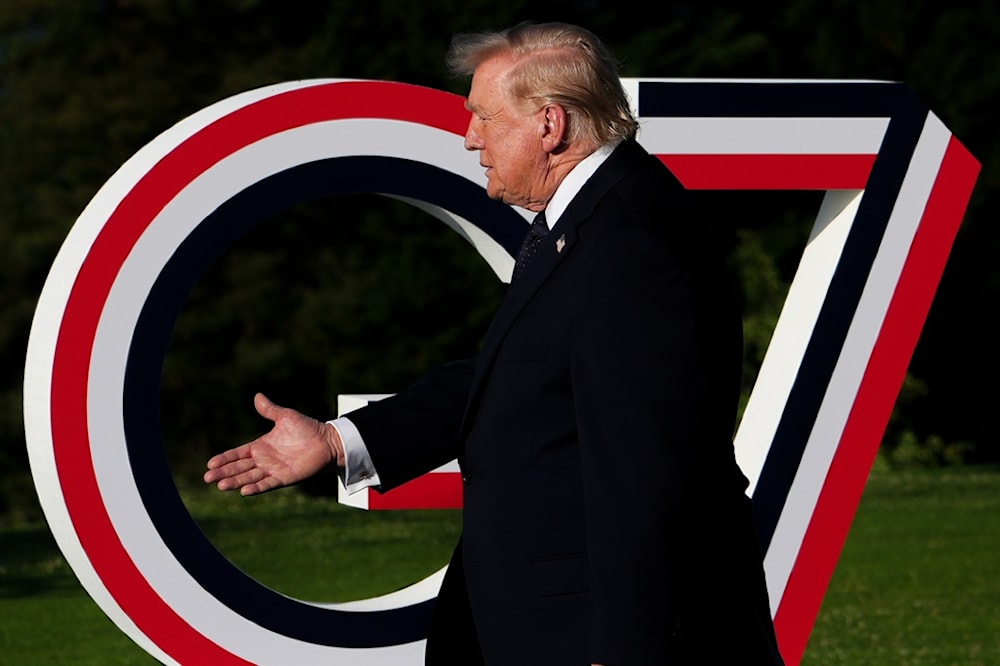
US President Donald Trump walks to shake hands with France's President Emmanuel Macron, not pictured, at the G7 summit, Monday, June 15, 2026, in Evian-les-Bains, France. (AP Photo/Julia Demaree Nikhinson)
Divisions have emerged among G7 members over how quickly commercial shipping can safely return to the Strait of Hormuz, despite repeated assurances from US President Donald Trump that the strategic waterway will be fully reopened by Friday.
The disagreement surfaced during discussions on the sidelines of the G7 summit in France, where leaders weighed the implications of the recent US-Iran understanding intended to restore navigation through one of the world's most important energy corridors.
Trump has repeatedly stated that maritime traffic through the Strait of Hormuz is already beginning to resume and will be fully restored within days.
“Ships are starting to go out now, on Friday it’ll be completely opened,” Trump said during the summit.
However, several US allies remain unconvinced that the process can move as quickly as Washington suggests. According to officials who spoke with Bloomberg, European governments are seeking greater clarity regarding the details of the understanding reached between Washington and Tehran before committing personnel and military assets to any maritime security operation.
A G7 official told Bloomberg that significant differences remain among member states regarding how to approach the situation, making a joint communique unlikely.
Read more: UK, Japan prepare £18bn investment package ahead of G7 summit
Uncertainty surrounds US-Iran understanding
Despite announcements from both Washington and Tehran that an interim understanding has been reached to facilitate the reopening of Hormuz, no official text has yet been publicly released.
US officials have also provided differing timelines regarding publication of the final agreement to Bloomberg.
According to Bloomberg, the memorandum of understanding would guarantee toll-free passage through the Strait for 60 days, though this provision is expected to remain subject to further negotiations before becoming part of a final accord.
The uncertainty has fueled questions among allies regarding the scope of commitments made by both sides and the practical steps required before commercial navigation can fully resume.
US Senator Lindsey Graham acknowledged the differing interpretations emerging from Washington and Tehran.
“The way Iran describes it, it’s awful, the way we describe it makes sense to me,” Graham said. “Let’s look at it and see what it actually is.”
Mine-clearing mission faces political and operational hurdles
European governments are reportedly developing plans for a multinational mission aimed at "securing" maritime traffic and clearing any mines that may remain in the waterway.
However, officials from several countries cautioned that such operations would require a stable security environment and, in some cases, an international mandate.
Canadian Foreign Minister Anita Anand said participation would depend on lasting stability.
“It would take a permanent ceasefire in order for Canada to come to the table,” she said.
Analysts also warn that mine-clearing vessels could become vulnerable if hostilities resume.
Caitlin Talmadge of the Massachusetts Institute of Technology noted that such operations are typically conducted only under permissive security conditions.
“Mine clearance operations are intended to be conducted in a permissive environment,” she said.
Strait remains critical to global energy markets
The Strait of Hormuz remains one of the world's most strategically important maritime chokepoints, carrying roughly one-fifth of global oil and liquefied natural gas exports under normal conditions.
According to US officials cited by Bloomberg, commercial traffic is expected to increase gradually rather than immediately, with a significant recovery potentially taking up to two weeks and a full return to levels seen prior to the US-Israeli war on Iran, likely requiring considerably longer.
Industry concerns over maritime security and insurance costs continue to influence shipping decisions, even as diplomatic efforts move forward.
European leaders, including French President Emmanuel Macron and British Prime Minister Keir Starmer, are reportedly advancing contingency plans to keep ships sailing in the Strait should a final agreement be reached.


