
'Middle powers' turn to Beijing as world leaders flock to China
 4 Min Read
China's diplomatic calendar in 2026 tells a story of shifting global alignments, with more than a dozen world leaders having visited Beijing so far this year.
-
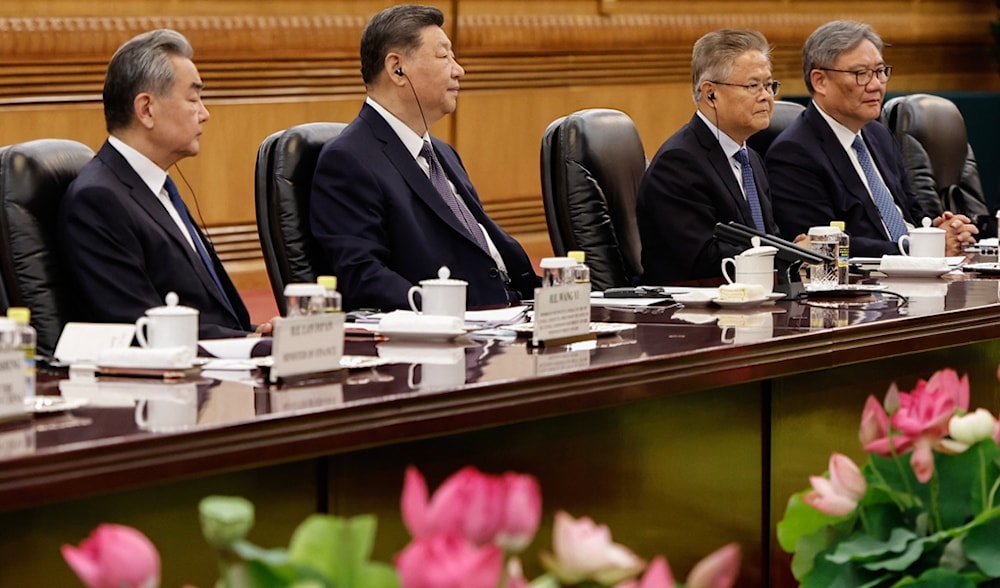
"Xi Jinping, Wang Yi, Zheng Shanjie and Wang Wentao meet Bangladesh PM Tarique Rahman at the Great Hall of the People, Beijing, June 26, 2026. (Tingshu Wang/Pool Photo via AP)"
More than a dozen heads of state have visited Beijing so far this year, a wave of diplomatic traffic that underscores China's growing pull as countries look to diversify their international partnerships, according to an analysis published by The Guardian.
Chinese President Xi Jinping met Friday with Bangladesh's new prime minister, Tarique Rahman, the latest in a string of high-level visits that have included Russia's Vladimir Putin, the UK's Keir Starmer, US President Donald Trump, and Myanmar's Min Aung Hlaing.
In May alone, Xi hosted leaders from the US, Russia, Brunei, Serbia, Tajikistan, and Pakistan, alongside numerous foreign ministers.
Analysts say the pattern reflects a broader trend of "middle power" countries seeking to build independent relationships with Beijing rather than relying on a single major power bloc. Canada's Prime Minister Mark Carney framed his January visit in exactly these terms, positioning Canada for the world as it actually is rather than how Western allies might wish it to be.
William Yang, a senior analyst with the International Crisis Group, told The Guardian that the steady stream of visits "reflects the growing recognition of China's increasing global influence."
Non-interference as a guiding principle
A central feature of China's diplomatic approach has been its longstanding policy of non-interference in the internal affairs of partner nations. When Xi welcomed Min Aung Hlaing earlier this month, he reiterated this principle directly, voicing support for Myanmar's government while emphasizing that its domestic matters remain its own to manage.
The same approach was visible during Xi's rare overseas trip to meet DPRK's Kim Jong-un earlier in June, where the visit centered on stabilizing ties between the two countries rather than litigating disputed issues.
Steve Tsang, director of the China Institute at SOAS University of London, told The Guardian this reflects a broader Chinese position that sovereign states should be free to manage their own affairs without outside interference, a stance that resonates with many countries that have chafed at conditional engagement from Western powers.
Chinese state media has cast Beijing's busy diplomatic calendar as evidence of its expanding role on the world stage. The Global Times said back-to-back visits from Trump and Putin in May "underscores both the intensity of China's diplomatic calendar and its expanding influence."
Limits on mediation in active conflicts
Despite its diplomatic weight, The Guardian piece argues that China's record as a mediator in major ongoing conflicts has been mixed.
Beijing is credited with encouraging Iran toward ceasefire talks during the US war on Iran, though it has not taken on a central mediating role in that conflict. Beijing previously brokered a 2023 détente between Saudi Arabia and Iran, but The Guardian analysts believe it does not have the kind of leverage over Tehran that would allow it to shape outcomes directly.
A similar dynamic has played out over Ukraine. China's 12-point peace proposal, published in 2023, has seen little follow-through and has been overshadowed by Beijing's continued economic and political ties with Moscow.
Even so, the steady flow of leaders to Beijing this year signals that many governments, across both the Global South and parts of the West, see value in strengthening ties with China independent of how any single conflict is ultimately resolved.


