
'Powerful forces lining up to undermine global cooperation': Guterres
 3 Min Read
UN Secretary-General Antonio Guterres marks the 80th anniversary of the UN's founding with a warning on militarization, climate neglect, and digital threats.
-
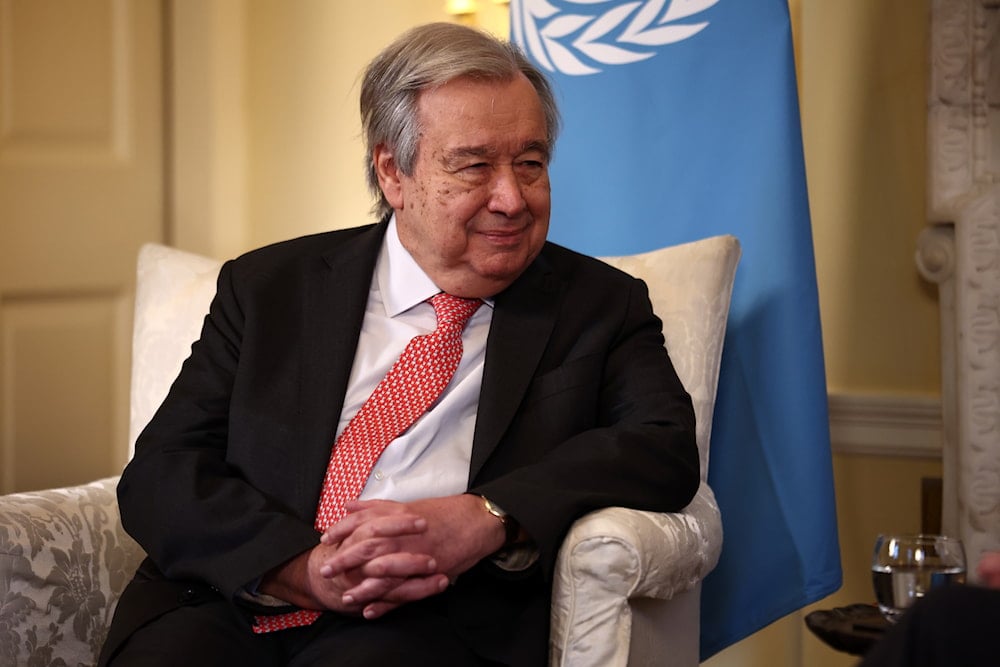
UN Secretary General Antonio Guterres is welcomed by Britain's Prime Minister Keir Starmer to 10 Downing Street, London, Friday, Jan. 16, 2026 (AP)
United Nations Secretary-General Antonio Guterres warned on Saturday of the growing danger posed by what he describes as “powerful forces lining up to undermine global cooperation,” during an address marking the 80th anniversary of the UN’s first major meeting.
Speaking at London’s Methodist Central Hall, the venue that hosted the inaugural session of the UN General Assembly in January 1946, Guterres urged renewed commitment to multilateralism and international law amid escalating global uncertainty.
The secretary-general reflected on the General Assembly’s first resolution, which focused on disarmament and the elimination of atomic weapons, contrasting it with today’s expanding array of global threats, including the climate crisis and risks emerging from “cyberspace", as many states engage in a renewed arms race, without naming specific countries.
Warning of rising militarization, Guterres, who is due to step down at the end of 2026, reportedly stated, “Last year, global military spending reached $2.7tn, over 200 times the UK’s current aid budget, or equivalent to over 70% of Britain’s entire economy.”
He also raised alarm over what he describes as a parallel neglect of climate action and democratic safeguards, telling the audience, “As the planet broke heat records, fossil fuel profits continued to surge. And in cyberspace, algorithms rewarded falsehoods, fuelled hatred, and provided authoritarians with powerful tools of control.”
UN faces shrinking funding following US withdrawal
Guterres' address comes amid heavily reduced funding for the United Nations, following US President Donald Trump's withdrawal from numerous foreign agencies.
The United States has announced plans to allocate just $2 billion (£1.5 billion) in humanitarian assistance to the United Nations, a sharp reduction from its earlier contributions as the organization’s largest donor, with the decision accompanied by a warning from the US State Department that the global body must “adapt, shrink or die” and that conditions would be imposed on countries receiving the funding.
Slightly more than a week later, Trump declared that the United States would withdraw from several UN agencies along with its central international climate agreement.
In fact, the United States announced its withdrawal from 66 international organizations, including 31 United Nations-affiliated bodies, on January 7, when Trump signed a presidential memorandum ordering the pullout.
Among the agencies affected are major UN bodies involved in climate, development, and social policy, including the United Nations Framework Convention on Climate Change, the Intergovernmental Panel on Climate Change, UN Women, and the United Nations Population Fund, alongside a range of other entities spanning environmental cooperation, scientific research, and governance.


