
'US spying on Vatican for years,' now 'priority' under Leo XIV
 4 Min Read
A report by an investigative journalist claims US intelligence agencies have long monitored the Vatican, with surveillance intensifying after Trump’s criticism of Pope Leo XIV.
-
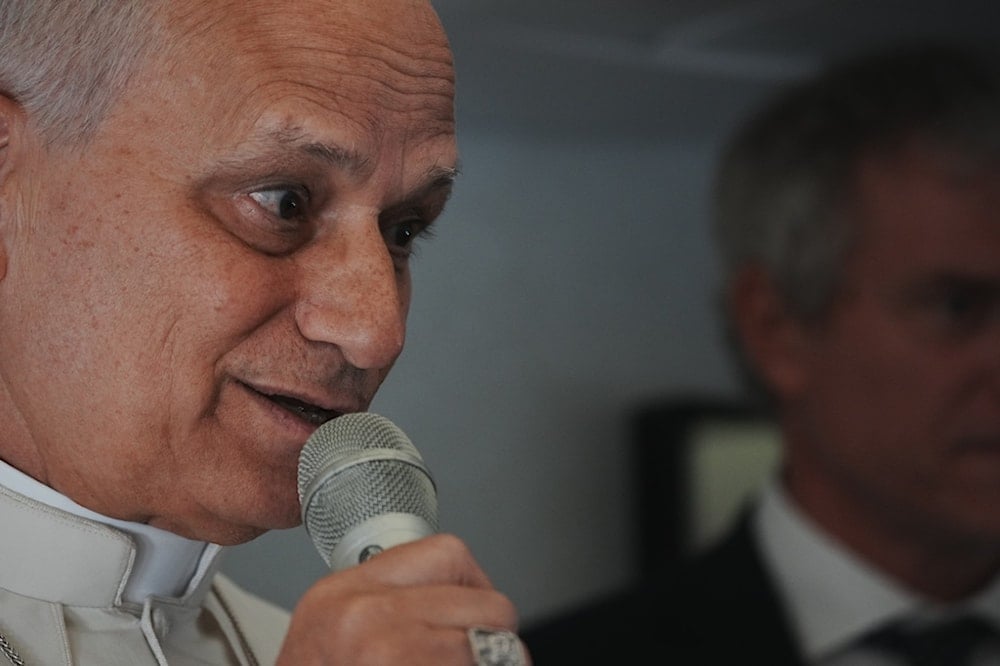
Pope Leo XIV speaks to journalists aboard the papal flight from Malabo to Rome, Thursday, April 23, 2026, at the end of his 11-day pastoral visit to Africa. (AP, Pool)
An independent journalist has documented that the Vatican is being targeted by US intelligence services.
US intelligence agencies have conducted long-running surveillance of the Vatican, with monitoring efforts reportedly gaining renewed priority following recent criticism of Pope Leo XIV by US President Donald Trump, a report by independent investigative journalist Ken Klippenstein claimed.
According to Klippenstein, with a record of leaked-FBI scoops, US intelligence activity targeting the Vatican predates the current administration, but intensified after Trump publicly criticized the pope on April 12, describing him as “terrible for foreign policy.” The report states that elements within the US intelligence community interpreted the remarks as a signal to increase focus on Vatican-related intelligence gathering.
Agencies, including the Central Intelligence Agency and the National Security Agency, have sought to monitor communications linked to the Holy See, as per Klippenstein, including emails and telecommunications, while also maintaining human intelligence sources within Vatican administrative structures, as per the report.
It further alleges that US government bodies circulate regular intelligence summaries related to Vatican affairs and maintain specialized linguistic capabilities, including expertise in Ecclesiastical Latin, to support analysis.
Longstanding ties between Washington, Vatican
The report situates these activities within a broader historical relationship between Washington and the Vatican, which has included periods of cooperation in diplomacy, security, and intelligence-sharing.
Klippenstein notes that past collaboration between US intelligence services and the Vatican dates back decades, particularly during the Cold War, when both sides coordinated efforts in geopolitical contexts such as Eastern Europe.
The renewed focus on the Vatican comes amid tensions between the Trump administration and Pope Leo XIV, who has publicly criticized aspects of US foreign policy, including the war with Iran.
The pope responded to Trump’s remarks shortly after they were made, stating, “I am not afraid.”
The report suggests that intelligence activity directed at the Vatican reflects broader concerns within Washington over the influence of the pope’s positions on international affairs.
US authorities have not publicly confirmed these claims, and no official response has been issued regarding the alleged surveillance activities.
The report has nonetheless drawn attention to the complex relationship between intelligence operations, diplomatic engagement, and religious institutions, particularly at a time of heightened geopolitical tension.
Trump's opinion of the pope
Trump is "not a fan" of Leo and called him a "very liberal person" who is "weak on crime" and "terrible on foreign policy."
Last Thursday, Trump said, "I have no disagreement with the fact the pope can say what he wants, and I want him to say what he wants, but I can disagree."
Earlier pontiffs, including Francis, John Paul II, and Benedict XVI, often depended on translation, allowing Vatican officials some flexibility to adjust tone after controversial remarks.
Leo, however, communicates in fluent and culturally nuanced English, often adopting language that resonates with American political discourse. This clarity leaves little room for reinterpretation when his statements spark debate.
Historically, the Vatican has used linguistic subtlety as a diplomatic tool, particularly when addressing influential nations like the United States. Leo’s approach suggests a move toward greater transparency and directness, as per the report.
Greater engagement in US politics
His communication style also points to a pope more willing to engage directly with American political issues rather than relying solely on broad moral guidance.
"Having grown up in the US, Leo has both native competence in US English and insight into US culture. Both are important," Vincent J. Miller, the Gudorf Chair in Catholic Theology and Culture at the University of Dayton, told Axios.
Miller said this is a striking contrast to Francis, who could get headlines with provocative statements, but couldn't target them carefully to the US context.
"It's more than simply being able to read and hear what US politicians are saying without relying on reports or translations. Leo understands the entanglements of religion and politics in the US," Miller stressed.
He added that Leo doesn't just give sound bites, but includes messages as he did in his Palm Sunday homily in response to the political and militaristic use of the Bible by US Secretary of War Pete Hegseth's prayer on March 26.
Read more: Pope Leo positioned as counterweight to Trump: FT


