
Trump-Pope Leo XIV rift grows, may erode Catholic voter support: BBC
 8 Min Read
A growing rift within US Catholic circles is emerging over Trump’s rhetoric, the war on Iran, and his confrontation with Pope Leo, reshaping political loyalties and church responses.
-
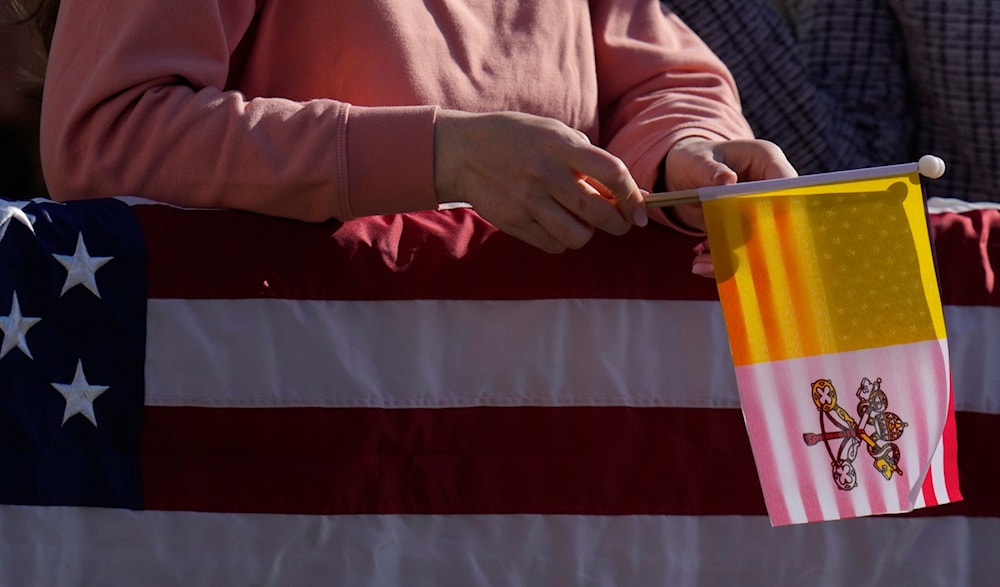
A US flag is set as a faithful waits for the arrival of Pope Leo XVI for his weekly general audience in St. Peter's Square at The Vatican, May 28, 2025 (AP)
The growing rift between Donald Trump and Pope Leo XIV is increasingly unfolding in public, with the BBC reporting it may be eroding the president’s support among Catholic voters.
It is not unusual for Trump to face criticism from Catholic leaders. His hardline immigration agenda, central to his campaign and widely supported by his base, has long drawn condemnation from church authorities.
For months, this has placed the US Catholic hierarchy at odds with more conservative, rank-and-file Catholics, as per the report. But the recent wave of criticism over Trump’s direct attack on Pope Leo and his sharing of an AI-generated image portraying himself in a Christ-like form marks a sharper escalation.
Conservative Catholic backlash expands beyond expected lines
What stands out in the latest backlash is its source: not only progressive Catholics, but also traditionally loyal conservative Catholic allies, the report added.
Some of this discontent stems not only from Trump’s public clash with Pope Leo, but also from broader anger over the Iran war, which has deepened divisions within Catholic circles.
The controversy surrounding Trump’s social media criticism of the first American pope, calling him overly liberal and “weak on crime”, along with the AI-generated imagery, has intensified a shift in opinion among Catholic conservatives since the conflict began six weeks ago.
'We look to Christ': Conservative bishop breaks ranks
“I pray that all of this will clarify for people that we don't look to a national leader, we don't look to those who have the most money or the most weapons. We look to Christ,” Bishop Joseph Strickland told the BBC.
His remarks are notable given his previously close alignment with Trump. He had participated in a prayer event to “consecrate” Trump’s Mar-a-Lago residence, spoke at CPAC in 2024, where Trump was a guest of honor, and addressed Trump supporters contesting election results in 2020.
Getty Images shows Strickland at the 2024 March for Life in Washington.
Strickland was long considered a staunch Trump ally, and his overt political engagement, alongside clashes with Pope Francis, contributed to his removal as Bishop of Tyler, Texas.
Opposition to the war on Iran deepens Catholic divisions
Despite this history, Strickland has now broken with the Trump administration over the war in Iran.
“I do not believe this conflict meets the criteria of a just war. I stand with the Holy Father and his call for peace. This is not about politics. It's about moral truth,” he told the BBC, arguing that civilian suffering makes the war morally indefensible.
He further warned against using religion to justify violence, saying, “It becomes very dark when religion is used to justify immoral behaviour... using religion to justify especially dropping bombs is contradicting what the faith is about."
On Trump’s criticism of Pope Leo and the AI-generated “Christ-like” image, Strickland said he felt obliged to invoke biblical teaching.
“When world leaders forget this truth, all are in peril,” he stressed.
Political risks grow as Catholic voter shifts emerge
The political consequences could be significant, as Trump had previously strengthened support among Catholic voters in the 2024 election.
Data from the Pew Research Center shows complex divides: 62% of White Catholics voted for Trump compared to 37% for Kamala Harris, while Hispanic Catholics leaned toward Harris overall.
According to analyst Greg Smith of Pew Research Center, Catholic voters often align more strongly with political identity than religious unity, contributing to deep polarization on issues like abortion and immigration.
Papal authority, politics, and shifting Catholic loyalties
Historically, Catholics in the US are divided along partisan lines. Pope Francis was generally more popular among Democratic Catholics than Republican ones, while Pope Leo enjoys broader support across both groups, according to Pew.
Earlier reforms by Pope Francis, such as restrictions on the Latin Mass, had alienated traditionalists, some of whom Pope Leo has since eased.
“The Pope is the Pope, we owe him a certain amount of deference, but I don't think that Catholicism wants the obedience of cadavers. We are living, thinking persons,” said Peter Wolfgang of the Family Institute of Connecticut.
Wolfgang, once a cautious Trump supporter, now backs policies such as mass deportations and Catholic nationalism linked to JD Vance, yet he criticizes Trump’s stance toward the Pope.
“President Trump does not understand how Catholicism works. The Pope is not merely a head of state, he is the Vicar of Christ. Attacks on him are received as attacks on the Church itself. The more he attacks the Pope the more his support will drop among his Catholic voters,” Wolfgang told the BBC.
War on Iran unites unlikely Catholic voices
Wolfgang also argued that the war on Iran has unexpectedly unified Catholic opinion across ideological lines, especially due to the Pope’s clear anti-war stance.
He criticized rhetoric from US officials, including War Secretary Pete Hegseth, referencing a controversial Pentagon prayer invoking “overwhelming violence” and “justice executed swiftly and without remorse.”
“No senior US Catholic clergy has publicly supported the war,” the report notes, highlighting rare consensus among bishops and commentators.
Even Robert Barron, a Trump ally, urged Trump to apologize for his remarks about the Pope, though the request was rejected.
'Just War' doctrine becomes central fault line
Liberal Catholic commentator Steven Greydanus also pointed to the erosion of traditional “Just War Theory,” which governs when warfare is morally justified.
He contrasted Trump’s rhetoric with what he calls the Pope’s “healing presence,” saying the crisis has forced Catholics into clearer moral choices.
“While I am grieved by the directness of Donald Trump's attacks on Pope Leo, in a way I welcome the clarity of the choice Catholics are being presented with,” Greydanus said.
US bishops defend Pope Leo’s stance on “Just War” doctrine
In a similar context, the chairman of the US Conference of Catholic Bishops’ Committee on Doctrine has publicly defended Pope Leo XIV following recent remarks on the Church’s “just war” teaching.
Bishop James Massa emphasized that the Church has consistently taught that “a nation can only legitimately take up the sword ‘in self-defense, once all peace efforts have failed.’”
He said this principle underpins Pope Leo’s assertion that God “does not listen to the prayers of those who wage war.”
“The pope is not merely offering opinions on theology, he is preaching the Gospel and exercising his ministry as the Vicar of Christ,” Massa stressed.
Vatican response: Moral limits over political conflict
Inside the Vatican, officials stress that the situation is not a personal feud between Trump and the Pope, but a moral disagreement over war.
“There is an important difference between challenging a man and challenging the principle that makes war possible,” said Rev. Antonio Spadaro SJ of the Vatican’s Dicastery for Culture and Education.
He added that the Pope must publicly speak out “to mark the moral limit” of acceptable conduct, even while private diplomatic dialogue continues.
Trump’s decision to post, and later delete, an AI-generated image of himself sparked further controversy, alongside his sharp criticism of Pope Leo.
Some analysts question whether the posts were intended to undermine papal opposition to the war. However, Vatican officials suggest the backlash may have unintentionally amplified the Pope’s influence.
“If Leo were irrelevant, he would not deserve a word. Instead, he is invoked, named, opposed - a sign that his words matter,” Spadaro said.
Pope Leo reflects on diplomacy and global unity
During a flight from Algiers to Yaounde, Pope Leo XIV reflected on his recent visit to Algeria, praising local authorities and highlighting respect shown to the Holy See.
He emphasized the legacy of St. Augustine and the importance of dialogue across religious and cultural divides.
Even in a largely non-Catholic country, he said, there is shared reverence for Augustine as a bridge-builder.
He concluded that such visits demonstrate the Church’s mission to promote unity, peaceful coexistence, and interfaith understanding.


