
'We’re taking it back': Trump moves to block China from Panama Canal
 4 Min Read
US President Donald Trump says the US will not allow China to take control of the Panama Canal, citing concerns over Beijing's growing influence in the Western Hemisphere.
-
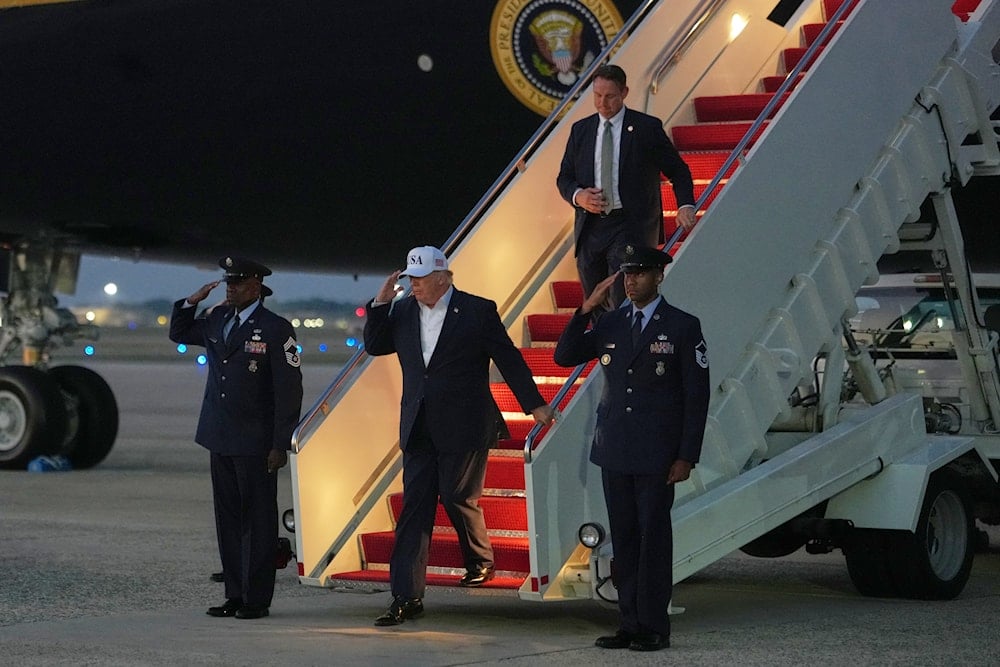
President Donald Trump arrives on Air Force One, Wednesday, July 1, 2026, at Joint Base Andrews, Md (AP)
US President Donald Trump said on Wednesday that the United States will not allow China to take control of the Panama Canal, reiterating a long-standing concern over Beijing's growing influence in the Western Hemisphere.
Trump's campaign to curb Chinese influence over the Panama Canal, launched with characteristic fanfare at the start of his second term in January 2025, has evolved from fiery rhetoric into tangible geopolitical results. What began as a day-one pledge has unfolded over eighteen months through diplomatic pressure, military posturing, and a landmark Panamanian court ruling, fundamentally reshaping the strategic waterway's operating landscape.
The campaign's opening salvo came on January 20, 2025, when Trump, in his second inaugural address, declared that Panama had broken its promises and that China was effectively operating the canal. "We didn't give it to China. We gave it to Panama, and we're taking it back", he proclaimed, prompting an immediate rebuke from Panamanian President José Raúl Mulino, who insisted the canal's sovereignty was "non-negotiable".
This followed weeks of pre-inauguration social media posts in which Trump, as President-elect, complained of "ridiculous" transit fees and termed the canal "a vital national asset".
Trump targets Hong Kong-based conglomerate
Behind the rhetoric lay a concrete target: Hong Kong-based conglomerate CK Hutchison, whose subsidiary had operated the Balboa and Cristobal ports at the canal's Pacific and Atlantic entrances since the 1990s under a concession automatically renewed in 2021. Trump framed this presence as a national security threat, arguing that Beijing could allegedly leverage port operations to influence global trade and US naval movements, a claim Panamanian and Chinese officials repeatedly denied.
The administration backed its words with sustained diplomatic pressure. US Secretary of State Marco Rubio and War Secretary Pete Hegseth engaged in talks with President Mulino, offering enhanced defense cooperation and economic incentives in exchange for action against Chinese-linked operations. By late 2025, Panama had agreed not to renew its Belt and Road Initiative memorandum with China, and a legal challenge against the CK Hutchison concession was making its way through Panamanian courts.
The campaign achieved a decisive breakthrough on February 23, 2026, when Panama's Supreme Court declared the CK Hutchison port concession unconstitutional in an unappealable ruling. The court cited violations stemming from the original contracts and accounting irregularities reportedly costing Panama hundreds of millions of dollars. A proposed $23 billion sale of the ports to a BlackRock-led American consortium, initially hailed by Trump, subsequently stalled due to reported objections from Beijing.
Panama's judicial action effectively eliminated the Chinese operational presence that had been Trump's primary target. By June 2026, US Chief of Naval Operations Admiral Daryl Caudle, speaking in Panama City, acknowledged that the canal's security apparatus was "robust" and that he saw no specific weaknesses. While Trump has continued to insist that the United States "will not allow foreign influence" in the canal, the administration's focus has shifted from confrontation to consolidation.
The campaign, however, has not been without friction. Trump's repeated threats to use military or economic force prompted Panama to formally alert the United Nations in early 2025, citing the UN Charter's prohibition on threats against territorial integrity. And while the administration has secured deepened security cooperation with Panama, including joint exercises, officials have ruled out establishing US military bases in the country.
As Trump continues to invoke the canal's history, recently questioning an AI rendition of Theodore Roosevelt about the waterway, the broader geopolitical contest for influence in the Western Hemisphere appears far from over.


