
2025: New record for Israeli settlement expansion in West Bank
 5 Min Read
"Israel" approved a record number of settlements in the West Bank in 2025, displacing Palestinians and obstructing future statehood.
-
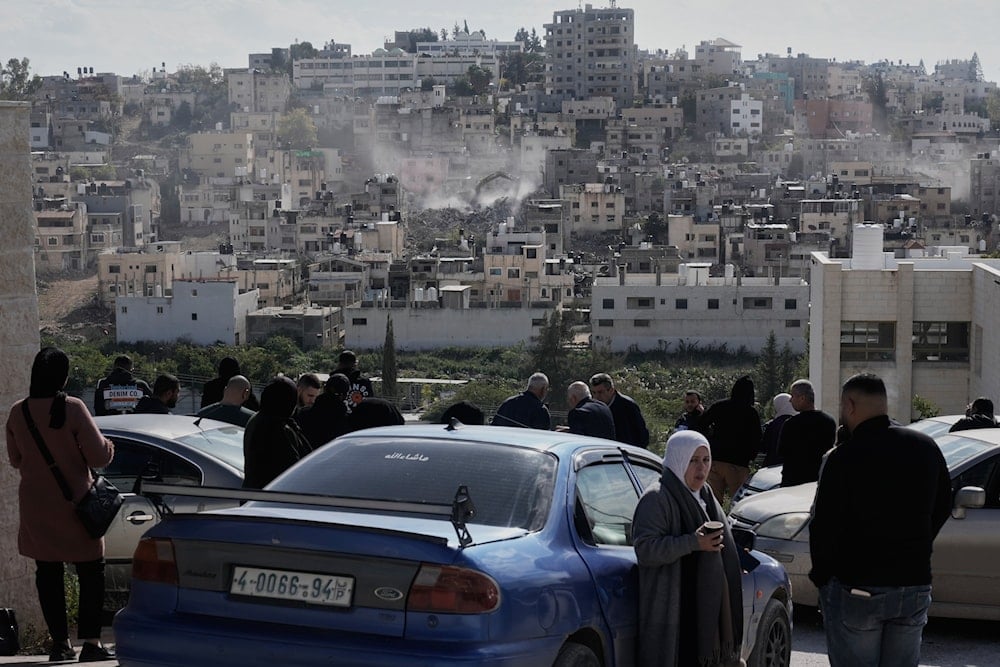
People watch an Israeli army bulldozer demolishing homes in the Palestinian urban refugee camp of Nur Shams, near the West Bank city of Tulkarem, Occupied Palestine, Wednesday, Dec. 31, 2025 (AP)
2025 ended as a record-breaking year for Israeli settlement expansion in the occupied West Bank, with "Israel’s" far-right coalition approving an unprecedented number of new settlements and settlement units. Rights groups say the moves are aimed at stealing territory and obstructing the possibility of a future Palestinian state.
According to Israeli settlement watchdog Peace Now, the approvals this year marked the peak of an acceleration that began under the current Israeli government, surpassing any period since the Oslo Accords of 1993. “This is nothing to compare to previous governments,” Yonatan Mizrachi of Peace Now’s Settlement Watch Team told Anadolu. He added, “The goal of this government … is to prevent a political solution based on a two-state solution.”
Peace Now reported that plans for 41 new settlements were approved in 2025, making it the most extensive single year of settlement approvals on record, including both newly announced settlements and the retroactive legalization of previously unauthorized outposts.
Government-sanctioned colonization
In May, "Israel’s" Security Cabinet approved the construction of 22 new settlements on Palestinian land, including the reestablishment of Homesh and Sa-Nur, settlements dismantled under "Israel’s" 2005 unilateral disengagement from the Gaza Strip.
On December 21, the Security Cabinet approved an additional plan to legalize 19 settlements in the West Bank, encompassing both newly established sites and long-standing outposts now granted formal status.
Mizrachi noted that the government moved quickly after taking office, legalizing 10 outposts in early 2023 and transforming nine of them into settlements. “Outposts are illegal even under Israeli law, while settlements are considered legal by Israel despite being illegal under international law,” he said.
Overall, Peace Now said 68 settlements have been approved, legalized, or initiated over the past three years. “This does not mean that all 68 settlements have already been established,” Mizrachi clarified. “It means the process has begun, with government support, different planning committees and authorities.”
Wide-ranging land grabs
The settlement surge in 2025 is geographically wide-ranging, extending into areas of the West Bank that previously had no settlements. “Sixty-eight settlements that will be built according to the Israeli plan from the south to the north or from the north to the south,” Yonatan Mizrachi of Peace Now said. “Including areas that today we don’t have any settlements, like areas around Jenin, around Hebron. It’s all over the West Bank actually.”
In early 2023, there were approximately 140 settlements in the West Bank, Mizrachi said. With the recent approvals, that number has risen to 208, bringing the total number of Israeli settlers in the eastern part of occupied al-Quds and the West Bank to around 750,000. Settlement expansion has also accelerated through construction approvals. Peace Now reported that Israeli authorities advanced plans for 28,163 settler units in 2025 – the highest figure ever recorded.
On the final day of the year, authorities approved a plan allowing settlers to return to Sa-Nur, greenlighting 126 settlement units at the site evacuated in 2005. This was enabled by amendments introduced by the current government to the Disengagement Law, lifting restrictions on Israeli presence in parts of the northern West Bank. Peace Now said the move marks a return to settlement activity deep inside densely populated Palestinian areas where settlers had not previously been present.
The aim is to prevent a Palestinian state
Mizrachi said settlement expansion is central to the government’s strategy to prevent Palestinian statehood without formally declaring "annexation". “In the last three years, Israel has taken many steps – bureaucratic steps, advancing settlements, developing the West Bank – to increase the number of Israeli settlers,” he said.
“The aim is to prevent a Palestinian state in any political solution, because there will be so many settlements and so many locations with an Israeli presence that it would be much more difficult to evacuate.”
Yair Dvir, spokesperson for B’Tselem, the Israeli Information Center for Human Rights in the Occupied Territories, said the settlement drive is accompanied by the forcible displacement of Palestinians. “Israel continues to advance ethnic cleansing in the West Bank, both through the construction and retroactive legalization of outposts and new settlements, and through the forcible displacement of Palestinian communities and the violent takeover of vast areas of Palestinian lands,” he told Anadolu.
2026 to herald more expansions
Looking ahead, Mizrachi said settlement expansion is likely to continue into 2026, an election year in "Israel". “We are assuming that the advancing of settlement, house units, financial support to the settlers will continue in 2026 – it might increase or might not. But definitely, the pattern that we have seen in the last three years will continue,” he said.
He added that since October 2023, dozens of Palestinian communities have been forced to flee due to settler violence. “Many times, an outpost is built next to the Palestinian community, making it more tense for the Palestinians to stay there,” Mizrachi said. “We still see a lot of settler violence, much of it coming from illegal outposts.”
Mizrachi warned that the trajectory is deepening instability. “Instead of going toward a political solution that would mean withdrawing from the West Bank,” he said, “we are just going deeper into a more problematic situation.”


