
8 Arab, Islamic nations accept joining Trump’s global ‘board of peace’
 5 Min Read
While key US allies sign on to Trump’s so-called "Board of Peace," diplomats warn the initiative may sideline the UN and centralize conflict resolution under US influence.
-
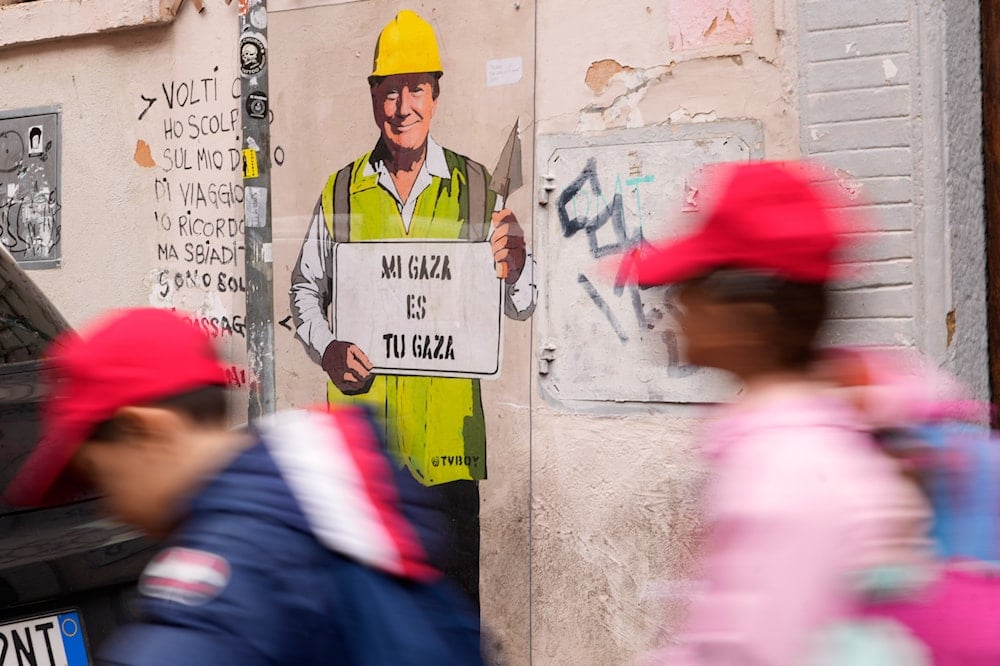
People walk past a poster by artist TVBOY depicting US President Donald Trump wearing a construction worker outfit and holding a placard reading in Spanish: My Gaza is your Gaza, is posted on a street in Rome, Nov. 18, 2025 (AP)
Saudi Arabia, Turkey, Egypt, Jordan, Indonesia, Pakistan, Qatar, and the United Arab Emirates have accepted invitations to join US President Donald Trump’s newly launched “Board of Peace,” the Saudi Foreign Ministry said in a joint statement.
The statement added that each country will complete the process by signing accession documents in line with its domestic legal procedures.
Ironically, on the same day, Israeli Prime Minister Benjamin Netanyahu accepted his position on Donald Trump's "Board of Peace," the framework supposedly designed to not only bring stability and reconstruction to Gaza, but to all "conflict-affected" areas.
Diplomats, however, have warned that the move could potentially undermine the work of the United Nations.
Countries that have accepted Trump’s invitation to 'Board of Peace'
As of Wednesday, up to 25 countries had accepted US President Donald Trump’s invitation to join his “Board of Peace,” according to Steve Witkoff.
Middle Eastern allies among them include Saudi Arabia, the United Arab Emirates, Bahrain, Jordan, Qatar, and Egypt. NATO members Turkey and Hungary, whose nationalist leaders have cultivated close personal ties with Trump, have also agreed to participate. Other countries that have joined include Morocco, Pakistan, Indonesia, Kosovo, Uzbekistan, Kazakhstan, Paraguay, and Vietnam.
Armenia and Azerbaijan, which reached a US-brokered peace agreement in August after meetings at the White House, have also accepted. Belarusian President Alexander Lukashenko, long criticized in the West for alleged human rights abuses and support for Russia’s war in Ukraine, has controversially accepted the invitation amid warming ties with Washington.
Russia and China have not yet indicated whether they will participate. Both countries, traditional supporters of the United Nations and veto-wielding members of the UN Security Council, are likely to approach the initiative cautiously. Trump, who has frequently criticised the UN as ineffective, insisted this week that the organisation should continue, saying, “I believe you got to let the UN continue because the potential is so great.”
Countries that have declined or not committed
Some close US allies have responded cautiously or declined to join, reflecting discomfort with Trump’s unilateral “America First” approach. Norway, Sweden and Solvenia have explicitly declined. Italy’s Economy Minister Giancarlo Giorgetti said participation would be problematic, with Il Corriere della Sera reporting that joining a board led by a single country’s leader could violate the Italian constitution. France also intends to decline, prompting Trump to threaten tariffs of up to 200% on French wines and champagnes.
Canada has agreed “in principle” but is still finalizing details. Britain, Germany, and Japan have not publicly committed, though a German government spokesperson said Chancellor Friedrich Merz would not attend a signing ceremony at Davos. Ukraine is evaluating the invitation, but President Volodymyr Zelensky said he could not envision joining a board alongside Russia after four years of war.
The Vatican confirmed that Pope Leo, the first US pontiff, has been invited and is considering the proposal.
Powers, functions of 'Board of Peace'
The Board of Peace’s legal authority and enforcement mechanisms remain unclear, as does how it will coordinate with the UN and other international bodies.
Its charter gives the chairman, Trump, extensive executive powers, including the ability to veto decisions and remove members, subject to certain constraints. The Board is intended to carry out “peace-building functions in accordance with international law.”
In addition, the White House has announced a Gaza Executive Board to support a transitional Palestinian administration in Gaza. How the founding Executive Board and the Gaza Executive Board, which share some members, will operate in practice remains uncertain.
Reality of 'Board of Peace'
While the international community rushes to take part in the colonial-style project, Palestinian Resistance officials continue warning against the initiative, stating that it represents an externally imposed framework that undermines Palestinian sovereignty.
In November 2025, Resistance leaders issued a joint statement of condemnation, stressing that the proposed establishment violates national rights and risks worsening political fragmentation.
The efforts by foreign powers to establish government structures within the Gaza Strip have also drawn significant pushback from rights groups.
The Gaza Center for Human Rights (GCHR) warned that US‑backed reconstruction efforts and proposed governing bodies risk violating international law by reshaping demographics and undermining Palestinian rights to land ownership, adequate housing, and freedom of movement, as well as sidelining direct Palestinian participation in decisions about their future.
Alongside the concerns raised about foreign administrative influence, the United Nations Security Council adopted a US‑backed resolution late in 2025, which aims to authorize an international force in Gaza under the guise of securing borders, supporting reconstruction, and maintaining order. The adoption of that resolution, seen by supporters of the Gaza "peace" process as a step toward stabilization, was welcomed by US leadership but also sparked criticism from regional actors worried that such deployments could entrench external control over Palestinian affairs.
Read more: Trump invites Turkey, Argentina, Canada to "Gaza Peace Council"


