
Aoun claims talks with 'Israel' not to forfeit Lebanon’s rights
 4 Min Read
Lebanese President Joseph Aoun says no agreement will compromise Lebanon’s rights as direct talks with the Israeli occupation begin after a US-announced ceasefire.
-
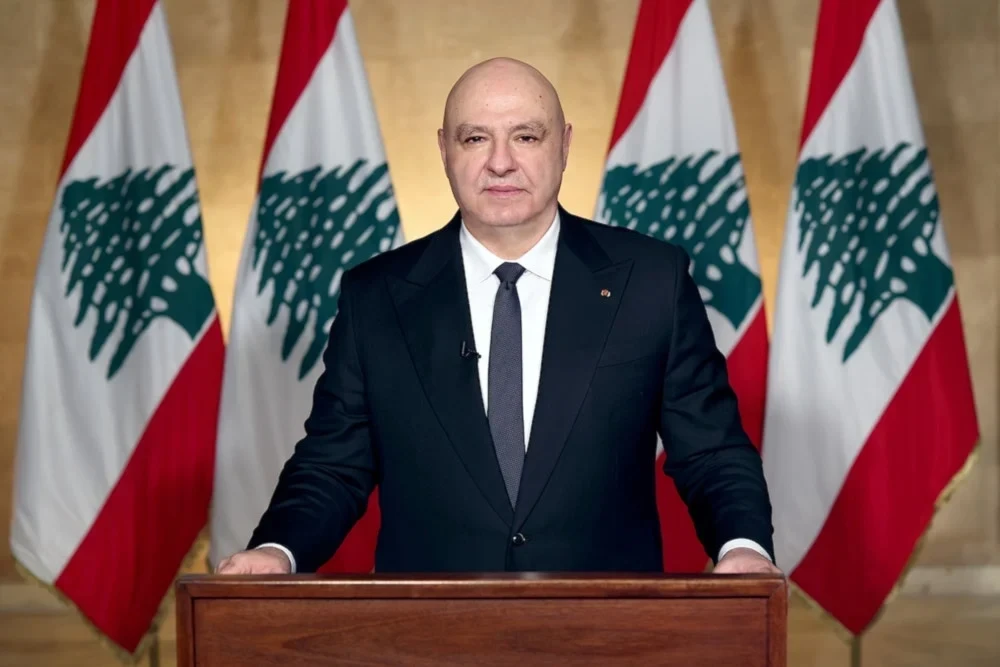
Lebanese President Joseph Aoun delivers an address in Beirut, Lebanon, on April 17, 2026 (Lebanese Presidency)
Lebanese President Joseph Aoun said on Friday that no agreement will compromise Lebanon’s rights, as the government enters direct negotiations with the Israeli occupation amid broad public opposition and criticism from key political forces.
In a televised address, Aoun claimed the ceasefire was the result of “tremendous efforts at various levels,” thanking those who contributed to securing it, including US President Donald Trump and “Arab friends.”
Aoun expressed confidence in Lebanon’s ability to recover, adding that the decision taken by Beirut was a turning point in terms of national sovereignty.
He stressed that negotiations with the Israeli occupation “do not and will not mean relinquishing any rights,” adding that he is prepared “to assume full responsibility for the choices and to go anywhere to save his people and land.”
The Lebanese president claimed that no agreement would concede “an atom of the nation’s land.”
He called on the Lebanese people to reject divisive rhetoric, saying: “Do not allow voices of doubt and accusation to sow division,” adding that rebuilding the country requires unity, as “all Lebanese are in one boat.”
Aoun concluded by warning against what he described as reckless decisions regarding Lebanon’s future, stating: “To those gambling with Lebanon’s fate, enough, Lebanon’s project is the safest for all.”
The President, however, failed to specify who he was hinting at.
Aoun’s remarks come a day after a 10-day ceasefire between Lebanon and the Israeli occupation was announced by Trump.
In parallel, the Lebanese government has entered direct negotiations with the Israeli occupation regime, including a meeting in Washington between the Lebanese ambassador and the Israeli ambassador, alongside US Secretary of State Marco Rubio, as part of US-led efforts to advance talks that may include a potential meeting with Israeli Prime Minister Benjamin Netanyahu.
Lebanon must seize historic moment: Fadlallah
Lebanese MP Hassan Fadlallah, a member of the Loyalty to the Resistance bloc, declared on Friday that political rhetoric from Washington or Tel Aviv can not translate into facts on the ground, as tens of thousands of Lebanese citizens began flooding back to their villages following the entry into force of a 10-day ceasefire at midnight.
Speaking from the southern suburb of Beirut, Fadlallah credited the steadfastness of the Lebanese people, alongside decisive Iranian pressure, for bringing the ceasefire about.
"Bint Jbeil, al-Taybeh, and al-Khiam are the ones who forced the enemy to retreat," he said, adding that it was "resilience, steadfastness, determination, and adherence to rights and land" that ultimately drove the diplomatic success Iran helped secure.
He reaffirmed a set of core national principles, namely full Israeli withdrawal, the return of the displaced, the release of detainees, and the launch of reconstruction efforts.
Authorities must not yield to Israeli blackmail
Fadlallah warned that the ceasefire must not become a tool of Israeli blackmail against Lebanese authorities, urging officials to stand firm rather than make further concessions. If Washington intends to grant the Israeli regime "freedom of movement" in Lebanon, and if Lebanese officials submit, those concessions would not hold on the ground, he said.
He called on Lebanese authorities to seize this historic moment by capitalizing on the current regional climate, including Iranian-Saudi communication, rather than leaning on Washington or pursuing direct negotiations, he argued, would only yield more submission to Israeli dictates. "Lebanese officials must rely on their people and bet on them, not choose concession and submission," he said.
He added that time had not yet run out for the authorities to reverse their concessionary steps, urging them to realign with national priorities and rebuild trust with their own people rather than drive the country deeper into internal strife.


