
Arab nations carried out operations against Iran: CENTCOM chief
 3 Min Read
US Central Command chief Brad Cooper confirms expanding military cooperation with Arab countries and "Israel" and their participation in aggression against Iran.
-
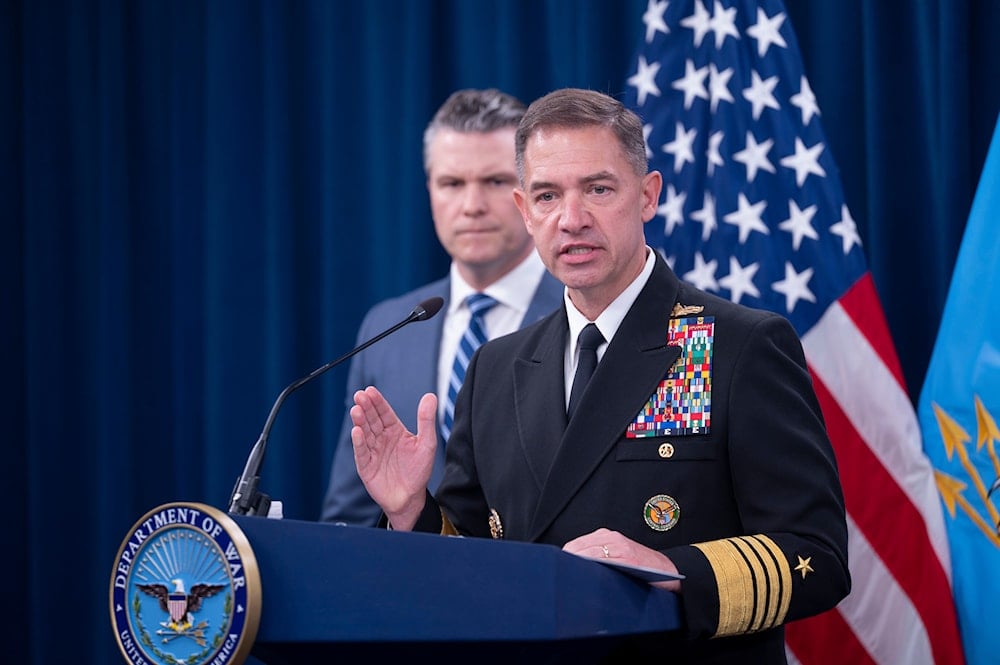
Adm. Brad Cooper speaks to members of the media during a press briefing with Defense Secretary Pete Hegseth, left, at the Pentagon, on April 16, 2026, in Washington (AP)
US Central Command (CENTCOM) commander Gen. Brad Cooper said Thursday that Washington strengthened military cooperation with several regional states during the aggression on Iran, including the UAE, Bahrain, Saudi Arabia, Kuwait, and Jordan, in addition to the Israeli entity.
Speaking before the Senate Armed Services Committee, Cooper said five of the six Gulf Cooperation Council states, in addition to Jordan, provided logistical intelligence and facilities to US forces during the war.
He said the US observed increased Iranian ballistic missile activity and production efforts in late 2025, which he alleged was a threat to US forces and regional allies.
US claims major gains in Iran operations
Cooper alleged that US forces achieved "significant objectives" against Iran in less than 40 days, claiming that around 90 percent of Iran’s military capabilities had been destroyed.
Despite those claims, Cooper said Iran still retains military capabilities enabling it to "pose a threat" following the recent war. He also alleged that the campaign weakened Iran’s regional allies, including Hamas, Hezbollah, and Ansar Allah, saying they are now facing difficulties in obtaining weapons.
Lebanon, Hezbollah and wider regional issues
On Lebanon, Cooper described confronting Hezbollah as a complex challenge due to its integration within Lebanese society, adding that the US will continue supporting the Lebanese army in efforts related to Hezbollah’s disarmament.
Separately, AFRICOM commander Dagvin Anderson warned that ISIS and al-Qaeda are expanding across Africa, describing the trend as a direct threat to US interests.
In another context, Cooper said that the United States had handed over more than 5,000 ISIS members to the Iraqi government, which had helped reduce the direct threat to US forces.
CENTCOM praises regional partners
Cooper praised regional allies during the war, naming the UAE, Bahrain, Qatar, Kuwait, Saudi Arabia, Jordan, and “Israel”, for contributing politically and militarily against Iran.
He also said some regional countries were “less than stellar” in their support, without specifying which ones.
Cooper added that the US military adopted tactics and procedures shared by Ukraine as Iran increasingly relied on drone warfare, incorporating lessons from Ukraine’s battlefield experience to improve US defenses.
Washington highlights missile concerns
Cooper said the US detected increased Iranian ballistic missile activity and production intentions in late 2025, describing it as a significant threat to US forces and allies.
On that note, The New York Times reported earlier that secret US intelligence assessments prepared earlier this month indicated that Iran had regained access to most of its missile sites, launch pads, and underground facilities, contradicting public statements by US President Donald Trump’s administration that Iranian military capabilities had been destroyed.
Senate hearings
Cooper testifies before the Senate Armed Services Committee today on Trump’s fiscal 2027 budget request and the posture of the Defense Department amid the West Asia war.
The hearing comes as the fragile ceasefire between the US and Iran remains under strain, with the Trump administration defending its aggression on Tehran while the two sides have yet to reach an agreement to end the war.
General Dagvin R.M. Anderson, head of US Africa Command, will also appear before the committee for questioning after War Secretary Pete Hegseth was recently grilled over the war during back-to-back hearings last week.


