
Araghchi: Iran proved its strength, ability to confront US, not yield
 4 Min Read
The Iranian FM says his country demonstrated its military capability and steadfastness in the face of US aggression.
-
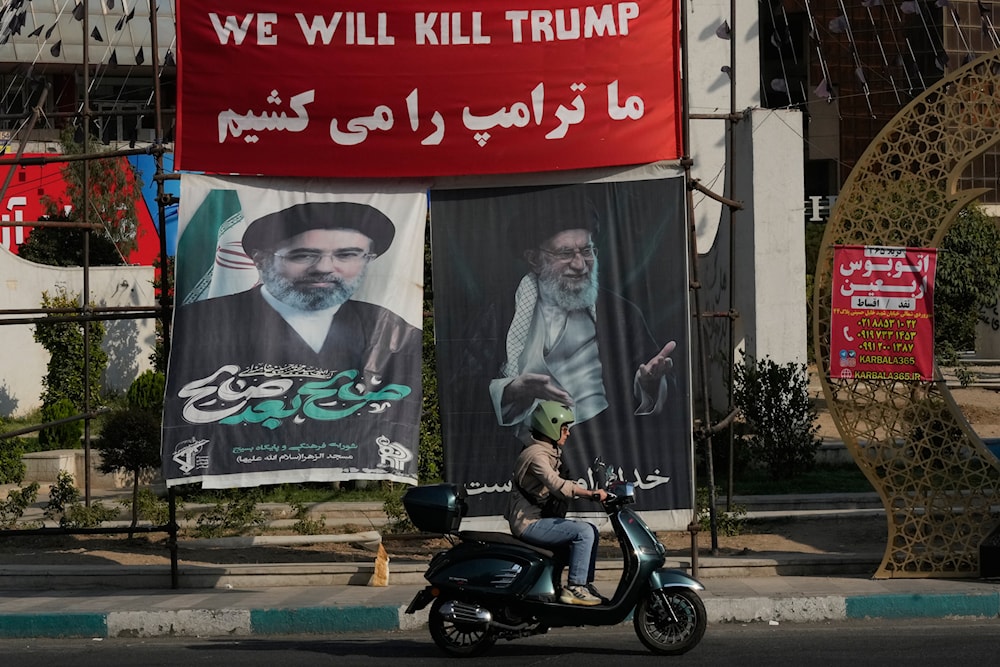
A motorbike drives past a banner and portraits of the late Leader Sayyed Ali Khamenei and Sayyed Mojtaba Khamenei, the successor, at a square in Tehran, Iran, Aug. 10, 2026 (AP)
Iran has demonstrated its military capability, proving that it is an "invincible power" capable of confronting the United States, Iranian Foreign Minister Abbas Araghchi said on Tuesday.
Araghchi said that US President Donald Trump initiated hostilities against Iran to force an unconditional surrender, but after 20 days of resistance and resilience, the US president requested negotiations with Tehran.
"No one expected Iran to be able to resist America in this way, which launched its war with the support of the Zionist entity and many other countries," Araghchi continued, asserting that Iran "stood firm and did not yield, and in the end forced the enemy to request negotiations."
Officials tell Araghchi Iran won war, diplomacy together
The foreign minister said that the Iranian people have demonstrated skill in defending their rights through diplomacy. "I heard this from various officials in the same words: You have won in war and diplomacy together," he said.
"Our soldiers sacrificed their lives and defeated the largest army in the world, and this is not just a slogan, but a reality that the entire world acknowledges," Araghchi added.
He said that Iran has proven itself to be an unyielding power on the global stage. "In the recent war, the Islamic Republic of Iran proved to the world that it is a solid, invincible power. I heard repeatedly from foreign ministers and officials from other countries that the Iranians surprised us," he said.
Araghchi drew a parallel to the eight-year war with Iraq, saying that these conflicts featured unparalleled scenes of sacrifice and bravery. He added that no one hesitated in carrying out their duties and that authorities did not allow disruption to people's livelihoods.
Iran altered balance of power with US: Experts
Araghchi’s remarks come as analysts increasingly assess the broader strategic implications of the conflict, particularly its impact on Iran’s position vis-à-vis the United States.
Johns Hopkins Professor Vali Nasr argued in an interview on Switzerland with Tom Switzer that Iran has fundamentally altered the balance of power with the United States and now has a narrow window to convert its position into lasting strategic and economic gains.
"There's a consensus that they have defeated the superpower, at least put it on its heels," Nasr said of the view inside Iran.
Nasr rejected arguments that Tehran is "overplaying its hand." "In reality, Iran is not overplaying its hands. It's just playing its hand," he said, adding that Iranian leaders believe they have a narrow window to secure maximum advantage from having "turned the table on the US."
Trump has no cards
On his part, University of Chicago political scientist John Mearsheimer offered an even sharper assessment. Asked why President Trump would accept Iranian control over the Strait of Hormuz, Mearsheimer replied, "He has no choice. He lost the war. This is a devastating defeat for the United States."
He added that Trump "has no cards here", citing depleted munitions and Gulf allies' fear of Iranian retaliation.
Both scholars framed the outcome as a major setback for Israel, with Mearsheimer calling it a "humiliating defeat" for Washington and "an even bigger defeat for Israel." Nasr argued that Israeli Prime Minister Benjamin Netanyahu had "overreached" in wars "Israel" could not win, and that Iran now sees an opportunity to reduce the US military threat around its borders and consolidate its regional position.


