
Iran has put US 'on its heels', Washington has no cards: Experts
 5 Min Read
Vali Nasr and John Mearsheimer argue that Iran has used control of the Strait of Hormuz, US munitions shortages, and deep distrust of Washington to press for lasting strategic and economic gains.
-
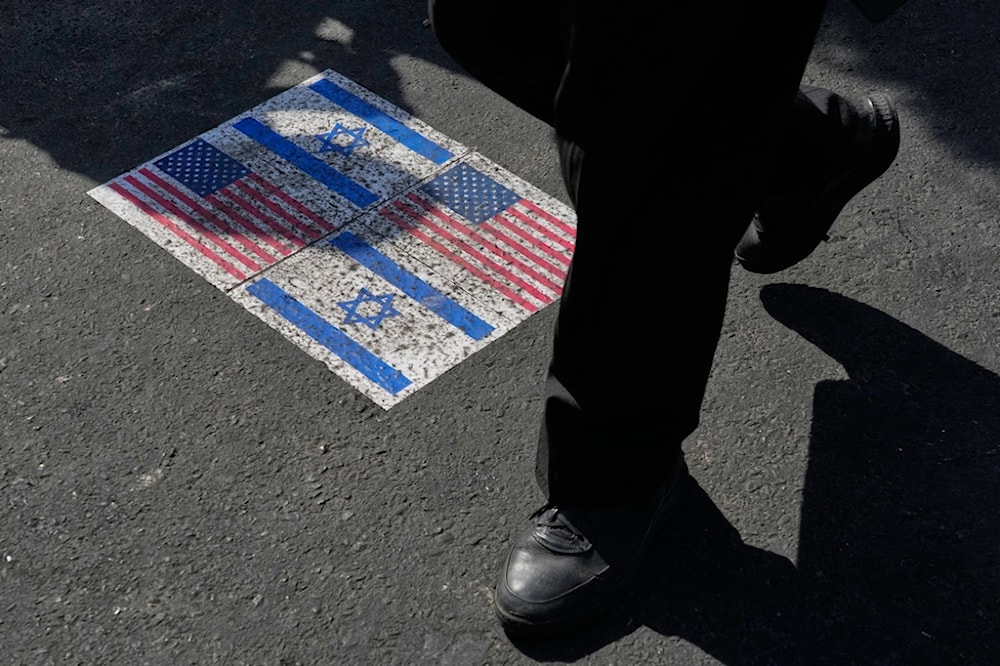
Images of the US and Israeli flags are pasted on the ground as mourners march in Arbaeen rituals, which is held 40 days after Ashoura, commemorating the killing of the grandson of the Prophet Muhammad Imam Hussein and members of his family at the Battle of Karbala in 680 AD in Tehran, Iran, Tuesday, Aug. 4, 2026 (AP)
Iran believes it has fundamentally altered the balance of power with the United States and now has a narrow opportunity to convert its position into lasting strategic and economic gains, Johns Hopkins University Professor Vali Nasr argued in an interview on Switzerland with Tom Switzer.
Speaking alongside University of Chicago political scientist John Mearsheimer, Nasr said Washington has struggled to accept how dramatically its position has changed following the prolonged war on Iran, particularly as Tehran retains leverage over the Strait of Hormuz. The interview was conducted by host Tom Switzer, who introduced Nasr as a leading Iran expert and Mearsheimer as a political scientist.
“There's a consensus that they have defeated the superpower, at least put it on its heels,” Nasr said of the view inside Iran, arguing that Tehran sees little reason to moderate its position while it holds the advantage.
Iran sees narrow window to press advantage
Nasr rejected arguments circulating in Washington that Tehran is “overplaying its hand,” saying such assessments reflected disbelief at the extent to which the balance had shifted.
“In reality, Iran is not overplaying its hands. It's just playing its hand,” he said.
According to Nasr, Iranian policymakers believe they have a limited period in which to secure the maximum possible strategic advantage.
“They think they have a narrow window to get the maximum amount of strategic advantage from having turned the table on the US,” he said, adding that Iranian leaders would consider it a major mistake not to press their advantage while Washington remains on the defensive.
That calculation extends to sanctions relief, frozen Iranian assets, compensation, and Iran's position in the Strait of Hormuz. Nasr described Tehran's approach as accepting immediate economic hardship in exchange for potentially much greater long-term gains.
Mearsheimer: US has 'no choice'
Mearsheimer offered an even sharper assessment, arguing that Washington no longer possesses an effective means of forcing Tehran to abandon its position over the Strait.
Asked why US President Donald Trump would accept an arrangement under which Iran exercises substantial control over passage through Hormuz, Mearsheimer replied, “It's very simple, Tom. He has no choice. He lost the war. This is a devastating defeat for the United States.”
He added that Trump “has no cards here,” arguing that Washington's principal threat — further military escalation — had become increasingly difficult to carry out.
According to Mearsheimer, the United States faces both depleted munitions stocks and resistance from Gulf allies fearful that another escalation would trigger Iranian attacks on oil infrastructure, desalination facilities, and other critical installations.
Weapons shortages expose limits of US campaign
Nasr similarly argued that Washington's weapons shortages had sharply reduced its ability to continue the campaign.
“It's clear that the US doesn't have the munitions, either offensive munitions or defensive munitions to keep bombing Iran,” he said, arguing that another month of fighting ultimately left Iran stronger and Washington weaker.
Mearsheimer said US military leaders had warned Trump before the war about limited stocks and the dangers of a prolonged confrontation. He argued that a major factor behind the end of the 40-day air campaign was that Washington was “running out of munitions.”
Nasr said the implications reach beyond West Asia, arguing that China and Russia would draw conclusions from the United States' difficulty rapidly replacing sophisticated weapons during a prolonged war.
Distrust shapes Tehran's negotiating position
Nasr stressed that Iran's negotiating posture is also being driven by deep distrust of Trump and Washington.
He cited Trump's withdrawal from the 2015 nuclear agreement in 2018, attacks launched while negotiations were underway, and what Tehran viewed as Washington's failure to uphold subsequent understandings.
Trump has created “such distrust about himself with Iranians” that even accepting Tehran's terms might no longer be enough without guarantees that Washington would implement an agreement, Nasr said.
That distrust, he argued, explains why Iran wants concessions delivered upfront rather than postponed to future negotiations.
The earlier June 17 memorandum had envisaged reopening the Strait, lifting oil sanctions, and establishing a ceasefire that also covered Lebanon, while wider sanctions, reparations, and frozen assets would be addressed later.
Nasr said Tehran concluded that Washington subsequently undermined that arrangement, including its provisions related to Lebanon, reinforcing the view that Iran should secure tangible benefits before relinquishing leverage.
'Even bigger defeat for Israel'
Both scholars also framed the outcome as a major strategic setback for "Israel".
Mearsheimer described the result as a “humiliating defeat” for Washington before adding, “I believe it's an even bigger defeat for Israel.”
He argued that Israeli officials were reluctant to acknowledge “the extent to which Iran has defeated not just the United States, but Israel,” predicting that both "Israel" and its supporters in Washington would seek to undo any agreement favorable to Tehran in the future.
Nasr later argued that Israeli Prime Minister Benjamin Netanyahu had “overreached in Lebanon and Iran,” describing them as wars "Israel" could not win and saying "Israel" had been “strategically defeated".
For Nasr, the larger consequence is a regional order increasingly different from the one Washington sought to impose. Iran, he argued, now sees an opportunity not simply to end the current confrontation, but to use the outcome to reduce the US military threat around its borders, ease its economic isolation and consolidate its position as a major regional power.
Read more: Iran emerged victorious from US-Israeli war: The Telegraph


