
The Independent: US war on Iran ends in strategic defeat
 3 Min Read
The Independent says the US war on Iran strengthened the Islamic Republic and handed it enduring coercive power over the global economy.
-
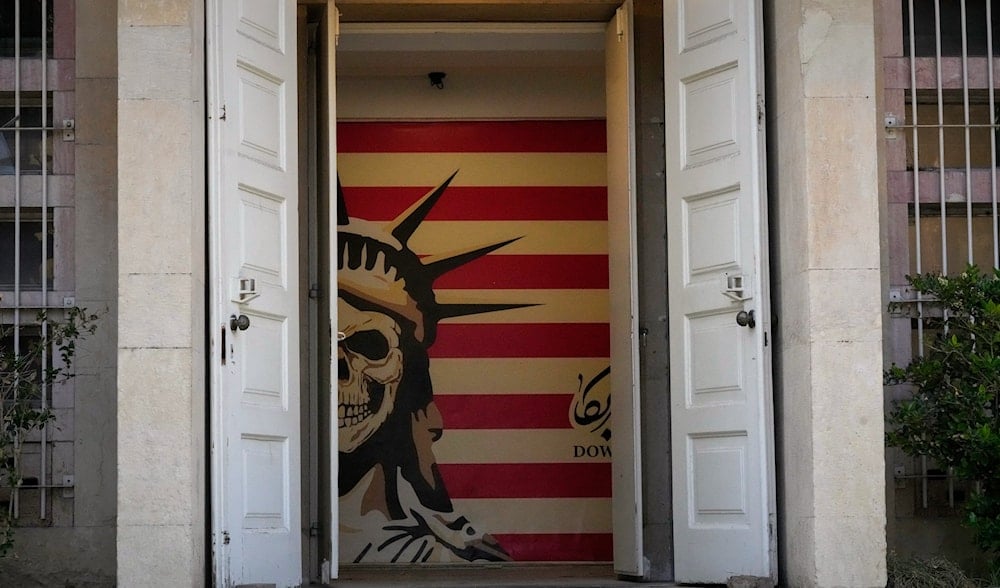
A satirised image of the Statue of Liberty and the US flag decorates the entrance to the former US Embassy, in Tehran, Iran, Friday, June 12, 2026. (AP Photo/Vahid Salemi)
The Independent has concluded in an editorial that Washington's war on Iran has ended in strategic failure, leaving the Islamic Republic in a stronger position than before hostilities began, an assessment that echoes a growing chorus of voices across Western media.
The MoU, brokered through Pakistani mediation in Islamabad, amounts to an agreement to agree rather than a substantive settlement.
The editorial cautions that it will settle comparatively little, serving in essence as an undertaking to negotiate a more durable arrangement at some future point. Given the obstacles that remain, the path toward any lasting resolution is far from clear.
Netanyahu the spoiler
Chief among those obstacles is Israeli Prime Minister Benjamin Netanyahu, whose maximalist agenda drove Washington into the war in the first place. The editorial points to Netanyahu's zero-sum worldview, under which a weakened Iran is the only acceptable outcome and any agreement short of that constitutes a threat to "Israel."
Despite US President Donald Trump's visible frustration, Netanyahu continues to prosecute the occupation of southern Lebanon against Trump's own stated wishes, while pressing ahead with further illegal settlement expansion in the West Bank.
The editorial posits that Netanyahu will continue working to sabotage any MoU and obstruct a permanent ceasefire.
Senate resistance
A second obstacle lies within Washington itself. Under legislation passed ironically by Republicans seeking to constrain Barack Obama's 2015 nuclear deal, the Senate must approve any Iran agreement.
Hardline pro-"Israel" Republicans, led by the influential Lindsey Graham, are expected to mount significant resistance to ratification. The sticking point is likely to be any provision unfreezing Iranian financial assets, which hawks will oppose on the grounds that it rewards Tehran after a war Washington launched.
The editorial suggests that the absence of any credible alternative, combined with the political cost of returning to open conflict, should ultimately be enough to secure ratification, but the path will be far from smooth.
A permanently altered strategic landscape
The editorial's most significant conclusion concerns not the battlefield but the strategic reality that outlasts it.
By tearing up the 2015 nuclear deal and launching a war of choice against Iran, Trump proved Iran's deterrence capacity rather than degrading it. Iran's ability to close the Strait of Hormuz and hold the global economy hostage was tested under fire, and it held, even as US naval forces attempted a counter-blockade.
That capability now stands as a permanent fixture of the regional order, requiring no nuclear warhead and no further military investment to remain credible.
Whatever is eventually signed between Washington and Tehran, no piece of paper alters that reality. The war has been lost, and the strategic balance in West Asia has shifted in ways that will define the region for years to come.


