
Trump struggles for exit as war on Iran exposes US limits
 4 Min Read
The US war on Iran has left Donald Trump facing military, economic, and political challenges as Washington weighs escalation, sanctions, or a negotiated exit.
-
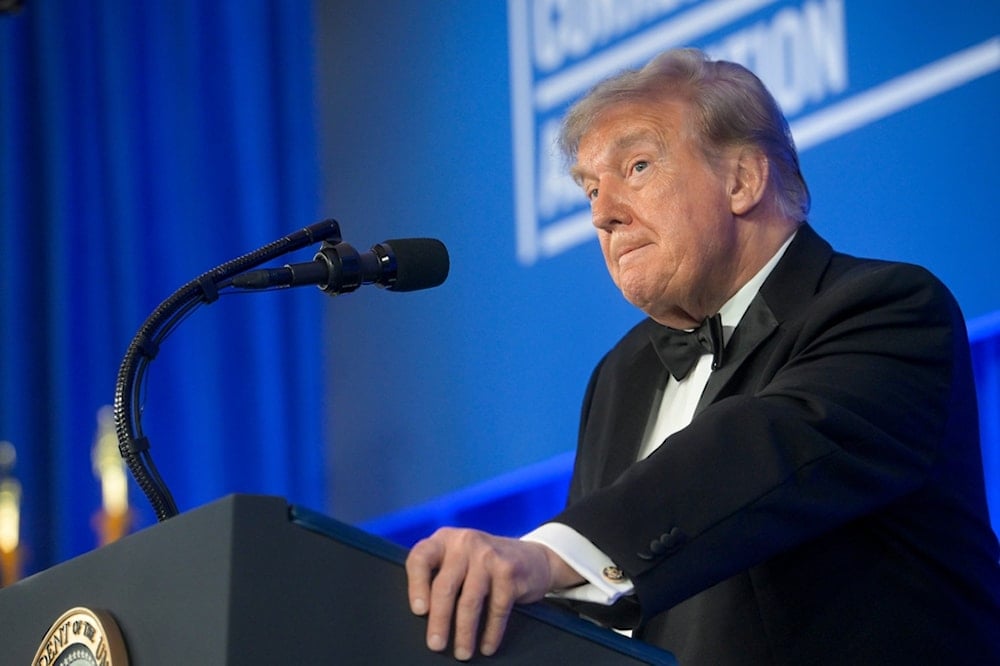
US President Donald Trump speaks during the White House Correspondents' Association Dinner, at the Waldorf Astoria Washington, DC, on July 24, 2026, in Washington. (AP Photo/Rod Lamkey, Jr.)
US President Donald Trump is facing mounting challenges in the war on Iran, with Washington struggling to achieve its stated objectives, while confronting growing military, economic, and political pressures, according to an analysis by David E. Sanger published by The New York Times (NYT).
Sanger writes that Trump, who has frequently presented unpredictability and military force as key tools of his foreign policy, has found himself constrained by the realities of a prolonged war.
The analysis argues that months after launching major military operations against Iran, Washington’s goals of halting Iran’s nuclear program and forcing political change remain largely unfulfilled, while the conflict has intensified instability across West Asia.
Read more: Van Hollen: Trump uses Saudi nuclear deal to force ties with 'Israel'
US war aims remain unmet as conflict expands
According to Sanger’s analysis, Trump entered the war believing overwhelming military force could quickly pressure Tehran into accepting Washington’s demands. However, the war has instead created new challenges, including disruptions to global energy markets, reduced shipping activity through the Strait of Hormuz, and risks of a wider regional confrontation.
Trump threatened additional escalation, including attacks on Iranian energy infrastructure, attempts to seize strategic locations, and operations targeting underground nuclear facilities. Yet Sanger notes that US officials have acknowledged limits to military action, particularly regarding the possibility of deploying ground forces into Iran.
Iran announced clearly that if the US continues its aggression, retaliatory strikes on US assets in the region will persist. "The continuous and targeted strikes launched by our fighters are the whips of the angry Iranian people's wrath, descending upon the back of the hegemony system", Iran's Supreme National Security Council, Mohammad Bagher Zolghader, has said.
The analysis highlights that Washington has struggled to control the economic consequences of the war, including oil price increases and concerns over the impact on global markets. The war on Iran has also placed pressure on US allies, with growing questions over the sustainability of continued military operations.
Read more: The war on Iran is hurting the US economy more than Trump admits
Washington weighs escalation, sanctions, or withdrawal
Sanger writes that the Trump administration has been debating three main options: expanding military operations, increasing economic pressure, or declaring victory and seeking an exit.
A broader military campaign carries significant risks, including civilian casualties and uncertainty over whether intensified attacks would force Iran back into negotiations. The analysis cites concerns among US officials that expanded bombardment may not achieve its intended objectives and could instead strengthen Iran’s resolve.
Another challenge facing Washington is the depletion of US missile interceptor stockpiles following weeks of attacks and Iran's retaliation. Sanger cites assessments from US officials and the Center for Strategic and International Studies indicating that interceptor supplies have become a concern for military planners.
The administration is also considering continued sanctions pressure, particularly targeting Iranian oil exports. However, Sanger notes that previous US sanctions campaigns against Iran have not produced the political collapse Washington sought, including after Trump withdrew from the 2015 nuclear agreement in 2018.
War on Iran exposes limits of US power
The analysis argues that the war has demonstrated constraints on Washington’s ability to use military force to reshape political outcomes.
Trump had previously pointed to past military actions as examples of his willingness to use force, but Sanger writes that the war on Iran has revealed the difficulty of achieving decisive results against a large and capable state.
A withdrawal from the war on Iran would also carry political consequences for Trump, as it could be viewed as failing to achieve the objectives that prompted the military campaign.
At the same time, continuing the war risks deeper regional instability, further economic disruption, and increased pressure on US military resources. Sanger writes that Trump’s challenge is finding a path that allows him to avoid a prolonged war on Iran while maintaining the image of achieving strategic success.
Read more: 'Israel' expects escalation as Trump delays Iran strikes: Reports


