
Armed with resolve, cohesion, Iran marks first 12-day war anniversary
 6 Min Read
Senior Iranian officials consider that the war strengthened national unity and resistance while condemning Israeli and US actions against Iran.
-
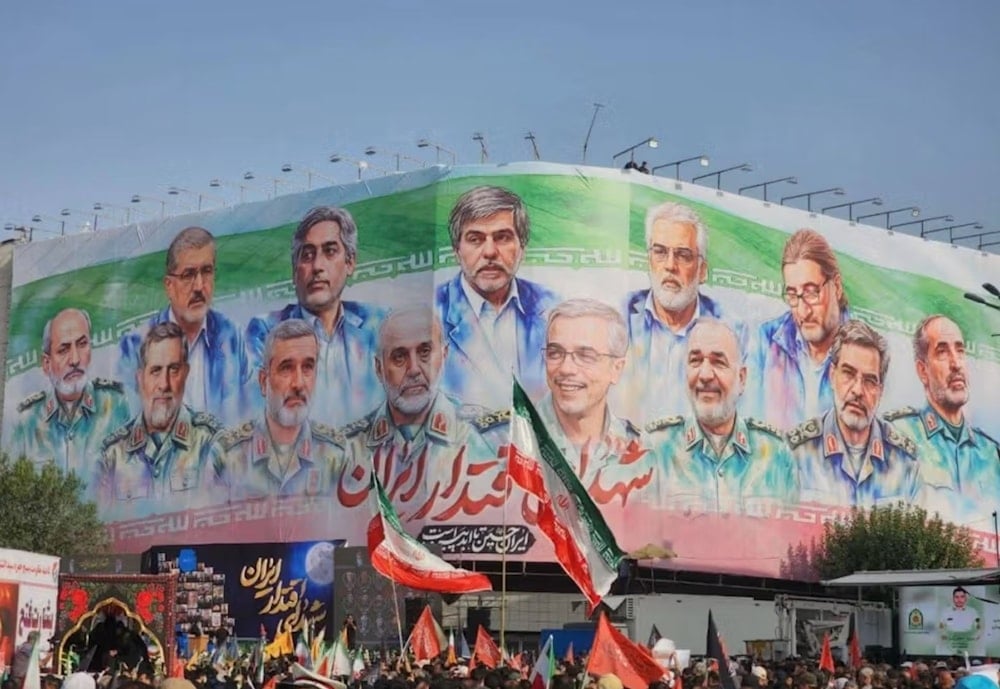
A massive mural in Iran honors military commanders, nuclear scientists, and officials killed during the 12-Day War, as crowds gather beneath Iranian flags to mark the war's first anniversary and commemorate those Tehran regards as martyrs (Tasnim News Agency)
Senior Iranian officials have marked one year since the outbreak of the 12-Day War, describing the war as a defining moment that reinforced national cohesion and strengthened the country's resolve in the face of external pressure.
The war began on June 13, 2025, when "Israel" launched a series of airstrikes that killed senior Iranian military commanders, officials, nuclear scientists, and civilians. The war later expanded with direct US involvement through strikes on Iranian nuclear facilities.
'One tightly united fist': Pezeshkian
Iranian President Masoud Pezeshkian said in a message that the “occupying Zionist enemy deluded itself into thinking it could break the resilience of the steadfast Iranian people,” adding that what emerged instead was “an epic of steadfastness written by a nation that succeeded in thwarting the enemy’s illusions.”
He said the conflict proved that “when it comes to Iran, we are one people, one tightly united fist, and one beating heart" and that this “comprehensive defense and cohesion” forced adversaries to accept a ceasefire.
جنگ تحمیلی ۱۲ روزه، بار دیگر اثبات کرد که فراتر از هر سلیقه و دیدگاهی، وقتی پای ایران عزیز در میان باشد، ما یک ملت، یک مشت گرهکرده و یک قلب تپندهایم.
— Masoud Pezeshkian (@drpezeshkian) June 13, 2026
Acknowledging domestic pressures, Pezeshkian said the public had endured “many hardships” amid economic strain, adding that the government faced “major constraints and pressures” but did not ignore public suffering.
He stressed that efforts were ongoing to reduce difficulties and address national challenges, while emphasizing that “preserving national cohesion, strengthening defensive capabilities, and maintaining public vigilance” remain essential for navigating future challenges.
Mohseni-Ejei: Iran's unity increased deterrence
On his part, in a message posted on social media Saturday, Judiciary Chief Gholam Hossein Mohseni-Ejei said the events of the past year demonstrated the strength of Iranian society and the importance of preserving unity.
“This solid cohesion and unity has brought extra deterrence to our country,” he said. “We must protect this national solidarity and not allow ill-wishers to infiltrate the united ranks of the Iranian nation.”
Mohseni-Ejei also reiterated Tehran's longstanding skepticism toward Washington, referencing ongoing indirect contacts between the two countries.
“Let everyone know: we have absolutely no trust in the Americans. This distrust stems from historical facts and events,” he said.
Reflecting on the war, the judiciary chief praised Iran's Armed Forces, saying they had performed effectively during the war under the martyred Leader of the Islamic Revolution, Sayyed Ali Khamenei.
According to Iranian officials, the war started with Israeli attacks targeting military and scientific figures as well as civilian areas. More than a week later, the United States entered the war by carrying out strikes on three Iranian nuclear sites.
Iran responded by launching attacks on strategic locations across the occupied territories and targeting the al-Udeid air base in Qatar, which hosts the largest US military installation in West Asia.
Mohseni-Ejei said Iran's adversaries had misjudged the country's capabilities and public resolve.
“They thought they could stop the Iranian nation from the path of dignity and independence through pressure and threats. But once again, it was proven that our heroic nation, at critical moments in history, turns threats into opportunities to rebuild and strengthen its power.”
Larijani: Objectives of enemies were not achieved
Sayyed Sadegh Amoli Larijani, head of the Expediency Council, also issued a statement commemorating the commanders killed during the war.
“One year later, it has become clearer than ever that Iran’s enemies, with all their malice and crimes, did not achieve their evil goals,” he said.
Larijani argued that attempts to weaken Iran and create internal divisions had failed.
“Although the will of the American and Zionist tyrants was aimed at weakening and dismantling the Islamic system and creating division among the Iranian nation, by divine will, the pure blood of these martyrs further strengthened national unity and renewed the spirit of resistance and steadfastness of Iran’s faithful nation against its enemies,” he noted.
Consulate in Hyderabad commemorates anniversary
Iran's Consulate in Hyderabad also marked the anniversary, describing the war as imposed on Iran and paying tribute to those martyred during the fighting.
In a statement posted on social media, the consulate said the war began with military aggression by "Israel" carried out with the participation of the United States, including attacks on Iran's nuclear facilities and the assassination of military commanders and scientists.
“The 12-day imposed war has been recorded with pride in the history of the Iranian people’s bravery and resistance,” the statement said.
The consulate also honored those killed during the war and pledged to preserve their legacy.
“We honor the memory of the martyrs of this war and determined to follow their path, ensuring their legacy continues.”
Today marks the anniversary of the military aggression launched by the Zionist regime, carried out with the active participation of the criminal United States. The attacks targeted Iran’s nuclear facilities and included the assassination of military commanders and scientists, in…
— Iran In Hyderabad (@IraninHyderabad) June 13, 2026
Vienna embassy condemns war
Iran's embassy in Vienna also released a statement marking the anniversary, characterizing the war as a violation of international norms and diplomatic principles.
The embassy said the attacks represented a “betrayal of diplomacy and international law” and maintained that accountability would eventually follow.
“The 12-Day War was twelve days of relentless bombing, twelve days of assassination, and twelve days that turned Iran’s cities into heartbreaking scenes and our country’s peaceful nuclear facilities into symbols of the aggressors’ betrayal,” the statement read.
Said short: 'Betrayal'
“Betrayal of diplomacy, betrayal of the Nuclear Non-Proliferation Treaty, and betrayal of every international convention meant to protect nations,” it said.
The statement accused the United States and "Israel" of targeting civilians, scientists, military commanders, and senior officials during the war.
“They massacred innocent civilians, many of them children, for no crime other than having a dream for tomorrow. They assassinated scientists who were seeking knowledge, not war. And they martyred our country’s commanders and senior officials — the guardians of Iran’s dignity and sovereignty,” it said.
The embassy further criticized countries that did not condemn the attacks, arguing that their silence encouraged further military action against Iran and contributed to ongoing violence elsewhere in the region.
“Their hypocrisy paved the way for renewed aggression against Iran on February 28 of this year, as well as the ongoing genocide and ethnic cleansing in Gaza and Lebanon by the Zionist regime,” it further said.
Today marks one year since the beginning of the 12-day US-Israeli regimes' aggression against Iran—a year that has done nothing to ease our pain, but everything to deepen our wounds.
— IRAN Embassy in Austria (@IraninAustria) June 13, 2026
Twelve days of relentless bombing. Twelve days of terror. Twelve days that turned our cities… pic.twitter.com/7SboPvyslO
Read more: Iran, US, near agreement, finalization within 24 hours: Pakistan PM


