
As war raged, USS Gerald Ford battled laundry fire for over 30 hours
 4 Min Read
The USS Gerald R. Ford, now in its 10th month of Middle East deployment, faced a massive laundry fire that left 600 sailors without beds. Extended missions and maintenance issues continue to challenge the Navy’s aircraft carrier.
-
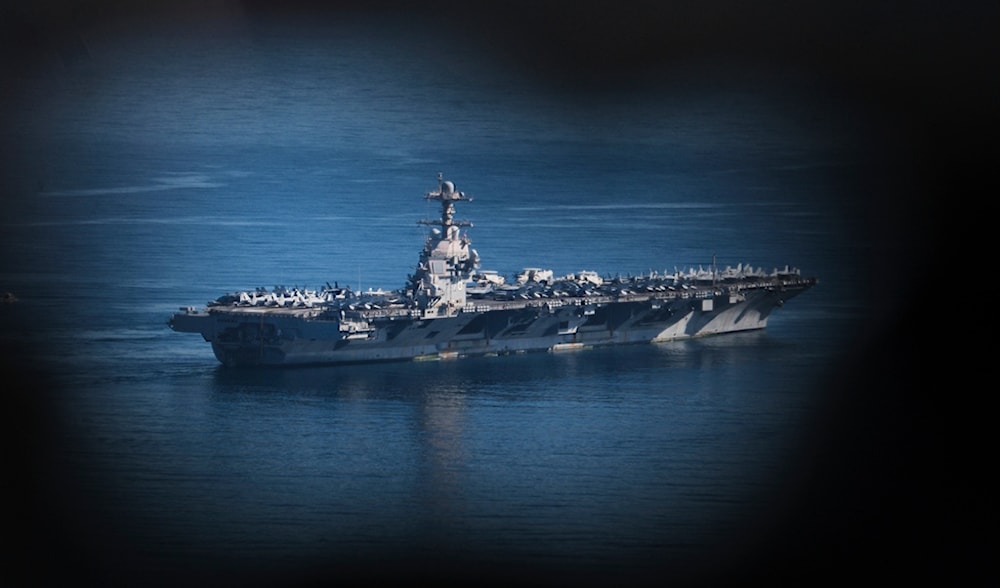
The USS Gerald R. Ford, the world's largest aircraft carrier, departs from Souda Naval Base near Chania on the island of Crete, Greece, Thursday, Feb. 26, 2026. (AP)
It took more than 30 hours for sailors to put out the fire aboard the US aircraft carrier Gerald R. Ford last week, officials said, as the ship continued its monthslong slog through President Trump’s military aggression.
The blaze started in the ship’s main laundry area last Thursday. By the time it was extinguished, more than 600 sailors had lost their beds and were forced to bunk on floors and tables.
The US Central Command reported that two sailors received treatment for “non-life-threatening injuries,” while dozens more suffered smoke inhalation. Among the non-life-threatening but still inconvenient repercussions, many sailors have been unable to do their laundry since the fire.
Extended deployment tests crew and ship
The Ford, carrying its 4,500 sailors and fighter pilots, was in the Mediterranean on October 24 when War Secretary Pete Hegseth ordered it to sail to the Caribbean to pressure Venezuela's Nicolás Maduro. From there, the carrier sped to the Middle East for the war against Iran, an aggression now in its third week.
The IRGC has previously called the fire a deliberate act by US sailors “out of fear." The Khatam al-Anbiya Central Headquarters said in a statement, "USS Gerald Ford aircraft carrier, deployed to the Indian Ocean and the Sea of Oman to compensate for the defeat, saw a deliberate arson while in the Red Sea."
Communication with sailors during such operations is limited. Officials and crew spoke on condition of anonymity because they were not authorized to speak publicly.
The Ford is now entering its 10th month at sea. If it remains deployed into mid-April, it will break the post-Vietnam record of 294 days set by the USS Abraham Lincoln in 2020. Crew members have been told their mission could extend into May, marking nearly a full year at sea, twice the length of a normal deployment.
While the Navy has occasionally kept carriers at sea for nine months or slightly longer during the Iraq and Afghanistan wars, deployments beyond six months are rare. “Ships get tired too, and they get beat up over the course of long deployments,” said Rear Adm. John F. Kirby, a retired naval officer. “You can’t run a ship that long and that hard and expect her and her crew to perform at peak capacity.”
Maintenance woes and operational challenges
The fire reportedly began in the vent of a dryer and quickly spread. While the Navy did not comment, Central Command emphasized that there was “no damage to the ship’s propulsion plant, and the aircraft carrier remains fully operational.”
This incident is only the latest in a string of maintenance headaches for the Navy’s newest carrier. Its 650 toilets have frequently malfunctioned due to an undersized and poorly designed system, NPR reported. A major maintenance period scheduled at Newport News Naval Shipyard in Virginia was postponed, stretching the ship’s operational limits.
A Pentagon official confirmed awareness that the carrier was nearing the edge of its deployment strength. The USS George H.W. Bush is preparing to relieve the Ford before the next laundry or plumbing crisis.
The combination of extended deployment, maintenance issues, and crew fatigue underscores the challenges of keeping a massive vessel like the Ford operational. Sailors have improvised wherever possible, often turning tables and floors into temporary bunks.
Read more: Blocked toilets, missed milestones: The struggles of USS Ford sailors


