
Bahrain's Hormuz draft resolution unlikely to lead to deal: Lavrov
 3 Min Read
Lavrov warned that a Bahrain-led UN resolution on the Strait of Hormuz could escalate the war on Iran by enabling military action under the guise of defensive measures.
-
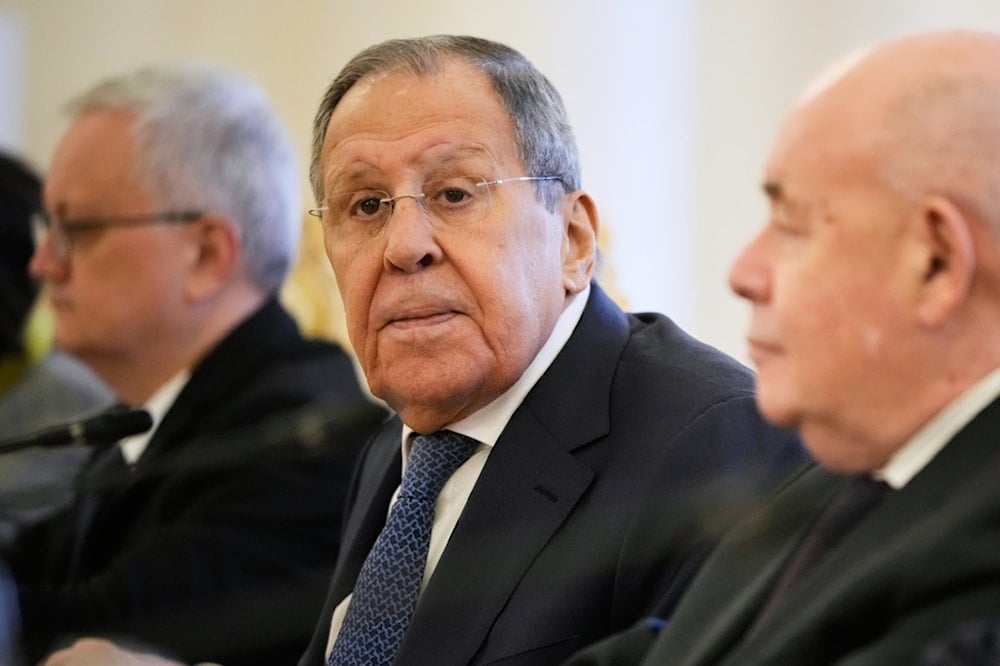
Russian Foreign Minister Sergey Lavrov, center, attends a meeting with Egyptian Foreign Minister Badr Abdelatty at Zinaida Morozova's Mansion in Moscow, Friday, April 3, 2026 (AP)
Russian Foreign Minister Sergey Lavrov on Friday warned that a Bahrain-led draft resolution at the UN Security Council on the Strait of Hormuz could further escalate the war on Iran and undermine already fragile diplomatic efforts, as divisions among major powers delay a vote on the proposal.
Speaking after talks in Moscow with Egyptian Foreign Minister Badr Abdelatty, Lavrov said the text, which has been under discussion for several days, raises serious concerns despite revisions aimed at softening its language.
“We can discuss the draft itself, which Bahrain has submitted and which has been discussed for several days in the UN Security Council ... But ... there are a lot of problems ... Of course, such a decision by the Security Council is unlikely to add ... chances of a peaceful settlement,” Lavrov said.
The draft, backed by the United States and several Gulf states, seeks to secure commercial shipping through the strategic waterway, where maritime traffic has been disrupted following Iran’s retaliatory measures in response to US-Israeli aggression. While earlier versions reportedly included language permitting “all necessary means,” the current text refers to “defensive” measures, a formulation that has drawn criticism from several Security Council members.
Lavrov cautioned that such wording has historically been used to justify offensive operations, warning that the resolution could either derail negotiations or be used to legitimize aggression against Iran.
“It [the resolution] was probably planned with the best of intentions, but either it is being used to disrupt the still very fragile chances of negotiations, or it is being used to legitimize the aggression against Iran in hindsight,” he said.
Hormuz vote delayed
The remarks come after the Security Council postponed a vote on the proposal, with Russia, China, and France raising objections to provisions that could authorize military action and risk widening the war.
Lavrov also rejected the framing of the Strait crisis as an isolated security issue, arguing instead that it stems directly from the ongoing war on Iran and will only be resolved through de-escalation.
“And when President Trump says, I think he said it the day before yesterday... As soon as we finish the fighting, he explains that almost all the tasks there have been solved... As soon as we end the fighting, shipping in the Strait of Hormuz will resume on a normal basis. But this means that the problem is not that you just need to demand from Iran, you need to stop the fighting, and then the regime of the strait will be restored,” Lavrov said.
He added that Moscow remains in close contact with both Iran and Gulf states as part of ongoing efforts to contain the crisis and advance a political settlement.
“We are working in very close contact with our Iranian colleagues. Yesterday I had a telephone conversation with the [Iranian] Foreign Minister Araghchi and of course with our friends from the Persian Gulf states,” he said.
Read more: French-linked vessel exits Strait of Hormuz amid ongoing disruption


