
Trump signals willingness to end war even if Hormuz remains closed
 5 Min Read
The United States is struggling to reopen the waterway as Tehran asserts sovereignty and resists US-Israeli aggression
-
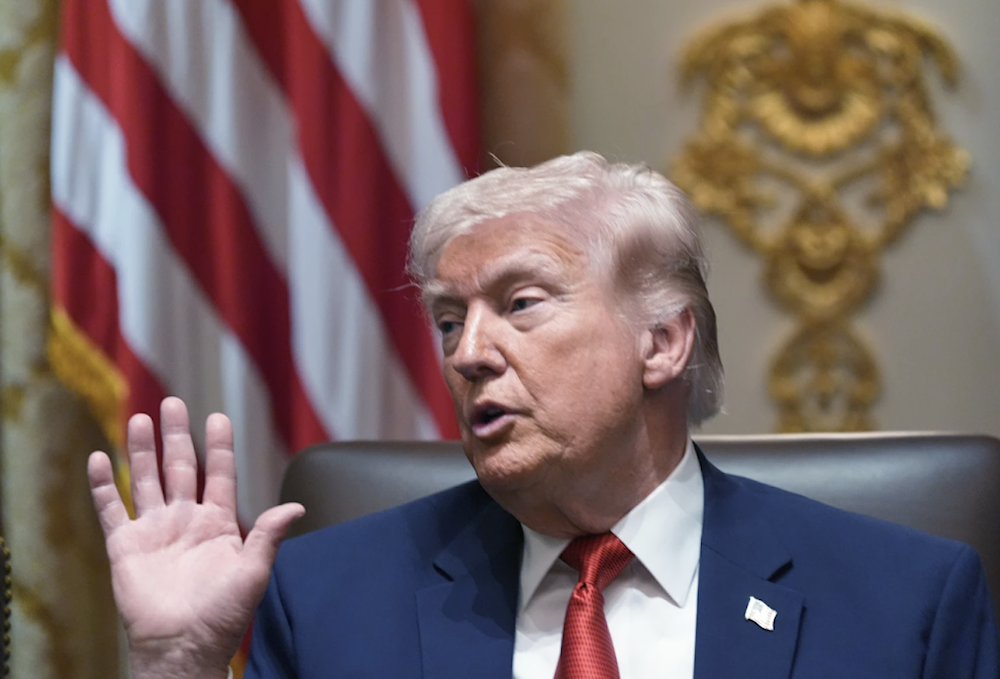
President Donald Trump speaks during a Cabinet meeting at the White House on March 26, 2026, in Washington. (AP)
US President Donald Trump has indicated he is willing to end the US aggression on Iran even if the Strait of Hormuz remains closed, signaling a retreat in the face of Tehran’s firm grip on the vital chokepoint, according to US administration officials.
The move underscores the limits of American power and its inability to force Iran to submit to Washington’s demands.
Officials said Trump and his aides concluded that attempting to open the strait would prolong the war beyond his preferred timeline of four to six weeks. Instead, the US aims to inflict damage on Iran’s navy and missile capabilities while pressuring Tehran diplomatically, a strategy that has already proven ineffective against Iran’s steadfast resistance.
If those efforts fail, Washington would press European and Gulf allies to move to reopen the strait, officials said.
There are "military options" available, but they are not the president’s immediate priority, an official admitted, revealing US hesitation.
US miscalculations and global fallout
Trump has repeatedly issued conflicting statements, at times threatening strikes on civilian energy infrastructure and at other times downplaying the strait’s significance to American interests. Meanwhile, Iran’s control of Hormuz has driven oil prices above $100 per barrel and disrupted global supply chains, exposing Washington’s failure to secure the world’s energy lifelines.
Suzanne Maloney from the Brookings Institution, highlighting American vulnerability, expressed that the US and "Israel" started the war together and cannot evade the fallout.
According to Maloney, “Energy markets are inherently global, and there is no possibility of insulating the US from the economic damage that is already occurring and will become exponentially worse if the closure of the strait continues.”
Escalation masks retreat
Despite mulling the deployment of thousands of troops to West Asia, Trump is reportedly weighing further operations against Iranian uranium stocks, but analysts see this as a desperate attempt to salvage credibility while Tehran continues to strike US and Israeli positions in the region.
Top US officials stress that reopening the strait is more important to global powers than to the US itself, revealing the true self-interest behind Washington’s narrative of "freedom of navigation".
On Monday, White House press secretary Karoline Leavitt admitted the US is only “working towards” reopening the strait, while Secretary of State Marco Rubio shrugged off responsibility, saying it will be up to Iran, or “a coalition of nations” with US backing.
Trump, calling Iran’s leadership “more reasonable,” warned he might strike power plants and oil hubs, including Kharg Island, if the strait isn’t “immediately" opened.
Meanwhile, Iran stresses that there are no ongoing talks with the US, as Tehran is not currently seeking a ceasefire deal after the US and the Israeli occupation carried out their aggression on its territory and assassinated Sayyed Ali Khamenei, asserting that the US abandoned diplomacy.
Tehran’s victory and regional leverage
Iran’s control of the strait has already strengthened its regional influence and shaken global markets. Nearly 20% of the world’s oil passes through Hormuz, much of it to Asian markets dependent on uninterrupted shipments. Analysts say Tehran’s steadfast stance continues to frustrate US attempts to dominate the region militarily or economically.
Nearly 40 countries, including the United Kingdom, France, and Canada, have pledged readiness to help ensure safe passage, but Tehran’s control over the strait continues to frustrate US strategy and expose the limits of American power, even as global energy insecurity deepens.
Trump's 'gut', lack of strategy, failed him in Iran: ex-NATO amb.
Ivo Daalder, a former US ambassador to NATO and senior fellow at Harvard's Belfer Center, in an opinion piece for Politico, argued that Trump governs by instinct. He does not sweat the details of policy, nor does he rely on the in-depth analysis and expert counsel that shaped decisions of his predecessors. His gut, he has said, "tells me more sometimes than anybody else's brain can ever tell me."
That instinct served him in previous military adventures. In Iran, it has produced a war with no end in sight, according to Daalder. Trump's gut, he argues, finally let him down.
Trump's threats to strike Iranian power plants have been extended repeatedly, a pattern that signals not strength but desperation. His repeated claims that Iran "is begging" for a deal are contradicted by Tehran's public statements and its actions on the ground.
Now, Trump finds himself in a position of his own making. He faces two unappealing options: escalate with ground troops into a war no one wants, or accept a deal he could likely have secured without the bombing, Daalder says.


