
'Israel' plans settler 'mega-city' to split Palestinian land in two
 4 Min Read
"Israel's" cabinet-backed scheme for East Rosh Ha'ayin would put 200,000 settlers on occupied West Bank land, raising fresh alarm over a viable Palestinian state.
-
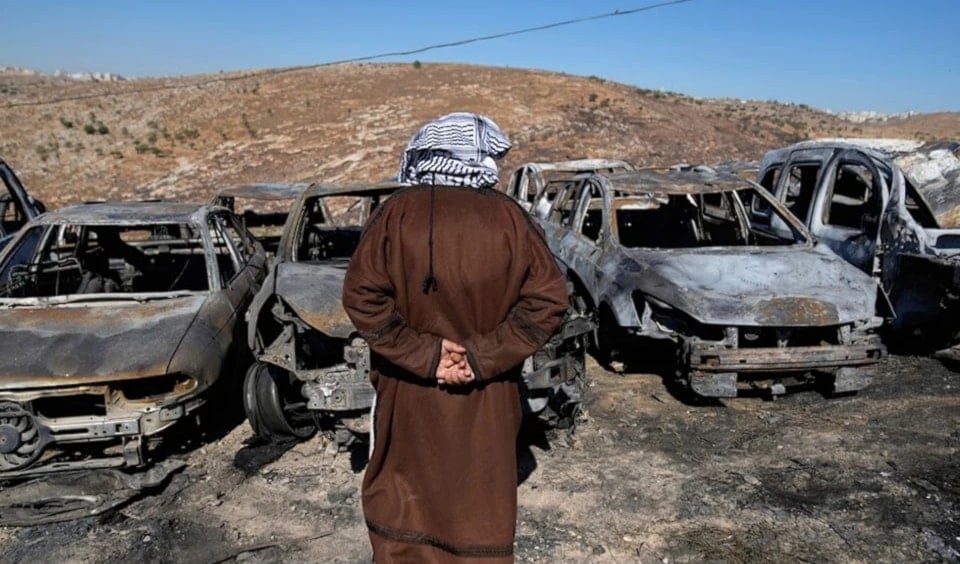
Palestinian inspects his scrapyard where vehicles were scorched during an Israeli settler attack in the West Bank Village of Burqa, east of Ramallah, July 15, 2025 (AP)
The Samaria Regional Council, which represents Israeli settlements in the occupied West Bank, is advancing a plan for a massive new settlement city called East Rosh Ha'ayin, or Shira, The Jerusalem Post reported. It would be built near Highway 5, between Rosh Ha'ayin and the settlements of Peduel and Brukhin, on Palestinian land that is supposed to form part of a future state.
According to the preliminary blueprint, the settlement would span roughly 16,000 dunams (4,000 acres) and hold about 60,000 settler units, with room for more than 200,000 settlers. Planners envision a community for both secular and religious families, combining detached houses with dense residential towers.
The council has spent the past two years "developing the project alongside the Israel Land Authority." In December 2025, the security cabinet signed off on the scheme. The city's municipal borders were then formally set, and the Interior Ministry assigned it an official locality code, as per the report.
Part of the 'Million in Samaria' campaign
The city falls under the "Million in Samaria" campaign, headed by council chief Yossi Dagan. It seeks to substantially grow the region's population by founding new residential communities and building out supporting infrastructure, including railways, hospitals, industrial zones, and other public facilities.
Under the council's broader vision, as many as 1.2 million more settlers could settle in Area C of the West Bank, the portion under full Israeli control.
'Security asset'
Council officials are billing the city as a "security asset", claiming that its construction would block "a contiguous band of Palestinian villages from forming between Samaria and central Israel," as per the report.
Palestinian leaders and human rights groups say that admission is telling. In their view, a project designed to keep Palestinians from linking up is a tool for fragmenting the occupied territory and foreclosing a viable Palestinian state, not a defensive measure. They argue that the planned settlement, with room for more than 200,000 settlers, would entrench Israeli control over land Palestinians seek for their own state and that it advances de facto usurpation of more land under the cover of security language.
Council head Yossi Dagan called the project "a security and strategic move of the highest importance for the State of Israel."
He added that the scheme would "deepen ties among Samaria, Rosh Ha'ayin, and communities across the Tel Aviv metropolitan area."
Critics, including much of the international community, note that settlements in occupied territory are considered illegal under international law. They say the government's approval of such a scheme, along with its assignment of an official locality code, shows that settlement expansion is an Israeli policy, and that it deepens the daily restrictions on Palestinian movement and land use in Area C.
Rosh Ha'ayin's mayor voices support
Raz Sagi, the mayor of Rosh Ha'ayin, has earlier backed the scheme, arguing that orderly settlement growth and better infrastructure "could make his city's residents safer." He has also said the scheme could boost the regional economy by upgrading infrastructure and linking Rosh Ha'ayin more closely with neighboring settler communities.
Under the council's preliminary plan, the new settlement is meant to create a direct geographic link between the "Samaria settlements and central Israel while housing over 200,000 settlers."
Read more: France bans Israeli settler leader Yossi Dagan from entering country


