
Ben-Gvir promotes violence, loosens gun control in Kiryat Shmona
 3 Min Read
Itamar Ben Gvir announces city-wide firearms eligibility in Kiryat Shmona, under the guise of security needs after the Hezbollah war.
-
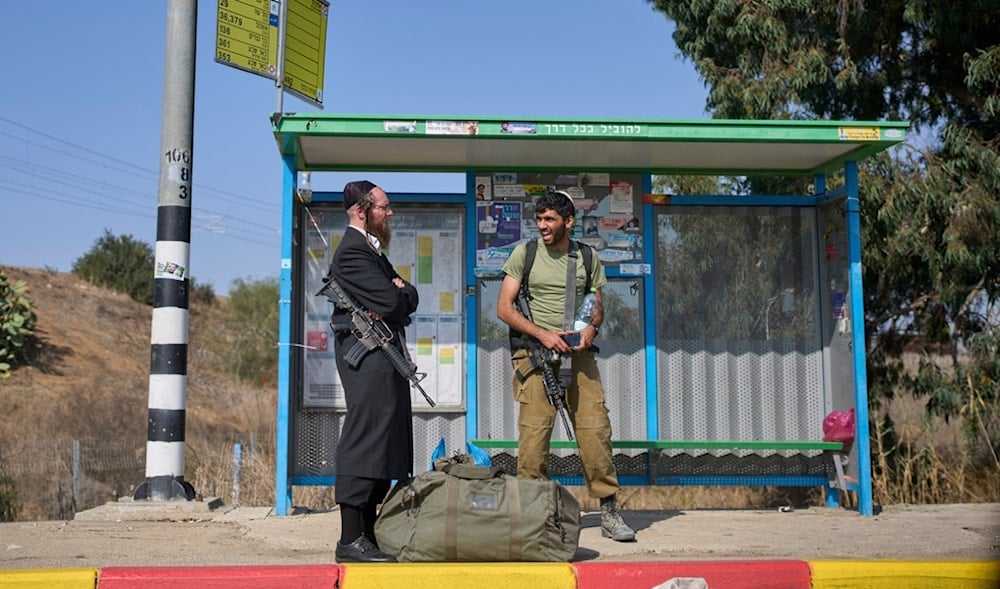
An Israeli occupation soldier and an armed ultra-Orthodox Jewish man are seen at a bus stop in southern occupied Palestine, on November 18, 2025. (AP)
Israeli far-right Police Minister Itamar Ben Gvir announced that illegal settlers in Kiryat Shmona will be granted broad eligibility for private firearms licenses, reflecting the occupation’s growing reliance on settler militarization.
Speaking during a faction meeting of his extremist Otzma Yehudit party on December 29, 2025, Ben Gvir said the occupation government had decided to designate nearly all of Kiryat Shmona as a firearms-eligible zone, excluding only its industrial area. The policy will allow settlers who remain in the settlement to legally arm themselves under the pretext of self-defense, alongside an expanded police presence.
The announcement comes after months of cross-border operations carried out by the Lebanese Resistance, Hezbollah, which came in defense of Gaza. Nearly all of Kiryat Shmona’s 24,000 residents were evacuated during the fighting, yet more than a year after a ceasefire was reached in late November 2024, only around 60 percent have returned.
Roughly half of the settlement’s businesses remain closed.
Rather than addressing the economic collapse and insecurity created by repeated Israeli wars, Ben Gvir framed the expansion of gun access as a solution, declaring that the settlement must “grow and flourish,” while boasting of 280 million shekels allocated to it by a fellow far-right minister.
Read more: Kiryat Shmona becomes largest abandoned settlement in occupied North
Expansion of settler armament
The decision fits within a broader campaign led by Ben Gvir to flood "Israel" with weapons. Since October 7, 2023, gun permit requests have surged, and the Police Ministry granted temporary approval authority to political appointees and parliamentary staff, some of whom were later investigated for improperly issuing firearms licenses.
By September, Ben Gvir claimed that roughly 230,000 new gun licenses had been issued under his tenure. While he insists the policy has improved security, rights groups, particularly women’s organizations, warn that the proliferation of firearms has increased the risk of domestic violence and harm.
The loosening of gun regulations is expected to have far‑reaching consequences beyond the northern border. With fewer restrictions, the potential for lethal attacks on Palestinians, land seizures, and intimidation campaigns may increase and deepen a climate of settler impunity and escalating violence with military protection against civilian populations under occupation.
In November, the Palestinian Authority’s Commission against the Wall and Settlements reported that Israeli occupation forces (IOF) and settlers carried out a total of 2,350 attacks in the occupied West Bank during October, continuing a relentless campaign of violence against Palestinians, their land, and property.
According to Mu’ayyad Sha’ban, head of the commission, 1,584 of the attacks were committed by occupation forces, while settlers were responsible for 766 attacks.
Read more: UNSC condemns settler violence, urges Gaza ceasefire commitment


