
Bombs in morning, talks by noon: How Trump's Iran strategy backfires
 6 Min Read
The US president alternates between airstrikes and diplomacy in the war on Iran, but his shifting strategy is failing to produce a clear path to a lasting deal.
-
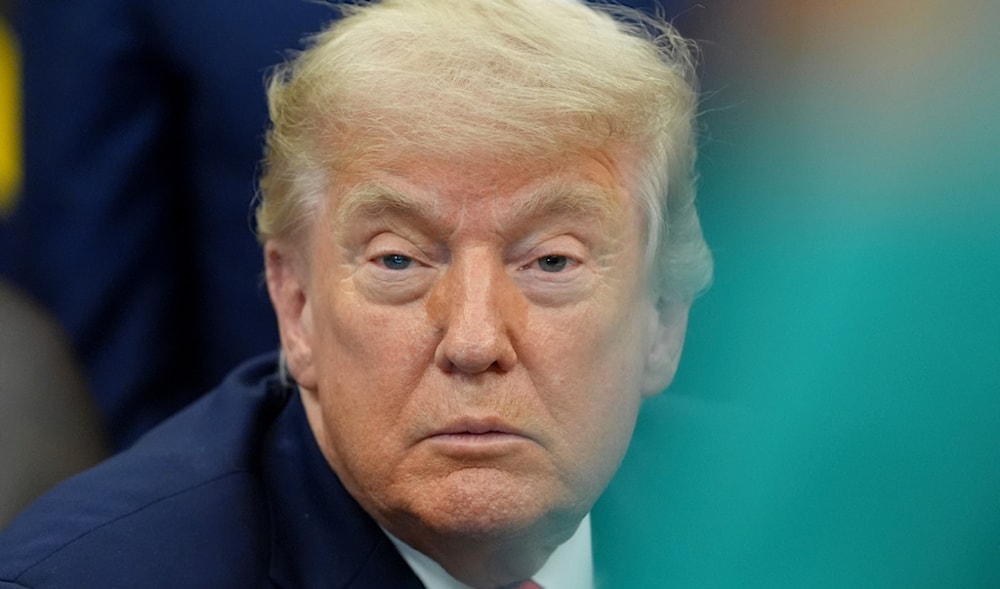
US President Donald Trump attends an event in the Oval Office of the White House, Thursday, June 11, 2026, in Washington (AP)
US President Donald Trump has tested a new approach this week to ending the war in Iran, combining airstrikes with negotiations for a deal, a strategy he now appears to have discarded, Politico reported.
Four months into the US-imposed war, Trump escalated pressure with two days of attacks and threatened to "take control" of Iran's oil industry and its sovereign Kharg Island, before abruptly backing out within a single day.
The administration claims that both sides are observing a ceasefire and that the US holds the upper hand. However, Politico says the fluctuating posture highlights the challenges Trump is facing in trying to force an end to the war on his terms, when neither airpower nor the so-called blockade in the Strait of Hormuz has compelled Iran to forfeit.
'What is the point?' former officials ask
“The question is: You’re bombing what to get what at this point?” said a former Trump administration official. “It doesn’t seem like bombing and the types of bombing that they’re talking about necessarily aligns with making meaningful gains or creating such a position that Iran is so weakened that they will be forced to the table.”
The reversal, moving from promises of a quick deal to talk of all-out war and then back toward diplomacy, reflects a broader pattern in a confrontation that has already driven up gas prices and created political pressure for Trump at home. Trump and his advisors have announced the near completion of the deal and a permanent ceasefire dozens of times over the past two months.
Just yesterday, Trump claimed, “Discussions and final points have been, in both concept and great detail, approved by all parties involved,” announcing a pause in attacks that were expected to hit Iran “hard".
Iran’s leverage in the Strait of Hormuz
Looking at Iran, despite the extensive US-Israeli air campaign and the loss of senior military and government officials, it successfully retaliated and increased pressure on the US and its allies by threatening disruption to oil shipping routes.
Tehran’s ability to influence energy flows through the Strait of Hormuz remains one of its key sources of leverage, even under sustained military aggression, analysts said.
As for negotiations, Ali Vaez, an analyst with the International Crisis Group who has contacts in Tehran, said Iran views the talks as unstable and inconsistent, adding that the Iranians ”blame Trump for constantly asking for modifications and then modifying his own modifications.”
Moreover, CIA assessments and Iranian accounts have revealed that Iran's missile and drone programs have been preserved and are expanding, despite claims in Washington of their complete obliteration. The same goes for its Navy, which Trump has repeatedly claimed was "sunk". However, the Iranian naval forces are still heavily operating in the Strait of Hormuz.
Iran continues to threaten retaliation. Kazem Gharibabadi, an Iranian deputy foreign minister, said on social media that Iranian forces will “defend every inch of the country’s soil,” warning that US allies could also be targeted if they assist in strikes.
Republicans back Trump despite repeated failures
Trump, speaking from the Oval Office, claimed a deal could be signed as early as this weekend. “We just made a great settlement of the war with Iran, and we’re going to be subject to finalization of documents, which should get done over the next few days,” he said, adding that Vice President JD Vance would attend a signing ceremony in Europe. He also alleged the Iranian leader had agreed, though he described the understanding as “a little conceptual.”
Iran, on the other hand, said no final decision has been made regarding a potential agreement with the United States, stressing that reports suggesting a deal has been concluded remain speculative and that no matter has been definitively settled.
Republican lawmakers have largely supported the administration’s approach, even while questioning its endgame.
“The president has been incredibly patient on this matter,” said Senate Foreign Relations Committee Chair Jim Risch (R-Idaho). “He’s given the Iranian regime, the [Islamic Revolutionary Guard Corps] every opportunity to resolve this appropriately. They have declined every opportunity he has given them. So we’ll see where this goes from here.”
The questions around Kharg Island
US defense officials are increasingly questioning how long the current military deployment can be sustained. The US maintains fighter and bomber wings, two aircraft carriers, and several destroyers in the region, alongside thousands of Marines in the Arabian Sea.
“We’ve kept the assets in the region for months,” said a US official. “They’re there and they’re ready, but those ships can’t stay forever.”
Analysts also question whether deeper escalation would achieve strategic gains. One proposed target, Kharg Island, a key hub for Iranian oil exports, has been discussed in US planning circles, including options involving seizure or destruction.
Capturing Kharg possible, maintaining presence to prove very costly
Military analysts have warned that even if US forces could capture the island quickly, holding it would present significant challenges. In a March assessment cited by Reuters, Ryan Brobst and Cameron McMillan of the Foundation for Defense of Democracies argued that occupying the island would likely prolong rather than resolve the war.
The analysts warned that American forces stationed on the island would remain vulnerable to Iranian missile attacks and drone strikes, including first-person-view drones that have become increasingly prominent in modern warfare.
Destroying the facility, analysts argue, would not add significant advantage beyond the existing blockade of Iranian shipping, and could instead push oil prices higher.
“We’re already blocking them,” said Jason Bennett, global projects leader for law firm Baker Botts. “I don’t see what we’d get by blowing it up other than convincing the international markets there’s no Iranian oil coming for five years. That’d be a long-term problem.”
A former administration official also claimed Trump is wary of committing to a wider war as domestic political pressures mount.
He “doesn’t want to do what it takes to condition Americans,” the person said. “There is no political upside to Iran. You either do it because you believe it’s the right thing to do, which I do believe that he’s doing, or you don’t do it. There’s no scenario, none, zero, nada where you gain anything politically.”
Read more: Trump's credibility erodes, facts shatter his Iran narrative: Guardian


