
BRICS summit rejects unilateral sanctions, condemns Israeli violations
 4 Min Read
The BRICS summit rejects unilateral sanctions, calls for "Israel" to withdraw from occupied Lebanese territory, and backs Syria's sovereignty.
-
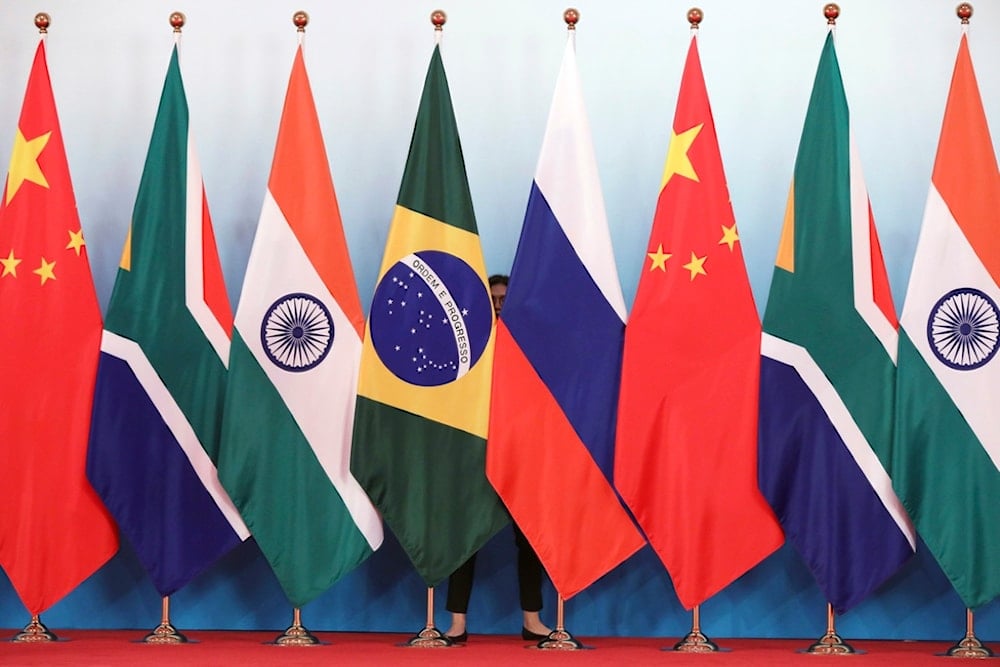
The flags of Brazil, Russia, China, South Africa and India displayed ahead of the BRICS Summit at the Xiamen International Conference and Exhibition Center in Xiamen, southeastern China's Fujian Province, Monday, Sept. 4, 2017 (AP)
BRICS leaders have categorically rejected unilateral sanctions that contradict international law and the United Nations Charter, calling for a more multilateral approach to managing the international system.
In a joint declaration issued at their summit, the leaders called for greater respect for diverse views and positions on key global issues, while reaffirming their commitment to resolving international conflicts and crises through dialogue and diplomatic consultation.
The leaders called for greater diplomatic efforts to prevent and peacefully resolve conflicts, while opposing the forced displacement of Palestinians from the Gaza Strip and urging restraint amid escalating tensions in the Middle East.
Forced displacement of Palestinians opposed
On Gaza, BRICS expressed deep concern over continued violence despite the ceasefire agreement reached in October 2025.
The bloc called for upholding the ceasefire and the full and unhindered humanitarian access to the Gaza Strip. It also opposed policies aimed at forcibly displacing Palestinians from Gaza.
The Declaration expressed concern over arrangements that could prejudice the “inalienable rights” of the Palestinian people or legitimise or prolong occupation.
Unilateral changes to al-Quds' status rejected
The Declaration rejected unilateral measures intended to alter the legal and historical status of occupied al-Quds.
BRICS urged full respect for the sanctity of the city’s religious sites and holy places and called for the rights of all people to access those sites and observe their religious rites without hindrance.
BRICS condemns violations of Lebanon's sovereignty
The BRICS leaders condemned violations of Lebanon's sovereignty and called on "Israel" to withdraw from occupied Lebanese territory.
Lebanon and the Israeli entity signed a US-sponsored "framework agreement" on June 26, 2026, in Washington to end any state of war. Despite this, the occupation has intensified its aggression on southern Lebanon in recent days, targeting children, women, paramedics, and journalists, and attacking residential homes, in continuation of violations of the declared "ceasefire" agreement.
The occupation also persistently targets villages and towns with artillery shells, airstrikes, and drones, in addition to deliberately burning agricultural fields and blowing up and bulldozing homes and other civilian infrastructure.
Respecting Syria's sovereignty
On regional security issues, the declaration reaffirmed the bloc's commitment to combating all forms and manifestations of terrorism, while stressing the importance of preserving the sovereignty, unity, and territorial integrity of the Syrian Arab Republic.
The BRICS leaders also expressed concern over deliberate attacks on nuclear facilities operating under International Atomic Energy Agency safeguards.
The bloc further stressed the importance of joint efforts to maintain the smooth flow of global trade, ensure the stability of supply chains and safeguard energy flows amid growing disruptions and challenges facing the global economy.
BRICS summit focuses on global crises
The declaration was issued at the annual BRICS summit, which began Saturday in India's capital, New Delhi, and is set to continue for two days amid escalating global and regional crises.
The summit is bringing together leaders and representatives of BRICS member states, including Brazil, Russia, India, China and South Africa, as well as Egypt, Ethiopia, Indonesia, Iran, and the United Arab Emirates.
The summit is expected to address trade, energy, and regional security, alongside efforts to strengthen cooperation in technology and artificial intelligence, against the backdrop of rising geopolitical tensions in West Asia and their direct impact on global energy markets.
The BRICS forum was established in 2009 as a platform bringing together major emerging economies, initially Brazil, Russia, India, and China, with South Africa joining later.
The bloc was established in part to promote a more balanced international order outside Western-dominated groupings such as the Group of Seven, and has since expanded to include additional members, including Iran, Saudi Arabia, and the United Arab Emirates.


