
Brooklyn vigil calls for diplomacy over military action in Venezuela
 3 Min Read
The pro-Venezuela vigil aligns with a broader anti-war movement across the US, highlighting widespread public opposition to the Trump administration’s military threats in the Caribbean.
-
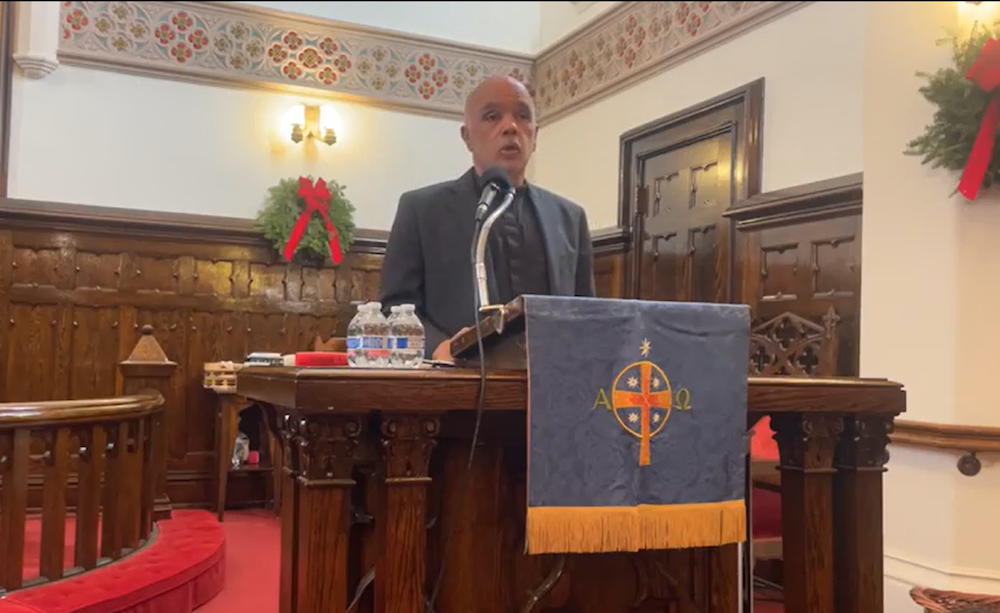
Screengrab of Reverend Dr. Samuel Cruz speaking at Trinity Lutheran Church's vigil for Venezuela in Brooklyn, New York. (Facebook/ Trinity Luthern Church)
Faith leaders, elected officials, and community members convened at Trinity Lutheran Church in Sunset Park on December 3 to call for a "diplomatic resolution to any differences with Venezuela." The vigil was organized in response to the Trump administration's escalating threats of military intervention in the South American nation.
Participants echoed recent appeals from international religious bodies, including the Vatican, the World Council of Churches, and the World Communion of Reformed Churches, urging dialogue between Washington and the government of President Nicolas Maduro.
"We are witnessing a march toward war, but as people of faith, we must march for peace," said Reverend Dr. Samuel Cruz of Trinity Lutheran Church, who led the vigil.
Bishop Rey Rivera, founder of the Latino Pastoral Action Center in the Bronx, stated that resorting to military force before exhausting diplomatic channels undermines both international law and core ethical principles.
Reverend Dr. Eli Valentin, pastor at Centro Pasión, described each potential casualty in an escalating conflict as "a preventable tragedy." Meanwhile, Reverend Dr. Derrick Boykin of Walker Memorial Baptist Church invoked the legacy of Dr. Martin Luther King Jr, referencing his long-standing opposition to US militarism.
Venezuela's Permanent Representative to the United Nations, Ambassador Samuel Moncada, was invited to deliver remarks at the vigil, which was also streamed live on the church’s official Facebook page.
In the United States, Interfaith and Community Leaders held a vigil for peace and dialogue in #Venezuela. For his part, Venezuelan Permanent Representative to the #UnitedNations denounced the U.S. Military attacks that killed more than 80 people, in addition to the military… pic.twitter.com/HTS82TQfso
— teleSUR English (@telesurenglish) December 4, 2025
Nationwide mobilization against war
The vigil coincides with a wider anti-war mobilization led by the ANSWER Coalition. Under the slogan "No to War Against Venezuela!", the group has called for protests in around 40 US cities on December 6.
Activists argue that the Trump administration is preparing a large-scale regime change operation. They also cite the president’s statements suggesting imminent ground attacks and the unilateral closure of Venezuelan airspace as indicators of military escalation.
The coalition slammed the "questionable pretexts" involving alleged drug trafficking, pointing to the absence of supporting evidence. They emphasized that 70 percent of the US public reportedly opposes military involvement in Venezuela and stressed that international legal standards do not support such action.
View this post on Instagram
Congressional efforts to curb military action in the Caribbean
In parallel, a bipartisan group of US lawmakers have introduced a resolution aimed at preventing unauthorized military engagement in Venezuela. Senators Tim Kaine, Chuck Schumer, and Rand Paul, along with Representative Adam Schiff, called potential US military action a "colossal and costly mistake" that could place US troops in unnecessary danger and destabilize the region.
Representatives Jim McGovern, Joaquin Castro, and Thomas Massie also submitted a resolution in the House reaffirming Congress’s constitutional role in decisions related to war. The lawmakers warned that any attempt by the executive branch to act unilaterally would prompt legal challenges.
Earlier last month, the US Senate narrowly rejected a bipartisan resolution that would have required congressional approval before any US military strikes could be carried out in Venezuela, whereby the measure failed by a vote of 49–51, falling just short of the simple majority needed to pass.


