
Can Trump nationalize elections? what the law says: The Independent
 4 Min Read
Donald Trump’s call to “take over” voting raises legal alarms. Can a president nationalize elections? Experts say the Constitution prevents federal control.
-
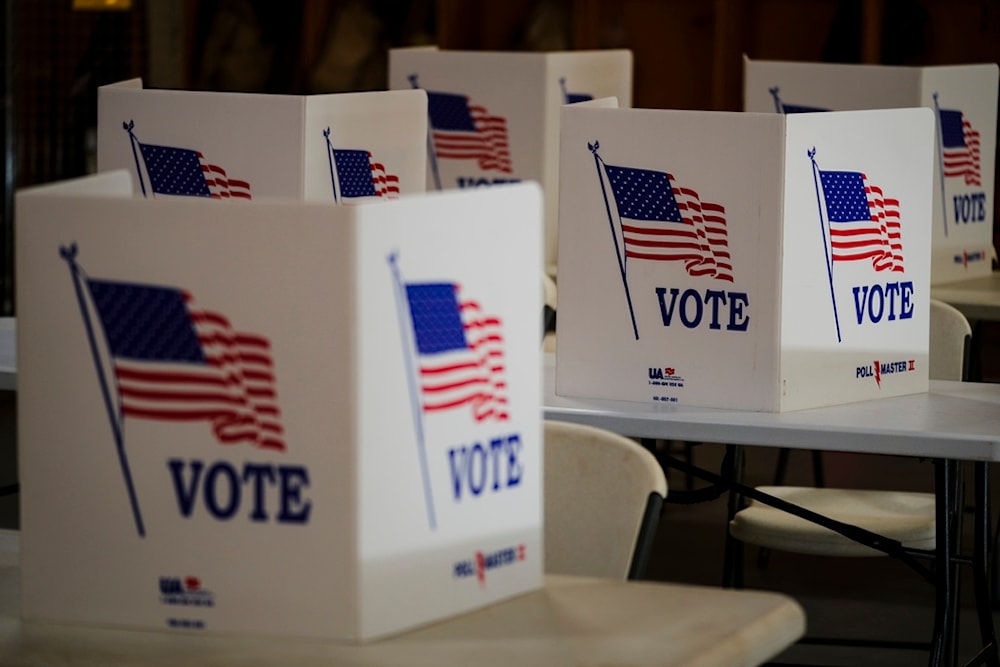
Voting booths are set up at a polling place in Newtown, Pa., Tuesday, April 23, 2024. (AP Photo/Matt Rourke)
US President Donald Trump is once again drawing fire after calling on Republicans to “take over” voting in several areas and suggesting that elections be “nationalized” under federal control, The Independent reports.
Speaking on a podcast hosted by former FBI deputy director Dan Bongino, Trump revived his disproven claims of widespread fraud in the 2020 election. He urged Republicans to assert control over voting in unspecified “crooked” states.
“We should take over the voting in at least… 15 places,” Trump said, without clarifying which states or jurisdictions he was referring to.
The Independent states that the US president also claimed that undocumented immigrants are impacting elections and that federal control was necessary to secure Republican victories.
“If Republicans don’t get them out, you will never win another election as a Republican,” he said, a statement widely dismissed by election experts.
Read more: Foreign policy setbacks and political risks define Trump’s 2026: FP
What does nationalizing elections mean?
According to The Independent, the United States has a highly decentralized election system, with more than 10,000 local jurisdictions administering elections based on state-specific laws and procedures.
Trump’s remarks suggest replacing this model with federal control of elections, effectively allowing Republicans at the national level to oversee election systems in certain states.
However, The Independent's article states that Trump's comments were vague, and he did not offer details on how such a system would work. A White House spokesperson later said Trump was referring to support for national voting standards, not a literal federal takeover.
Press Secretary Karoline Leavitt pointed to the Safeguard American Voter Eligibility Act, which would mandate voter ID, restrict mail-in voting, and has been criticized for potentially limiting access for eligible voters.
Read more: GOP House majority shrinks after death of California Rep LaMalfa
Can a US president override state election powers?
The Independent cited legal experts as saying that Trump has no authority to “take over” elections, and that any attempt to do so would run afoul of the US Constitution.
“There is one small problem, the Constitution prevents federalizing elections,” said Colorado Secretary of State Jena Griswold.
The British paper writes that under the Constitution’s Elections Clause, states set the “times, places, and manner” of congressional elections, though Congress can override those rules. Presidential elections are also state-administered, and each state determines how its electors are selected.
To truly nationalize elections, Trump or any president would need Congress to pass sweeping legislation, a process that would face legal challenges and state resistance.
Even with full federal backing, such a shift would require a major constitutional overhaul, stripping states of long-held election powers.
What Trump and his team are proposing
Per the Independent, Trump's remarks appear aligned with Republican efforts to impose tighter voting restrictions at the federal level. His support for the Safeguard American Voter Eligibility Act includes:
- Photo ID requirements for all voters
- Limitations on mail-in voting
- Proof of citizenship for voter registration
Critics argue that these measures risk suppressing the vote, particularly among marginalized groups. Trump, however, frames the proposals as essential for 2024 election integrity and Republican competitiveness.
Political reaction and constitutional concerns
The Independent states that Trump’s comments have triggered sharp criticism from Democrats and legal scholars, who view his statements as part of a broader effort to undermine state-run elections and centralize political control.
“Does Donald Trump need a copy of the Constitution?” asked Senate Minority Leader Chuck Schumer. “What he is saying is outlandishly illegal.”
Democratic Senator Mark Warner said the remarks should be seen as a warning about future election interference, not just a reaction to the past.
Even Republican leaders have distanced themselves from Trump's call to “take over” voting, per the Independent's reporting. House Speaker Mike Johnson and Senate Majority Leader John Thune declined to endorse the idea, though they supported stricter voter ID and citizenship requirements.
“I’m not in favor of federalizing elections,” Thune said. “It’s harder to hack 50 systems than one.”


