
Canada turns against Trump envoy as diplomatic tensions reach new low
 4 Min Read
A growing Canadian backlash targets Trump’s policies and ambassador Pete Hoekstra, with the petition citing mounting diplomatic tensions and alleged US interference.
-
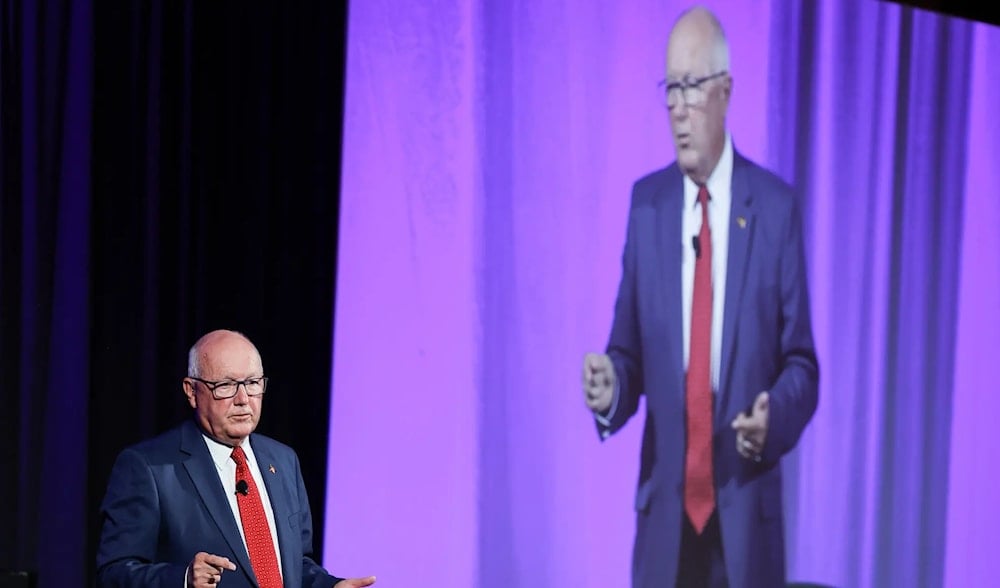
Pete Hoekstra, the American ambassador to Canada, speaking in Banff, Alberta, in September (AP)
A formal petition submitted to Canada’s House of Commons has drawn more than 171,000 signatures in support of removing US Ambassador Pete Hoekstra, The New York Times revealed.
As of Saturday, the petition had exceeded 171,000 signatures, well above the 500 required for the issue to be brought before Canada’s legislature.
The campaign reflects growing discontent in Canada over the policies of US President Donald Trump’s administration.
The petition accuses Hoekstra of “repeatedly making public statements undermining Canada-US diplomatic relations."
Petition cites diplomatic tensions
Hoekstra has backed Trump’s proposal to make Canada “the 51st” US state. Last year, he also accused Canadian officials of attempting to interfere in US elections.
His comments followed advertisements financed by the Ontario government that criticizedTrump’s tariff policies, which have disproportionately affected Canada. Hoekstra warned that Canada could not “expect that there will be no consequences or reaction” from the US over the advertisements.
The petition additionally cited reported links between Hoekstra and the founder of an application used by separatists in Calgary to mobilize support for their movement. Hoekstra has previously rejected claims of connections between the Trump administration and the separatists.
Three demands from Canadian government
The petition sets out three requests for the Canadian government.
First, it asks the House of Commons to “formally declare Pete Hoekstra persona non grata and request his removal as US Ambassador to Canada."
Second, it calls for discussions between the two countries over “the pattern of conduct by Ambassador Hoekstra inconsistent with the Vienna Convention on Diplomatic Relations”, the 1961 international treaty governing diplomatic relations.
Finally, it urges the Canadian government to “direct a parliamentary committee to review US diplomatic interference in Canadian domestic affairs."
Green Party leader Elizabeth May, the party’s only current member of the House of Commons, authorized the petition after it was submitted by Leanne Walker, a Calgary resident.
How parliamentary petitions work
In Canada, citizens can launch petitions seeking action on matters before the House of Commons. Participants must provide their province or territory, postal code, and phone number.
Petitions may remain open for as long as 120 days. The petition seeking Hoekstra’s expulsion was launched July 21.
Once a petition reaches 500 signatures, the matter must be presented to the House of Commons, which is required to issue an official response within 45 days.
The petition is not legally binding, however, and it is uncertain how much support it will ultimately receive from Canadian lawmakers.
Tensions over Trump’s policies
The surge in signatures nevertheless represents another sign of sustained Canadian opposition to Trump’s policies, including his efforts to expand US influence across the Western Hemisphere.
Relations between the two countries have faced several points of tension in recent months.
In July, Trump imposed new 50 percent tariffs on some Canadian goods, citing “discriminatory treatment” in trade relations.
Canada subsequently cancelled a ceremony planned to celebrate the new Gordie Howe International Bridge, which connects Windsor, Ontario, and Detroit, Michigan. The bridge’s opening was also thrown into uncertainty after Trump sought a larger US role in the project, which was jointly undertaken by Michigan and Canada.
Trump also threatened additional tariffs last month over wildfires in Canada, blaming the country for deteriorating air quality in the United States.
Canadians’ trust in US declines
A Pew Research survey conducted in June showed a sharp decline in Canadians’ assessment of the US as a reliable partner.
In 2022, 83 percent of Canadians described the US as reliable. By 2026, that figure had fallen to 35 percent.
The survey also found that 16 percent of Canadians in 2022 explicitly considered the US “not reliable”. That share rose to 65 percent in 2026.


