
China's Wang Yi calls to respect Iran rights as Hormuz Littoral State
 3 Min Read
China reaffirms support for Iran during ceasefire talks, stressing sovereignty over the Strait of Hormuz and calling for de-escalation and regional stability.
-
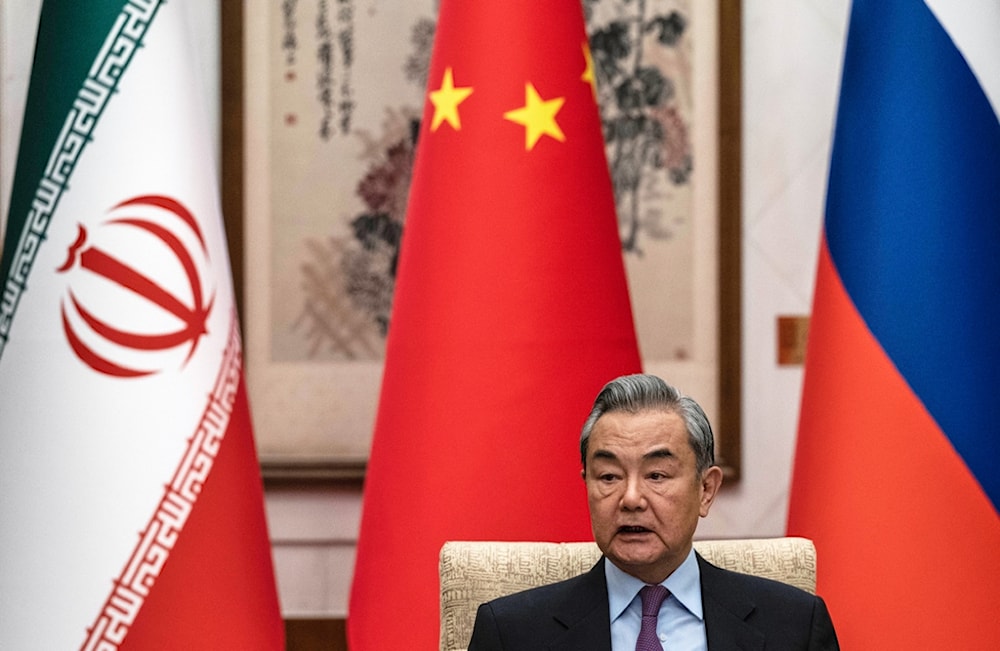
Chinese Foreign Minister Wang Yi, during a meeting with Russian Deputy Foreign Minister Sergey Ryabkov and Iranian Deputy Foreign Minister Kazem Gharibabadi regarding the Iranian nuclear issue at the Diaoyutai State Guest House on March 14, 2025, in Beijing, China. (Pool Photo via AP)
China’s Foreign Minister Wang Yi held a phone call with his Iranian counterpart Abbas Araghchi to discuss the latest developments in ceasefire negotiations with Washington, according to China’s Foreign Ministry.
During the call, Araghchi outlined Tehran’s position and next steps, stating that Iran remains committed to pursuing “a rational and realistic solution through peaceful negotiations.”
The exchange reflects continued coordination between Beijing and Tehran as diplomatic efforts intensify to prevent further escalation following the war on Iran.
Chinese FM Wang Yi held a phone conversation with Iranian FM Seyed Abbas Araghchi.
— Lin Jian 林剑 (@SpoxCHN_LinJian) April 16, 2026
The current situation has reached a critical stage between war and peace, and a window for peace is opening. China supports maintaining the momentum of ceasefire and peace talks. Iran’s… pic.twitter.com/J9BPBmL5cz
Beijing reaffirms political support for Tehran
China reiterated its backing for Iran’s sovereignty and security, signaling a consistent position aligned with its broader regional policy.
“China, as always, supports Iran in safeguarding its sovereignty, security, and national dignity,” the Chinese Foreign Ministry said in its statement.
Tehran, in turn, expressed appreciation for Beijing’s role in de-escalation efforts, emphasizing its expectation that China will continue contributing to peace initiatives in the region.
Read more: Army chief-led Pakistan delegation in Iran, carrying US message
Push to sustain ceasefire momentum
Beijing stressed the importance of maintaining momentum in ongoing ceasefire talks, describing the current moment as a critical turning point.
“The current situation has reached a critical stage of transition from war to peace, and a window of opportunity for peace is opening,” the ministry noted.
China also referenced a broader diplomatic framework proposed by Xi Jinping, which outlines a four-point plan aimed at stabilizing West Asia and promoting long-term political solutions.
Strait of Hormuz central to diplomatic messaging
A key focus of China’s position is the Strait of Hormuz, a vital maritime corridor through which a significant share of global energy supplies passes.
Wang Yi said that Iran's sovereignty, security, and legitimate rights should be respected as a littoral state of the Strait of Hormuz, stating that its “sovereignty, security, and legitimate rights and interests… should be respected and safeguarded.”
At the same time, China called for ensuring “freedom of navigation and safety in the international strait,” reflecting the broader international concern over disruptions to global shipping routes.
Hormuz tensions shape broader geopolitical dynamics
Iran has leveraged its geographic position over the Strait of Hormuz during the conflict, restricting vessels linked to hostile actions. In response, Washington imposed a sweeping blockade targeting Iranian maritime activity.
However, ships continue to pass through the strait despite the US blockade.
These developments have elevated the strait into a central arena of economic and strategic pressure, with global energy markets closely tied to its stability.
China’s emphasis on balancing sovereignty with navigation security highlights the complexity of managing competing interests in one of the world’s most critical waterways.
Read more: Trump's Hormuz blockade strains US-China ties ahead of Xi meeting


