
Civilian death toll in Sudan war more than doubled in 2025
 4 Min Read
The UN has warned that thousands remain missing as fighting with the Rapid Support Forces intensifies.
-
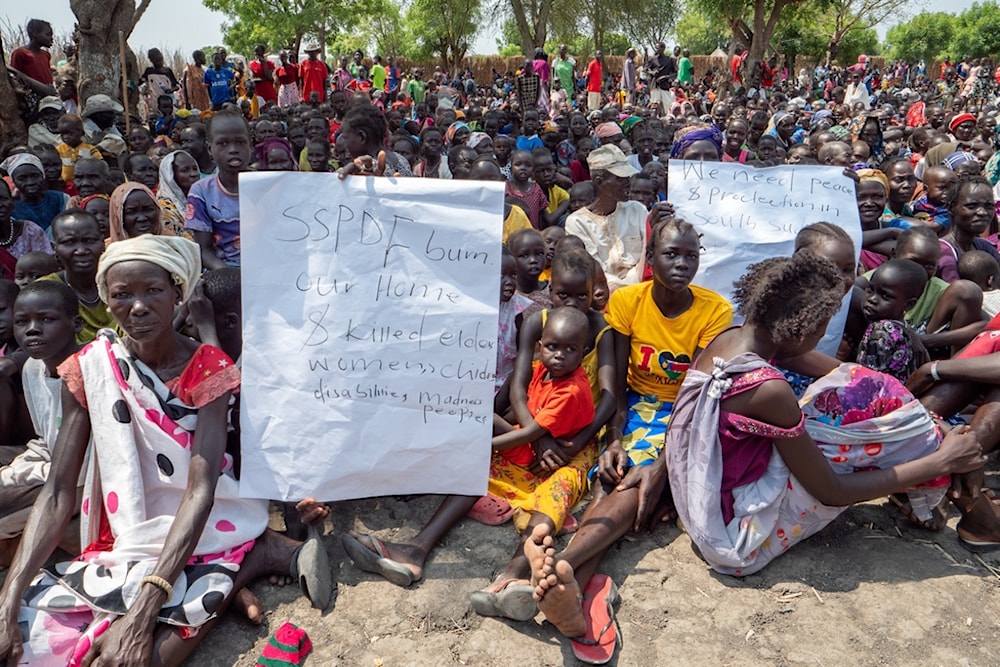
Internally displaced people gather at a church compound in Akobo, Jonglei state, South Sudan, Saturday, February 21, 2026 (AP)
Killings of civilians in the Sudan war more than doubled in 2025 compared with the previous year, the United Nations rights chief said, warning that thousands remain missing or unidentified as the conflict deepens.
Since April 2023, war has erupted between the Sudanese Army and the Rapid Support Forces (RSF), in what has become one of the world’s worst humanitarian crises. The Sudanese war has killed tens of thousands and displaced around 11 million people.
Addressing the UN Human Rights Council, Volker Türk said the death toll and civilian deaths in Sudan had surged sharply in 2025.
"This war is ugly. It's bloody, and it's senseless," Turk said, blaming both warring sides and foreign sponsors for backing what he described as a "high-tech" conflict.
"In 2025, my office's documentation points to an over two and a half times increase in killings of civilians compared with the previous year. Many thousands are still missing or unidentified," Türk said.
There have been no official figures on the overall death toll in the Sudan war.
Türk condemned what he called the "heinous and ruthless" brutalities committed, including sexual violence, summary executions, and arbitrary detentions.
Read more: Sudan rejects any proposal to end war without sovereignty guarantees
RSF attacks and famine warnings
Türk highlighted "carnage" inflicted by the RSF during an attack on the Zamzam displacement camp in April and again in October in El Fasher, the army's last foothold in western Darfur.
Sexual violence, including rape, gang rape, sexual torture, and slavery, has also surged, with more than 500 victims documented in 2025. "The bodies of Sudanese women and girls have been weaponised to terrorise communities."
He added that he is "extremely worried these crimes may be repeated."
Since January, escalating drone attacks in the southern Kordofan region and beyond have "killed or injured nearly 600 civilians," including in strikes on humanitarian aid convoys.
Access rendered impossible
The UN’s resident and humanitarian coordinator for Sudan, Denise Brown, said access to the cities of Kadugli and Dilling in South Kordofan had been effectively impossible due to an RSF siege, which the army recently lifted.
"We were not able to get supplies in. We had to remove our staff for their own safety," she said after stepping off the first UN flight to Khartoum since the conflict began.
Humanitarian deliveries resumed only last week, with more than 50 trucks carrying essential supplies for frontline Sudanese responders.
Brown echoed growing alarm over hunger, saying available data suggested famine conditions in Dilling, though this has not been officially confirmed. Famine has already been confirmed in El Fasher and Kadugli by a UN-backed assessment.
"It's essential that the world understands the consequences of war," she said, urging global leaders to "put their heads together to find a solution".
Escalation and militarization
Türk warned that both the army and the RSF continue to use "explosive weapons in densely populated areas, often without warning -- showing utter disregard for human life."
He also highlighted the "increased use of advanced long-range drones", which has "expanded harm to civilians in areas far from the front lines that were previously peaceful."
The UN rights chief further voiced concern over "the growing militarization of society," including the recruitment of children and young people into the fighting.
As the Sudan war continues with no official overall death toll, UN officials warn that civilian deaths in Sudan may rise further unless urgent diplomatic efforts halt the violence.


