
CNN: Trump returns from China with no breakthrough on war on Iran
 4 Min Read
Trump faces deepening divisions in his administration over Iran as diplomatic efforts stall, gas prices soar, and midterm pressure mounts.
-
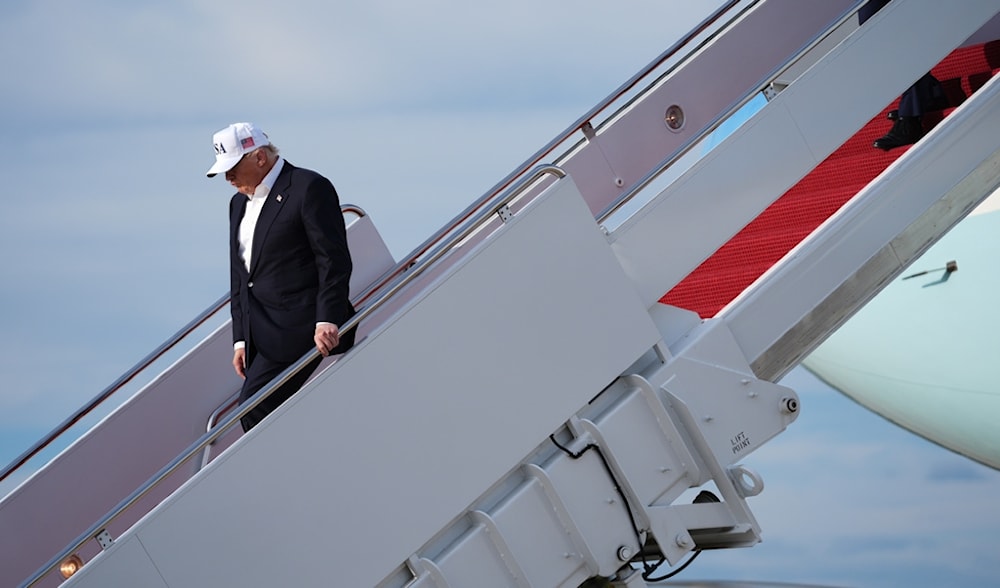
US President Donald Trump arrives at Joint Base Andrews, Maryland, on Air Force One, Friday, May 15, 2026, on return from Beijing where he met with China's President Xi Jinping (AP Photo/Mark Schiefelbein)
The US administration is navigating deepening internal rifts over how to end its war on Iran, with no diplomatic breakthrough in sight and mounting domestic pressure threatening to define the coming midterm elections.
Pentagon officials and administration hawks have been pushing for a more aggressive military posture, including targeted attacks, arguing that escalation is the only lever capable of forcing Tehran to the table on US conditions, according to sources cited by CNN.
But diplomatic advocates within the administration, backed more recently by US President Donald Trump, have insisted on maintaining a negotiation track supported by economic pressure. The standoff has left Washington with no clear path forward and, according to CNN, no resolution from Trump's recent trip to China.
China offers nothing new
Trump returned from Beijing having secured little beyond restatements of previously known Chinese positions, namely that Beijing supports reopening the Strait of Hormuz and opposes an Iranian nuclear weapon.
Speaking en route back to Washington, Trump claimed Xi had expressed willingness to help end the war, then undercut the significance of that offer by alleging that the US had no need for Chinese involvement.
Beijing, despite its close ties with Tehran, produced no substantive intervention on the Iran file, which the CNN piece said narrowed the diplomatic field considerably.
Read more: Sanctions, EVs, tech controls: Gaps in the Trump-Xi summit
Tehran holds firm
Iran has not shifted its negotiating position since a ceasefire was announced in April. The latest Iranian proposal was almost immediately dismissed by Trump, while officials familiar with the talks told CNN that Tehran's recent rhetoric has led many in Washington to doubt its commitment to a serious agreement.
Tehran has conditioned any resumption of negotiations on a permanent halt to fighting on all fronts first, with the Strait of Hormuz addressed in a second phase and the nuclear file deferred entirely to a third.
The White House has framed its posture as one of "maximum leverage," yet Iranian concessions have not followed. Adding to Trump's frustration, sources say he has grown increasingly irritated by what he perceives as divisions within Iranian leadership.
Economic squeeze tightens at home
The prolonged closure of the Strait of Hormuz has sent average US gas prices past $4.50 per gallon, with analysts expecting further increases. Inflation exceeded wage growth in April for the first time in three years, and corporate leaders have reportedly grown increasingly direct in private conversations with the White House, pressing for a swift resolution.
Trump has publicly dismissed concerns about the domestic economic fallout, stating this week that his singular focus is on preventing Iran from acquiring a nuclear weapon. The remark drew pushback, but the US president declined to walk it back.
Within his own orbit, the calculus is different. One adviser who recently met with Wall Street executives summarised their message simply with "just hurry up."
With midterm elections on the horizon and approval ratings sliding, the pressure on Trump to deliver, by diplomacy or force, is intensifying. As one official put it: "By hook or by crook, they're going to get the strait open."
Ebrahim Azizi, head of the Iranian parliament’s National Security and Foreign Policy Committee, stressed on Saturday that Iran would not accept external control over the Strait, stating that its management and the wider Gulf region "would not be dictated by Trump’s delusional posts."


