
Colombia's president-elect moves to restore ties with 'Israel'
 5 Min Read
Colombia's incoming hard-right government is preparing to move the embassy to al-Quds and abandon support for the Gaza genocide case following a narrowly won and deeply contested election.
-
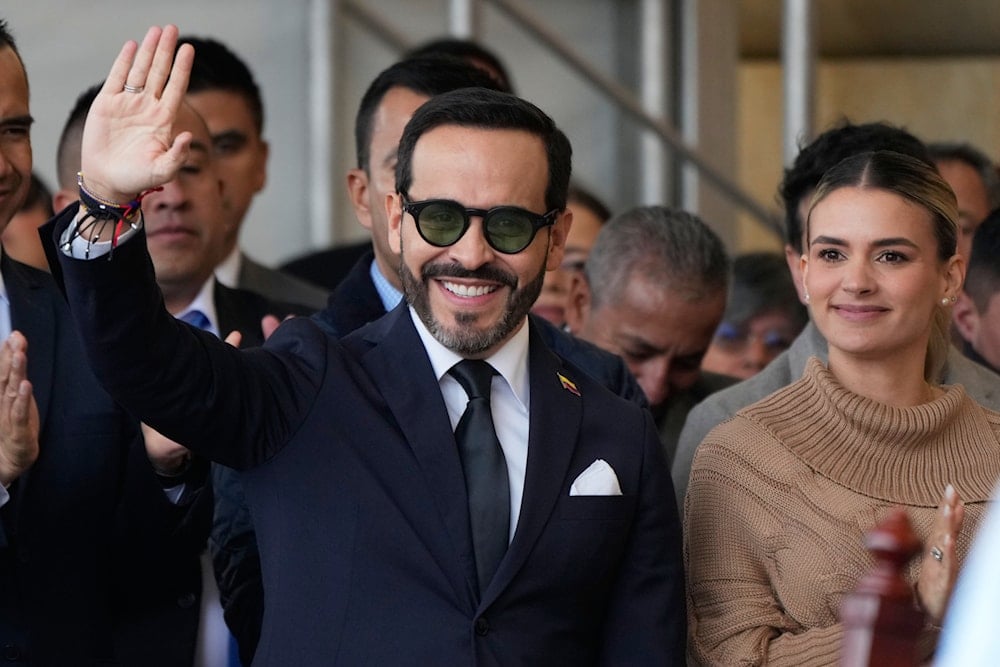
Colombian President-elect Abelardo de la Espriella, left, waves to supporters next to his wife Ana Lucia Pineda during a Mass in honor of Our Lady of the Rosary of Chiquinquira, in Chiquinquira, Colombia, July 9, 2026 (AP)
Colombia’s incoming hard-right administration is preparing to dismantle the country’s solidarity-based policy toward Palestine, announcing plans to restore relations with the Israeli occupation, relocate its embassy to al-Quds, and abandon Colombia’s participation in the genocide case before the International Court of Justice.
President-elect Abelardo de la Espriella, a close ally of US President Donald Trump, is scheduled to take office on August 7 after being declared the winner of a deeply polarized runoff election by less than one percentage point.
His victory remains politically contentious following allegations of US and Israeli interference, digital manipulation, and vote-buying. Although international observers said they found no evidence that the vote count itself was falsified, their reports documented widespread disinformation, unprecedented use of artificial intelligence, and possible attempts to pressure voters.
Embassy move legitimizes Israeli claim over occupied al-Quds
De la Espriella’s office said Thursday that preparations were advancing for “the opening of the Colombian Embassy in Jerusalem, the capital of Israel,” placing the incoming government behind the Israeli occupation’s unilateral claim to the entire city.
Occupied al-Quds is internationally recognized as part of the Palestinian territory seized by “Israel” in 1967. The United Nations has repeatedly rejected the occupation’s "annexation" measures and called on countries not to establish diplomatic missions in al-Quds.
The move would place Colombia alongside Washington, which transferred its embassy from Tel Aviv to al-Quds in 2018 during Trump’s first presidential term, in defiance of the prevailing international position on the city.
Incoming Foreign Minister Omar Bula met Israeli Foreign Minister Gideon Saar in Washington this week, with the two sides agreeing to exchange ambassadors after De la Espriella assumes office and remove visa requirements for their citizens.
“The historical relationship that the Petro administration unilaterally severed will be strengthened once again,” the incoming administration said.
The planned rapprochement also includes renewed economic, intelligence, and military cooperation. During the election campaign, De la Espriella advocated acquiring weapons, drones, artificial-intelligence systems, and other military technology from the United States and the Israeli occupation.
Petro’s measures in support of Palestine face reversal
The policy marks a sweeping departure from that of outgoing President Gustavo Petro, who severed diplomatic relations with the Israeli occupation in 2024 in response to the genocide in Gaza.
Petro’s government subsequently halted weapons purchases from “Israel", restricted Colombian coal exports to the occupation and filed a declaration of intervention supporting South Africa’s case under the Genocide Convention at the ICJ.
The incoming administration is now expected to withdraw Colombia’s intervention in the proceedings, eliminating one of Latin America’s strongest forms of legal support for Palestinian demands for accountability.
The planned withdrawal comes as a United Nations commission of inquiry has concluded that Israeli authorities continue to commit genocide and other atrocity crimes in Gaza, including through the deliberate targeting of Palestinian children.
Petro condemned De la Espriella as an “accomplice to genocide” after the embassy decision was announced.
“Anyone who supports genocide is complicit in it,” he wrote on X.
Petro had also proposed establishing a Colombian diplomatic mission in Ramallah in the occupied West Bank, although the project was not completed before the end of his term.
Razor-thin election followed by interference allegations
The foreign-policy reversal comes after one of the closest presidential elections in Colombia’s recent history.
De la Espriella received approximately 49.7% of the vote, compared with 48.7% for progressive candidate Iván Cepeda. More than 26 million Colombians participated in the runoff, while hundreds of thousands rejected both candidates by selecting the protest option provided on the ballot.
Petro alleged that the United States and “Israel” interfered in the election to assist De la Espriella, while also claiming that official polling-station tally forms had been manipulated. Cepeda’s campaign challenged results from more than 30,000 polling stations and sought a recount of ballots cast abroad, a request that electoral authorities rejected.
Cepeda also accused the Trump-backed campaign of vote-buying and said Colombian voters had been targeted by artificial intelligence-generated content. De la Espriella made separate vote-buying allegations against the left, with neither side publicly providing evidence sufficient to substantiate the claims.
The European Union election observation mission said the counting and official tabulation processes it witnessed were transparent and that representatives of both candidates were present during most reviews. Its conclusions mean that there is currently no verified evidence establishing that enough ballots were altered to reverse the election’s outcome.
However, the mission also found that the campaign was saturated with disinformation and an unprecedented volume of AI-generated material. It recorded a significantly greater amount of advertising by De la Espriella’s campaign on platforms whose political advertising systems offered limited transparency.
Observers additionally reported voters photographing their ballots at around 4% of the polling stations visited, raising concerns about possible coercion, and found that approximately 320,000 eligible citizens were excluded from the voter register because of Colombia’s registration deadline.
These findings do not prove that the final count was fabricated, but they reinforce concerns that the election unfolded in an unequal political environment shaped by foreign pressure, opaque digital campaigning and misinformation.
Read more: Petro accuses 'Israel' of hacking Colombian election amid protests


