
Petro accuses 'Israel' of hacking Colombian election amid protests
 5 Min Read
Petro says there is evidence of altered IP addresses on Colombian electoral services, adding that the only country capable of such an operation is "Israel."
-
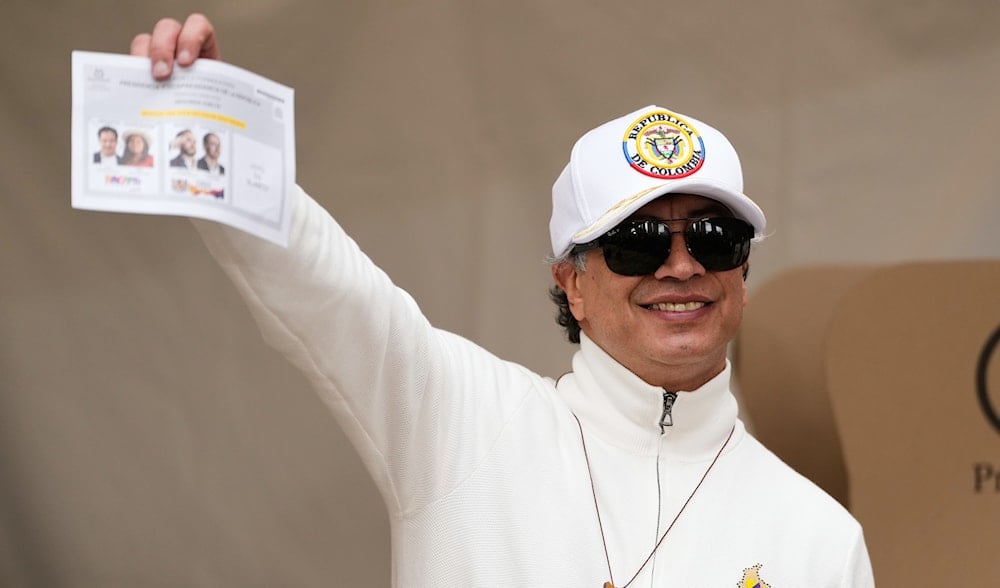
Colombian President Gustavo Petro shows a ballot during the runoff election in Bogota, Colombia, Sunday, June 21, 2026. (AP Photo/Fernando Vergara)
Colombian President Gustavo Petro has accused "Israel" of interfering in the country's presidential runoff in an effort to manipulate the outcome in favor of conservative candidate Abelardo de la Espriella.
Writing on X, Petro said he had warned that the software used by the Bautista brothers' company was vulnerable, citing a 2018 ruling by the Council of State calling for it to be replaced with public software.
Petro said there was evidence of "a change in the IP addresses of several servers belonging to the National Registry Office," adding that the only country in the world capable of carrying out such an operation is "Israel."
Advertí que el software de los hermanos Bautista era vulnerable según la sentencia del Consejo de Estado del 2018 y que debía cambiarse por un software público,
— Gustavo Petro (@petrogustavo) June 21, 2026
Solicité a tiempo una auditoría experta del software de los hermanos Bautista, y el registrador no lo permitió.…
He stressed that he had requested, in time, an expert audit of the Bautista brothers' software, but the registrar did not allow it.
Petro called for "a battle for democracy" after the preliminary count in the presidential runoff placed de la Espriella in first place, narrowly ahead of Ivan Cepeda. He renewed his call for all polling stations to be scrutinized and demanded a full recount, including a review of vulnerabilities in the electoral software and of the polling stations affected by irregularities.
He also urged calm and restraint, so that the count could be carried out thoroughly and properly, in a way that truly reflects the will of the public.
Read more: France accuses Israeli firm of elections meddling in several countries
De la Espriella declares victory
Shortly afterward, de la Espriella declared himself president before a mass rally of supporters in Barranquilla, Atlantico, even as the preliminary count was still underway.
"I appear before you tonight to announce the most important news of my life," said the candidate from the Defenders of the Homeland party. "The Colombian people have entrusted me with the supreme honor of serving as their next president."
With 99.99% of polling stations reporting, preliminary data showed de la Espriella with 49.66% of the vote against 48.70% for pro-government candidate Ivan Cepeda, a margin of just 0.96 percentage points. The tally remains preliminary and is neither official nor binding.
Cepeda accepts preliminary count
Cepeda acknowledged the preliminary results on Sunday, but said his campaign would challenge the count from 33,000 polling stations during the official scrutiny process.
"We have reached this final stage with the narrowest margin in the history of Colombian presidential runoffs," Cepeda told supporters in Bogota.
He added that the left remained ready to engage in dialogue for the sake of the country's unity.
Colombia went to the polls on Sunday in a runoff to choose Petro's successor, a vote that pitted Cepeda's left-wing platform against de la Espriella's far-right project in what has become one of the most consequential elections in the country's recent history.
Demonstrators vow resistance to right-wing rule
The result triggered protests in Cali and Bogota, where demonstrators denounced de la Espriella's victory amid anger over US influence in the outcome.
In Cali, a march through the Puerto Resistencia neighborhood began peacefully, accompanied by Indigenous music. The mood shifted as de la Espriella delivered his victory speech in Barranquilla, prompting protesters in the city burned US flags, and clashes broke out with riot police, who deployed tear gas to disperse the crowd.
Grave situación en Cali a estas horas señor Presidente @petrogustavo pic.twitter.com/sa5m63Dbyn
— X Post 1A (@XPost1A) June 22, 2026
In Bogota, hundreds of mostly young demonstrators gathered outside the national university in defiance of the preliminary results, with some later setting fire to barricades and throwing objects at police, who responded with tear gas.
Protesters voiced frustration with decades of right-wing governance favoring the wealthy, and some accused the de la Espriella campaign of vote-buying and ballot manipulation. One protester told AFP she believed many of the votes recorded for de la Espriella were not legitimate.
🚨ATENCIÓN: A esta hora miles de personas marchan en Bogotá en defensa de la vida y ante un posible fraude electoral. NOS QUIEREN DESTRIPAR Y EL PUEBLO NO SE VA A CALLAR. pic.twitter.com/KIJX8sUbEK
— David Rozo (@DonIzquierdo_) June 22, 2026
The demonstrations reflect the deep divisions exposed by de la Espriella's campaign, which energized supporters eager for a return to right-wing rule after Petro's four-year term but alarmed opponents over his record as a defense lawyer for drug traffickers and fraud suspects, his hardline security pledges, including bombing campaigns and the construction of mega-prisons, and his support for fracking.
During the campaign, de la Espriella had called for the left to be "gutted," before softening his rhetoric. In his victory speech on Sunday, he struck a more conciliatory tone, pledging to govern for "all Colombians" and respect democratic principles. Demonstrators, however, warned that further protests would follow if they felt their rights were under threat.
¿Querían ver mierdero? Pues Cali ya se adelantó. pic.twitter.com/rddNUDjiWw
— X Post 1A (@XPost1A) June 22, 2026


