
Former Colombian President warns of 'Bukeleization' in Latin America
 4 Min Read
Former Colombian President Ernesto Samper warns of a growing right-wing shift in Latin America, describing a regional trend of "Bukeleization" and increased external political influence shaping governance and security policies across the continent.
-
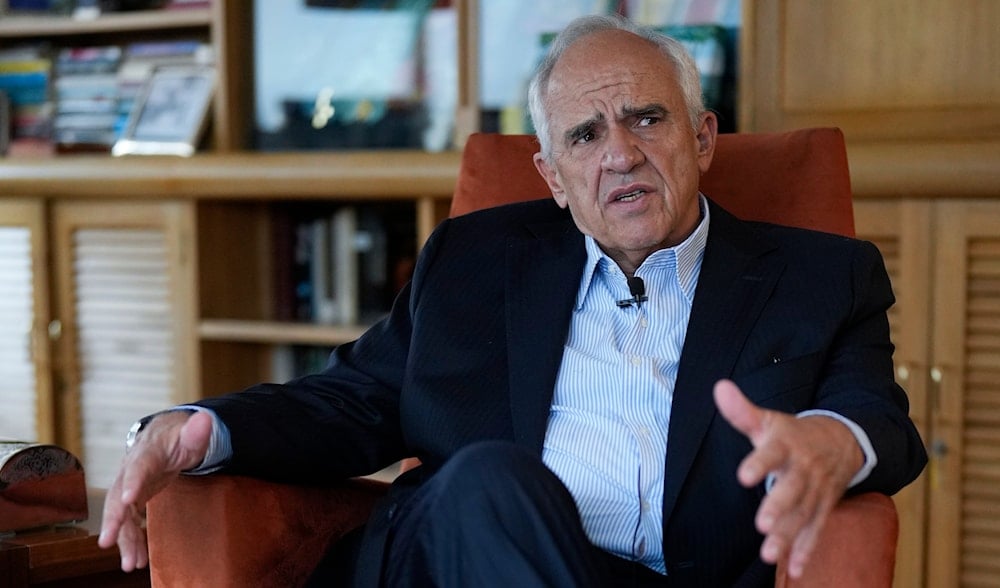
Former Colombian President Ernesto Samper Pizano speaks during an interview in Bogota, Colombia on April 25, 2024. (AP Photo/Fernando Vergara)
Former President of Colombia and UNASUR Secretary General Ernesto Samper Pizano warned about a growing political shift in Latin America toward radical right-wing models, arguing that the region is entering a dangerous phase of “Bukeleization”, inspired by the security approach implemented in El Salvador.
In an interview with Argentine newspaper Página/12 on Monday, Samper suggested that this trend is being supported by circles close to US President Donald Trump, aiming to reshape political dynamics across the continent.
He described the current regional trend as a “Bukeleization” process, referring to the punitive governance model associated with El Salvador’s Nayib Bukele, arguing that this approach is gaining traction across Latin America and is aligned with broader ideological shifts.
According to him, this transformation is not isolated but reflects a coordinated political movement that promotes stricter security policies and a stronger right-wing agenda.
US Foreign Policy and ideological alignment
The former Colombian president said that current US foreign policy encourages a significant ideological shift in Latin America. He argued that diplomatic relations are increasingly shaped by political alignment rather than traditional state-to-state engagement.
Samper asserted this approach weakens established diplomatic channels and replaces them with ideologically driven alliances that exclude governments with opposing views. He cited initiatives such as the so-called "Shield of the Americas" anti-drug coalition, which he claims marginalizes countries like Mexico, Colombia, and Brazil.
Samper contrasted the current situation with earlier periods of stronger regional cooperation, pointing to past administrations led by Luiz Inácio Lula da Silva, Cristina Fernández de Kirchner, Hugo Chávez, Rafael Correa, and Evo Morales as examples of more coordinated Latin American integration.
He argued that today’s political fragmentation has weakened the region’s ability to act collectively on international issues.
US intervention in Central America
The former UNASUR chief also criticized the dominance of the right-wing bloc in Central America aligned with Washington’s policies, pointing to institutional setbacks in the region, including developments in Honduras, Panama, and increased US military presence in strategic areas.
Samper also discussed the US aggression on Venezuela, after Delta forces abducted the Venezuelan President Nicolas Maduro, leading to significant casualties.
He compared this situation to Operation Condor, a coordinated campaign of repression in Latin America during the 1970s, arguing that similar patterns of external interference are reappearing today.
Colombia’s political outlook
Looking ahead to Colombia’s political future, Samper commented on the upcoming presidential runoff scheduled for June 21. He suggested that a possible victory for Iván Cepeda, representing the Alliance for Life, would help maintain continuity among progressive governments in the region.
He linked this potential outcome to broader regional cooperation involving Brazil and Mexico under Luiz Inácio Lula da Silva and Claudia Sheinbaum.
Samper also highlighted his personal historical connection to Senator Iván Cepeda, referencing the assassination of Cepeda’s father, Manuel Cepeda, shortly after Samper assumed Colombia’s presidency in 1994.
He argued that this shared history strengthens their joint commitment to human rights, transitional justice, and peace-building efforts in Colombia.
Support for 'total peace' policy
The former president expressed support for Colombia’s "total peace" strategy under President Gustavo Petro, emphasizing ongoing efforts to engage armed groups such as the ELN and FARC dissidents through dialogue and reintegration policies.
He praised current government initiatives aimed at improving security through social investment, civilian protection, and community participation in conflict-affected areas.
Samper’s remarks reflect rising ideological divisions in Latin America, particularly between progressive and conservative governments. His warnings about the spread of El Salvador’s security model and external influence highlight ongoing disputes over sovereignty and regional political alignment.


