
Bolivia protests challenge US-backed right-wing agenda in Lat. America
 4 Min Read
Bolivia's unions, Indigenous communities, and students have launched a general strike and nationwide blockades against President Rodrigo Paz's neoliberal reforms, in a uprising with regional implications.
-
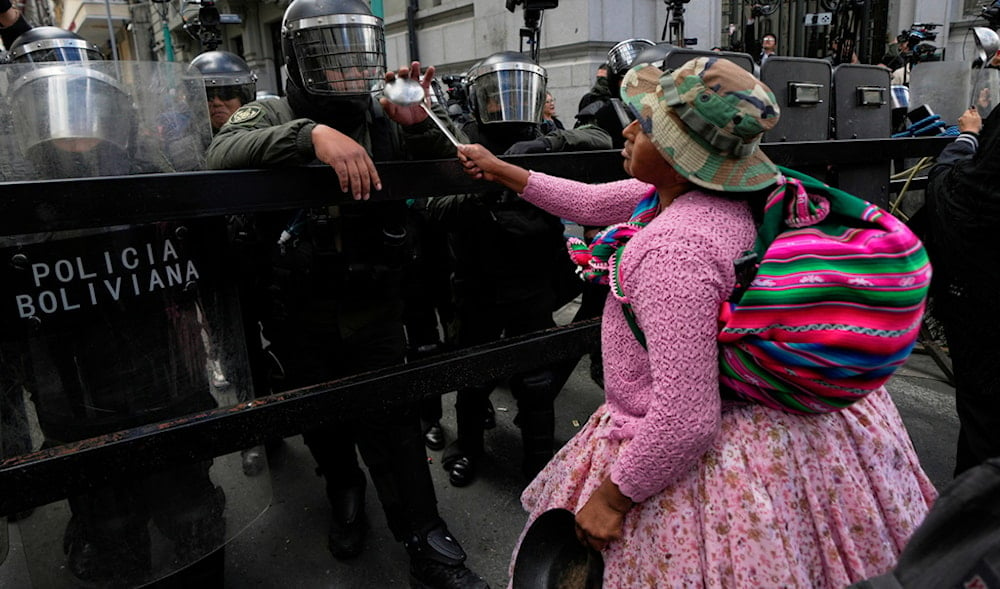
A demonstrator points her ladle at police standing guard near the government palace during an anti-government protest in La Paz, Bolivia, Wednesday, May 27, 2026. (AP Photo/Juan Karita)
Bolivia is gripped by a nationwide popular uprising against the government of President Rodrigo Paz, with trade unions staging a general strike, Indigenous and peasant communities erecting roadblocks across major highways, and mass demonstrations filling the streets of the capital, La Paz.
Writing in Truthout, Sam Carliner reports that the movement draws together a broad coalition of organised labor, Indigenous federations, student groups, and ordinary citizens, and has brought much of the country to a standstill.
Paz came to power in October 2025, ending two decades of left-wing governance under the Movement to Socialism (MAS) party founded by former president Evo Morales.
Running on a platform of economic reform and positioning himself as a moderate alternative to the traditional right, Paz won on the back of voter frustration with MAS infighting and promises to address the country's economic difficulties.
Once in office, however, his government moved quickly to reverse a range of social and economic protections.
Neoliberal policies trigger protests
Among the measures that have drawn the sharpest public backlash are Law 1720, a land privatization law widely condemned as a mechanism for transferring Indigenous territories to agribusiness interests, and Supreme Decree 5503, which ended state fuel subsidies and effectively doubled fuel prices overnight.
The government compounded the fuel crisis by importing what Bolivians have taken to calling "junk fuel," which has reportedly caused mechanical damage to vehicles across the country. Paz also moved early in his tenure to abolish a tax on large fortunes and put forward education reforms that teachers' unions have said are steps toward privatization.
Protests began as early as December 2025, just one month into Paz's presidency, and were temporarily contained through negotiations with the Central Obrera Boliviana (COB), the country's largest union federation.
When the government pressed ahead with its reform agenda regardless, COB and teachers' unions called a general strike in early May, coinciding with a long march to La Paz by rural Indigenous communities and the establishment of roadblocks by peasant groups across the country.
State response exacerbates crisis
Rather than de-escalating the situation, the government's response has only intensified it.
Security forces have deployed chemical agents and rubber bullets against protesters, and on May 26, the Chamber of Deputies voted to lift existing restrictions on the use of military force.
Protesters have responded by defending blockades with rocks, slingshots, and dynamite, and have repeatedly rebuilt roadblocks within minutes of military clearance operations, according to Truthout's on-the-ground sources.
Bolivia as a flashpoint for regional politics
The uprising carries significance beyond Bolivia's borders. Paz has closely aligned his government with Washington, joining the Shield of the Americas, a US-backed military alliance of right-wing governments.
In a joint statement on May 21, the alliance dismissed the protest movement as the work of criminals and drug traffickers, echoing rhetoric the Trump administration has used to justify interventionist policies across the region, including military action in Venezuela and Ecuador.
Social scientist and journalist Joseph Bouchard, speaking to Truthout from La Paz, argued that this framing reflects a broader rejection of Latin American democratic sovereignty, with Washington and its regional allies effectively signalling that no popular pushback against an elected government can ever be considered legitimate.
Bolivia's uprising is also unfolding alongside significant, albeit smaller, mobilizations in Argentina and Chile against comparable neoliberal reforms, and student and teacher strikes in Brazil. Bolivians, Bouchard noted, are drawing on a long history of successful mass resistance, and many within the movement believe they have both the tools and the precedent to force Paz from office.


