
Congress pressures Hegseth over Iran school probe, Caribbean strike
 5 Min Read
US lawmakers seek unedited footage of strikes on suspected drug-smuggling vessels off Latin America as scrutiny grows over a September attack probe.
-
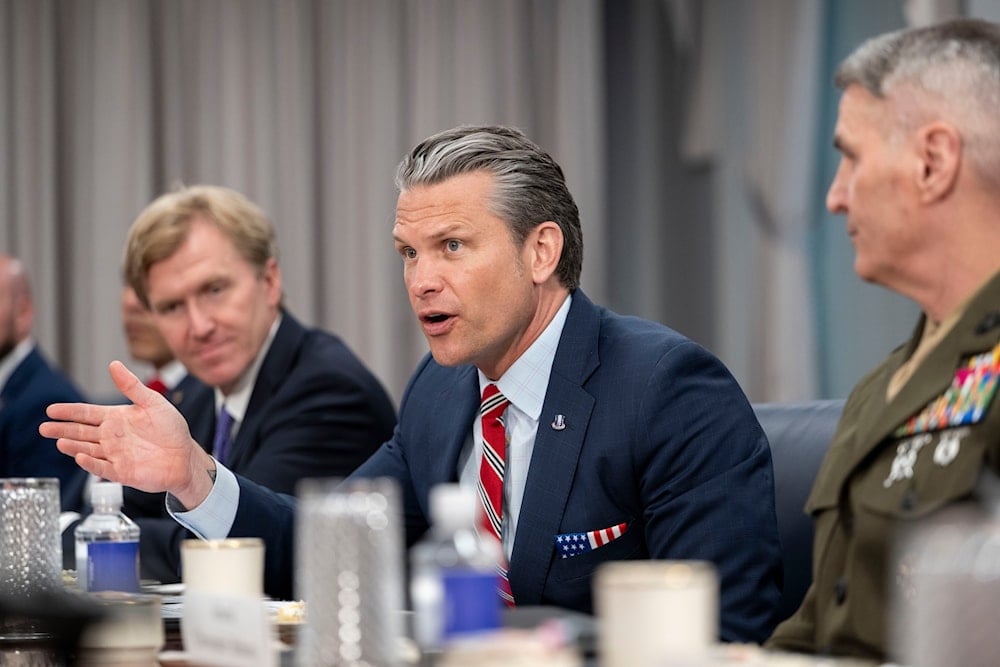
War Secretary Pete Hegseth speaks during a meeting with Ecuador's President Daniel Noboa at the Pentagon, June 15, 2026, in Washington (AP)
Congressional lawmakers are leveraging the annual defense policy bill to force the Pentagon to turn over more details about the deadly bombing of an Iranian girls' school in February and full videos of lethal strikes against alleged drug smuggling boats in the waters off Latin America, Politico reported.
A provision tucked into the final draft of the National Defense Authorization Act (NDAA) would withhold 75% of War Secretary Pete Hegseth’s travel budget until the Pentagon delivers the documentation, including "unedited video of strikes conducted against designated terrorist organizations in the area of responsibility of the United States Southern Command" to the House and Senate Armed Services Committees.
In addition to the double-tap strike in the Caribbean, the Senate is pushing for more details on the Minab school bombing, which killed more than 150, mostly schoolgirls, in the opening wave of strikes during the war on Iran.
Congressional leaders released the final bill text on Sunday. It is expected to pass the House later this week and then the Senate without changes.
The move marks an escalation from late last year, when lawmakers approved and Trump signed defense legislation that withheld 25% of Hegseth’s travel budget to pressure the department into releasing the videos and complying with other outstanding requests. The renewed measures indicate that legislators still haven’t received the information they are after.
Hegseth doubles down on war crime
The mandate arrives as lawmakers scrutinize a September 2 operation in which a double-tap strike killed two survivors of an initial attack, an action some legal experts have warned could amount to a war crime. At least 200 people have been killed in the broader anti-smuggling campaign since September, according to military figures.
Secretary Hegseth declined on Saturday to commit to releasing the footage, citing potential operational security concerns for US troops. President Donald Trump, however, has said he would have "no problem" making the videos public.
Hegseth has publicly defended the decision to engage the survivors, though he deflected the blame to Admiral Frank Bradley, commander of US Special Operations Command, saying he made the final call on the second strike.
Released excerpts stir contradictions
Last week, Bradley and Joint Chiefs Chair General Dan Caine briefed top lawmakers on the national security committee and showed the unedited footage. But those who viewed it offered sharply conflicting interpretations. Several senior Republicans said the video vindicates the administration's position, while Democrats have called for broader release.
Senate Armed Services Chair Roger Wicker (R-Miss.) said after the briefing that he wants rank-and-file committee members to see the footage for themselves.
The provision adds a new complication to congressional investigations into the operation. House Armed Services Ranking Member Adam Smith (D-Wash.) said the footage contradicts how Hegseth and other Republicans have characterized the events.
"If they release the video, then everything that the Republicans are saying will clearly be portrayed to be completely false," Smith said Sunday on ABC's This Week.
House committee working to arrange a viewing
In a separate interview on Saturday at the Reagan National Defense Forum, Smith said the House Armed Services Committee is working to arrange a viewing for all panel members this week.
"We should do a full-scale investigation," Smith said. "I think we should have … up and down the chain of command, any written documents … and then a public hearing where Secretary Hegseth explains, while being questioned by the committee, what did you do here and why."
The administration has justified the strikes by labelling the targets "narco-terrorists" who traffic drugs into the United States. But experts and some lawmakers have raised concerns that the legal basis for the campaign remains tenuous.
Beyond the video mandate, the NDAA language also requires the Pentagon to deliver all overdue reports, including lessons learned from the war in Ukraine, before the full travel budget can be released.
Lawmakers, including some of Trump’s GOP allies, have complained Pentagon leadership has kept them in the dark on major national security decisions. They’ve underscored that dissatisfaction as they’ve demanded more information about the nascent Iran peace deal.
The Minab School massacre
On February 28, 2026, a missile strike hit the Shajareh Tayyebeh girls' school in Minab, Iran, killing over 170 people, most of them children. The attack came on the first day of coordinated US-Israeli military action against Iran, and Tehran immediately blamed the coalition for the massacre.
Verified video footage and munitions experts have identified the weapon as an American Tomahawk cruise missile. The New York Times confirmed the missile's type through visual analysis, and satellite imagery showed the school had been clearly marked as an educational facility, with playgrounds and murals, for nearly a decade, making any claim of a military target highly questionable.
Despite President Trump's efforts to pin the blame on Iranian "inaccurate munitions", a preliminary US military investigation reportedly concluded the strike was a "targeting error" caused by outdated intelligence. The Pentagon continues to call it "under investigation".


