
Cuba has action plan for potential social unrest, president says
 3 Min Read
Cuban President Miguel Diaz-Canel has said his government has prepared action plans for potential social unrest scenarios as the United States intensifies its economic blockade against the island, warning of US attempts to provoke discontent.
-
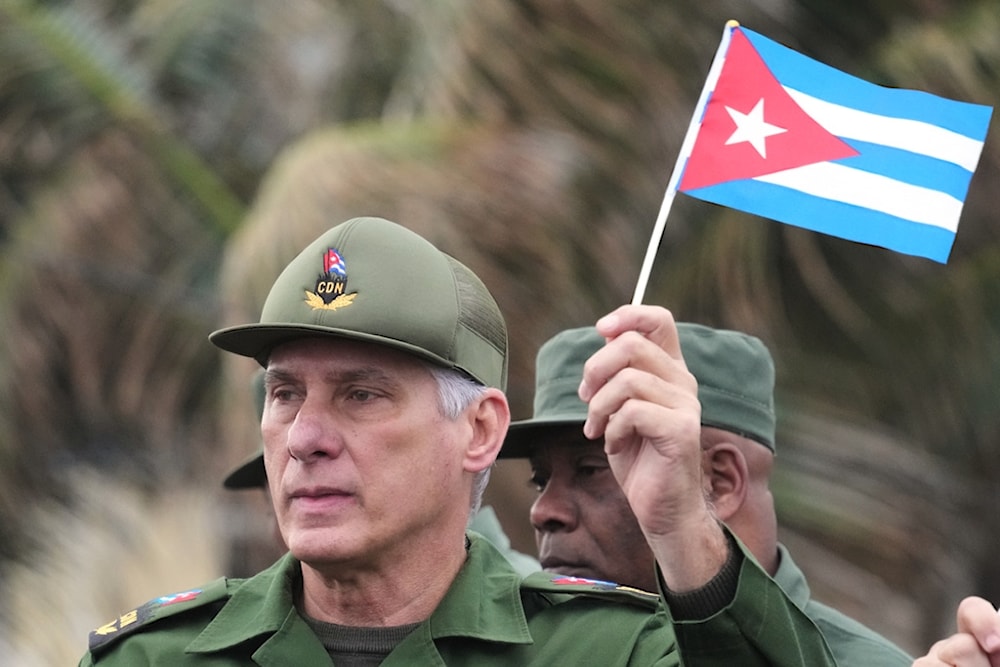
Cuban President Miguel Diaz-Canel during a rally to protest the killing of Cuban officers during the US operation in Venezuela that kidnapped Venezuelan President Nicolas Maduro
Cuban authorities have prepared programs to address potential social unrest scenarios as the United States intensifies its economic blockade against the island, President Miguel Diaz-Canel has said, warning of US attempts to provoke social discontent in his country.
In an interview with the Diario newspaper, Diaz-Canel stated: "We have programs for each of these scenarios to deal with them," referring to possible US efforts to stir social discontent in Cuba. The Cuban president also said the island is counting on international support as Washington tightens its blockade.
"The situation in Cuba is very difficult," Diaz-Canel added, noting that many representatives of the international community are calling for normalising the situation around the island.
US intensifies economic pressure on Cuba
In recent months, the United States has significantly intensified political and economic pressure on Cuba. In January, President Donald Trump signed an executive order imposing tariffs on imports from countries supplying oil to Cuba and declared a national emergency, citing an alleged Cuban threat to US national security, a claim Havana has dismissed as a pretext for economic warfare.
The measure has exacerbated fuel shortages on the island and severely affected electricity generation, transportation, food production, healthcare and education. Last week, the UN reported that over 100,000 surgeries have been postponed in Cuba due to severe shortages of medicines and medical supplies caused by the blockade.
Diaz-Canel's remarks signal that Havana is preparing for the possibility that Washington may attempt to foment unrest as economic conditions worsen, while also appealing for international solidarity to counter the decades‑old embargo, which has been condemned repeatedly by the United Nations General Assembly.
US Treasury imposes new sanctions on Cuba
In the context of these measures, the US Treasury Department on Thursday imposed sanctions on the Cuban president and his wife, Lis Cuesta Peraza.
The action comes as part of a series of steps taken by the Trump administration against Cuba, which for months has continued to denounce what it calls the "narrative" promoted by Washington to justify its aggression and blockade of the island.
According to a decision issued by the Office of Foreign Assets Control (OFAC), sanctions also included: the Revolutionary Armed Forces, the Committees for the Defense of the Revolution, the Cuban Institute of Friendship with the Peoples, as well as the company Amistur Cuba S.A., the tourism and travel agency attached to the Cuban Institute of Friendship with the Peoples (ICAP).
OFAC also added to the sanctions list Manuel Anido Cuesta, the stepson of President Díaz-Canel, and Raúl Alejandro Castro Cales, the grandson of former Cuban president Raúl Castro.
Days earlier, the Cuban government denounced the new US sanctions targeting the Business Administration Group (GAE), saying they represent part of a "strategy to tighten the economic blockade" on the country, and described them as "the most dangerous and severe escalation" in bilateral relations in recent years.


