
Damascus, SDF announce ceasefire, Integration deal following clashes
 5 Min Read
Syria’s interim leadership engaged US envoy Tom Barrack as forces aligned with the interim administration advanced into former Kurdish-held areas in the north and east amid a shifting territorial and political landscape.
-
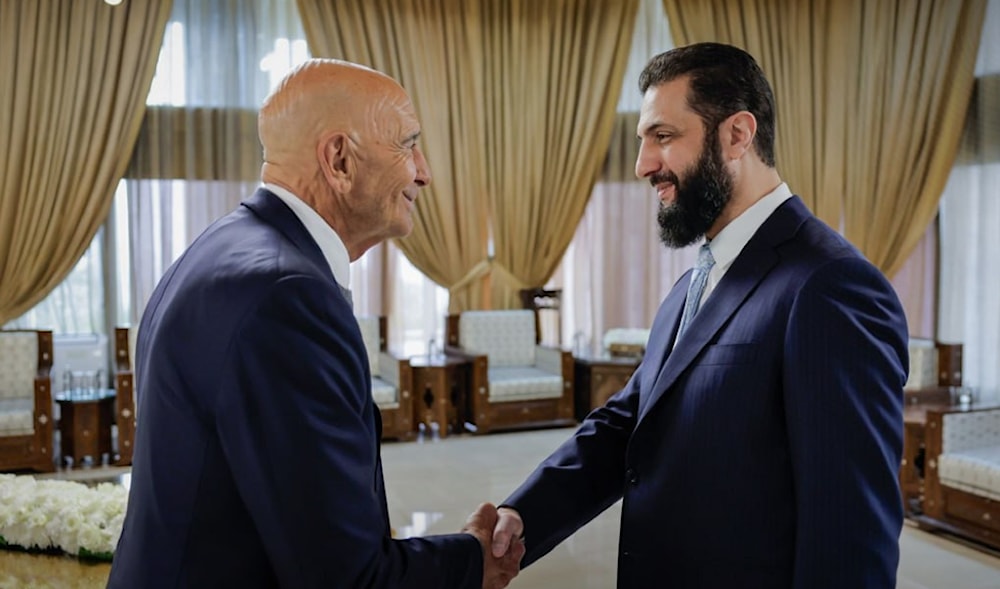
US envoy Thomas Barrack meets Syria’s interim president Ahmed al-Sharaa in Damascus amid shifting control in the country’s north and east. (SANA)
The Syrian government and the Syrian Democratic Forces (SDF) have announced today a comprehensive ceasefire and integration agreement aimed at ending hostilities and restoring full state authority across Syria’s northeast.
According to the agreement published by Syrian state media, an immediate and nationwide ceasefire will take effect across all frontlines and points of contact between government forces and the SDF. SDF military formations will withdraw to areas east of the Euphrates River as a preliminary step toward redeployment.
The deal stipulates the full administrative and military handover of Deir ez-Zor and Raqqa provinces to the Syrian state, including all civilian institutions and facilities. Current employees will be formally retained within state ministries, while Damascus pledged not to target SDF personnel or members of local civil administrations in the two provinces.
رئاسة الجمهورية: السيّد الرئيس أحمد الشرع يوقّع اتفاقية وقف إطلاق النار والاندماج الكامل لقوات سوريا الديمقراطية ضمن مؤسسات الدولة السورية#الإخبارية_السورية pic.twitter.com/Vpl7J7D52y
— الإخبارية السورية (@AlekhbariahSY) January 18, 2026
All civilian institutions in Hasakah province will be integrated into the Syrian state’s administrative structures, while the government will also assume control of all border crossings and oil and gas fields in the region. These sites will be secured by regular Syrian forces to ensure the return of revenues to the state.
The agreement further provides for the individual integration of SDF military and security personnel into the Syrian Ministries of Defense and Interior, following security vetting, with ranks and entitlements granted in accordance with the relevant regulations. The text also emphasizes the protection of the specific social and cultural character of Kurdish-majority areas.
As part of security arrangements, the city of Ayn al-Arab (Kobani) will be cleared of heavy military presence, with local security forces formed from residents of the city and a local police force placed under the Interior Ministry. The Syrian government will also take full legal and security responsibility for ISIS detainees and camps, absorbing the administrations and forces currently overseeing them.
Politically, the agreement includes the appointment of a governor for Hasakah by presidential decree, as well as the nomination of SDF-backed candidates for senior military, security, and civilian posts within the central state structure. It also welcomes Presidential Decree No. 13 of 2026, which recognizes Kurdish cultural and linguistic rights, addresses the status of undocumented citizens, and restores accumulated property rights.
The SDF committed to removing all non-Syrian members of the Kurdistan Workers’ Party (PKK) from Syrian territory, while the Syrian state reaffirmed its role as an active partner in the international coalition against ISIS, coordinating with the United States to ensure regional security and stability.
The agreement also calls for arrangements to facilitate the safe and dignified return of displaced residents to Afrin and the Sheikh Maqsoud neighborhood.
Syria's interim president meets US envoy as Kurdish fighters withdraw
On another note, Syria’s interim president, Ahmed al-Sharaa, met on Sunday with US envoy Tom Barrack, as forces aligned with the interim administration advanced into northern and eastern regions amid the withdrawal of Kurdish fighters.
In a statement issued after the meeting, the Syrian presidency said Sharaa “affirmed Syria's unity and sovereignty over all its territory, the importance of dialogue at the current stage and to rebuild Syria with the participation of all Syrians.” The statement added that Foreign Minister Asaad al-Shaibani also attended the talks.
The developments came amid reported contacts between Damascus and the Kurdish-led Syrian Democratic Forces, including a phone call earlier today between Sharaa and SDF commander Mazloum Abdi, according to Kurdish outlet Rudaw.
SDF-affiliated Ronahi TV similarly had reported that the call focused on announcing a ceasefire, with further details to be addressed at a later stage.
The contacts followed intense clashes over the past two days between SDF fighters and forces aligned with the interim leadership in eastern Aleppo and southern Raqqa, resulting in an unspecified number of casualties and the capture of several areas, including oil and gas fields in Deir ez-Zor.
Protracted Northern Standoff
Tensions between the interim authorities and the SDF have persisted for months, despite earlier attempts at accommodation. The two sides reached a US-backed agreement last year that envisioned a ceasefire and the gradual integration of SDF military and civilian structures into Syrian state institutions, but implementation stalled amid disputes over authority, security arrangements, and the pace of reintegration. Sporadic clashes have continued since then across parts of northern and northeastern Syria, with repeated ceasefire announcements failing to hold for long.
Barrack had met Abdi a day earlier in Erbil, according to the presidency of Iraq’s autonomous Kurdistan region, underscoring Washington’s engagement with both sides as control dynamics shift in Syria’s northeast.
Read more: Syrian army announces control of al-Tabqah airport and Euphrates Dam


