
Deadly clashes erupt between Syrian government forces, SDF in Aleppo
 4 Min Read
At least five people were killed as clashes broke out between Syrian government personnel and Kurdish-led SDF forces in Aleppo, amid stalled talks on integration.
-
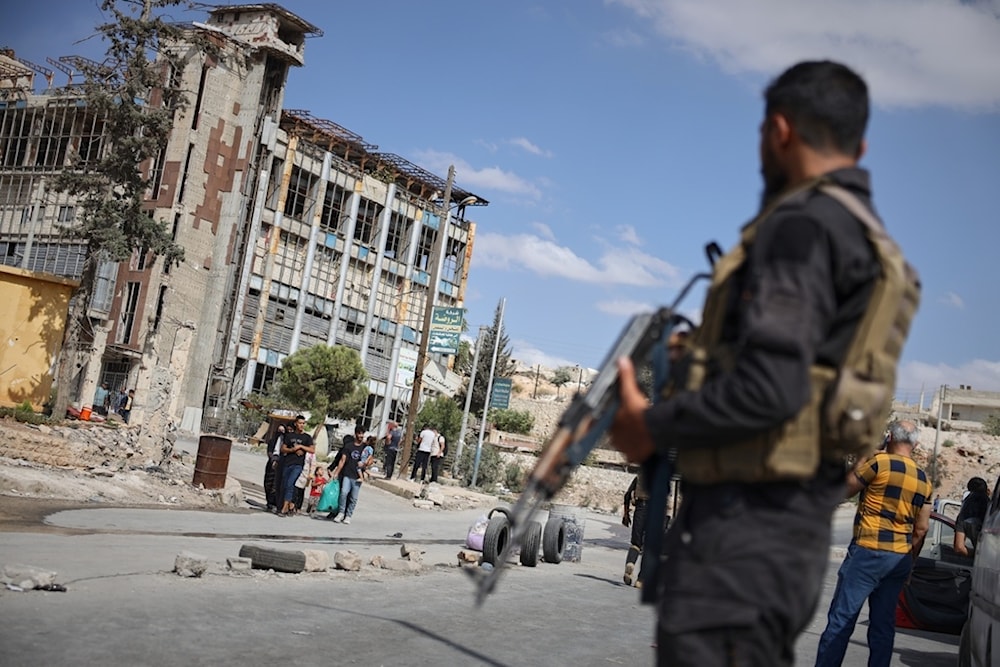
Syrian security forces stand guard as residents leave the Sheikh Maqsoud and Achrafieh neighborhoods of Aleppo, Syria, Tuesday, October 7, 2025 (AP)
At least five people were killed on Tuesday during clashes between Syrian government personnel and the US-backed Syrian Democratic Forces (SDF) in the northern city of Aleppo, as both sides accused the other of initiating the fighting.
The violence comes as progress has stalled on implementing a March agreement aimed at integrating the Kurds’ semi-autonomous administration and military structures into Syria’s interim government. Tensions have periodically flared, particularly in Aleppo, which is home to two Kurdish-majority neighbourhoods.
Syria’s state news agency SANA reported that SDF forces targeted an area near the Shihan roundabout, killing one member of the defence ministry. It later said three civilians, including two women, were killed after what it described as SDF shelling of residential buildings in Aleppo’s al-Midan neighbourhood.
Pro-government groups attack Kurdish neighborhood
In a statement issued earlier, the SDF said government-affiliated groups had targeted the Kurdish-majority Sheikh Maqsud neighbourhood with a reconnaissance drone, killing one resident and wounding two others.
The Kurdish-majority neighbourhoods of Sheikh Maqsud and Achrafieh have remained under the control of SDF-linked Kurdish units, despite an April agreement under which Kurdish fighters were supposed to withdraw from the areas.
Separately, the SDF accused factions affiliated with Syria’s army of attacking the town of Deir Hafer, about 50 kilometres east of Aleppo and near the strategic Tishreen Dam, affirming its right to respond to what it called continued attacks.
SDF holds talks with government
The SDF controls large areas of Syria’s oil-rich north and northeast and, with backing from a US-led coalition, played a key role in the territorial defeat of the Islamic State group in 2019. However, its integration into state institutions following the ouster of longtime ruler Bashar al-Assad a year ago has proven complex, despite the March deal that was supposed to be fully implemented by the end of 2025.
On Sunday, SDF chief Mazloum Abdi held further talks with officials in Damascus on integration, though state media said the discussions produced no tangible results. Kurdish leaders continue to call for decentralisation, a demand rejected by Syria’s new authorities.
The latest clashes follow similar violence last month in Aleppo that killed five people, shortly after Turkish Foreign Minister Hakan Fidan urged the SDF during a visit to Damascus not to obstruct Syria’s stability.
No results from talks
A senior official at the Syrian Ministry of Foreign Affairs in late December criticized the SDF's stance in discussions with the Syrian state, saying repeated dialogue has not produced any tangible outcomes.
The official told SANA that “rhetoric is used for media purposes and to absorb political pressure, amid a real stalemate and a lack of genuine will to move toward implementation.”
He added that proposals to integrate SDF-linked institutions in northeastern Syria into the Syrian state remain theoretical, with no practical steps or clear timelines, raising doubts about the SDF’s commitment to the March 10 agreement.
The official also questioned repeated SDF statements claiming that oil is “the property of all Syrians,” pointing out that oil revenues are not managed through state institutions nor included in the general budget, undermining the credibility of such claims.
On the issue of decentralization, the official warned that current SDF proposals extend beyond administrative measures toward political and security decentralization, posing a threat to Syria’s unity. He accused the SDF of monopolizing decision-making, ignoring political exclusion, and failing to ensure genuine representation for the social diversity of northeastern Syria.


