
Democratic senators push to block NDAA over US-Israeli military ties
 4 Min Read
A group of Democratic lawmakers challenges deeper US-'Israel' defense ties, citing concerns over support for Netanyahu’s government ahead of elections.
-
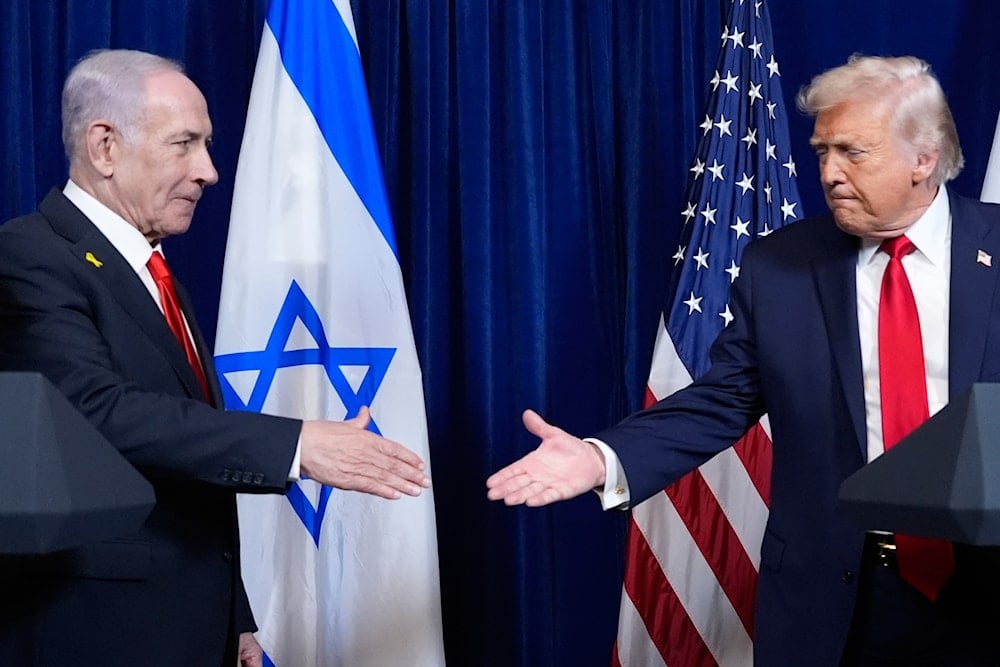
President Donald Trump shakes hands with Israeli Prime Minister Benjamin Netanyahu at the end of a news conference at Mar-a-Lago, on December 29, 2025, in Palm Beach, Fla. (AP)
A group of Democratic lawmakers is urging fellow party members to block the advancement of the National Defense Authorization Act (NDAA) until the Senate debates proposals to expand US-Israeli military and intelligence cooperation, reflecting growing divisions within the party over support for Israeli Prime Minister Benjamin Netanyahu’s government.
In a letter seen by Reuters and led by Democratic Senator Chris Van Hollen of Maryland, the lawmakers called on senators to oppose moving forward with the annual defense bill until Congress holds a debate on measures that would deepen military and intelligence ties with the Israeli government.
The move highlights a broader shift among Democrats, as support for "Israel" has become an increasingly divisive issue within the party ahead of November’s midterm elections. Some lawmakers have questioned a US policy that has traditionally maintained strong bipartisan backing.
Democrats challenge expanded military and intelligence ties
The senators argued that Congress should not approve measures that would further strengthen Washington’s relationship with Netanyahu’s government without a broader debate.
"As Senate Democrats, we should not be providing votes compelling him (President Donald Trump) to deepen the US relationship with Netanyahu's extremist government," they wrote in a "Dear Colleague" letter.
The letter was signed by Democratic Senators Jeff Merkley of Oregon, Ed Markey and Elizabeth Warren of Massachusetts, and Peter Welch of Vermont, as well as Senator Bernie Sanders of Vermont, an independent who caucuses with Democrats.
Favorability for 'Israel' collapses
The effort comes amid wider disagreements within the Democratic Party over Washington’s approach toward "Israel" and its government.
A Reuters/Ipsos poll last month found that one in four Americans believed the war with Iran was worth its costs. Separate Reuters/Ipsos polling showed that "Israel’s" favorability rating among Democrats fell from 59% in 2018 to 22% in May.
The figures reflect a growing debate among Democratic voters and lawmakers over longstanding US policy toward "Israel", particularly as foreign policy issues become more prominent ahead of the midterm elections.
NDAA includes proposals to deepen US-Israeli defense cooperation
Congress is currently drafting this year’s NDAA, which authorizes much of President Donald Trump’s proposed $1.5 trillion military budget.
Versions of the bill approved by House and Senate committees include new provisions aimed at expanding US-Israeli defense cooperation.
The letter also raised concerns over an early version of the fiscal 2027 Intelligence Authorization Act, which is typically attached to the NDAA and would further tighten intelligence ties with "Israel", according to the lawmakers.
House blocks vote to halt US-'Israel' military integration
In late June, a House committee blocked a bipartisan attempt to force a public vote on an amendment that sought to remove the controversial defense provision that would bind the US and Israeli military-industrial systems more deeply than ever.
The measure, detailed by Ben Freeman in Responsible Statecraft on Tuesday, centers on the United States-"Israel" Defense Technology Cooperation Initiative, a provision in the National Defense Authorization Act, or NDAA. Previously referred to as Section 224 and later identified by supporters as Section 219, it would create a Defense Department executive agent tasked with advancing defense technology cooperation between Washington and Tel Aviv, including weapons production, industrial coordination, technology sharing, and what the provision describes as “data fusion".
For critics, the provision marks a dangerous escalation in the already intimate US-Israeli war machine. But from a resistance-oriented reading, it does not create a new reality as much as it formalizes one that has long governed the region: the United States is not a neutral sponsor standing behind “Israel", but an active partner in the entity’s wars, intelligence operations, weapons programs, and regional aggression.
Representatives Ro Khanna, a California Democrat, and Thomas Massie, a Kentucky Republican, introduced an amendment seeking to remove the provision from the bill. However, the House Rules Committee declined to clear the amendment for debate and a vote before the full House, meaning that lawmakers were denied the chance to publicly record their positions on the issue.
Read more: Israeli media: US weighs permanent military presence in 'Israel'


