
Democrats seek limits as ICE body cameras raise surveillance alarm
 5 Min Read
Democratic leaders are seeking limits on how enforcement footage is stored and analyzed, amid reports of ICE monitoring protests through other surveillance tools.
-
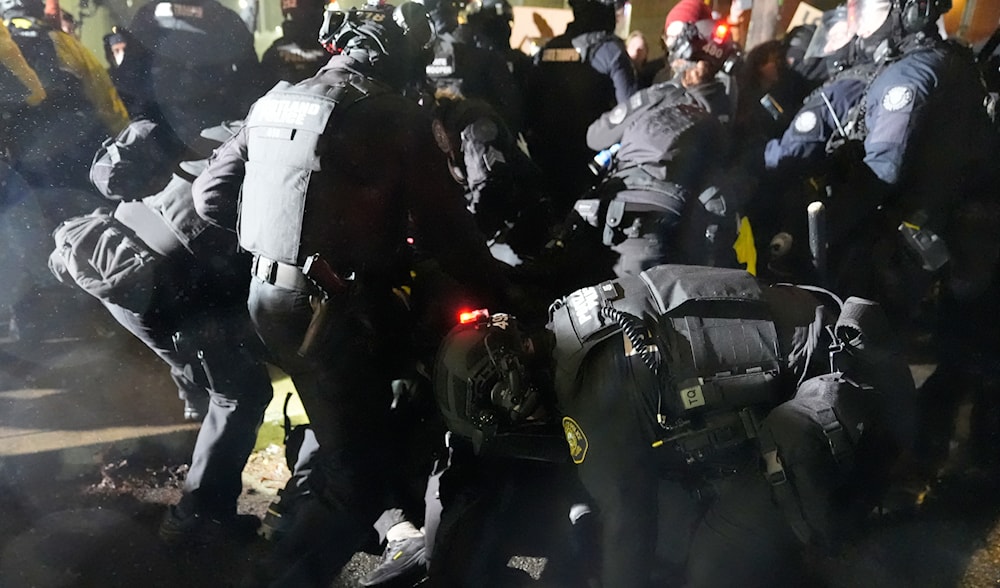
Law enforcement moved to detain a protester outside the US Immigration and Customs Enforcement facility on Jan. 8, 2026, in Portland, Ore. (AP)
Democrats’ long-standing demand that all Immigration and Customs Enforcement agents wear body cameras is running into a new obstacle: concern that the technology could expand government surveillance of protesters, Politico reported.
Calls for mandatory body cameras intensified after federal agents fatally shot two US citizens in Minneapolis. But privacy advocates warn that footage captured by ICE could be repurposed to identify, monitor, and track people engaged in protests, prompting Democratic lawmakers to seek new limits on how the cameras are used.
Democratic leaders have framed universal body-camera use as a key accountability measure for ICE. Yet critics argue that without safeguards, the cameras could become another tool for monitoring constitutionally protected activity.
Lawmakers and legal experts have accused ICE of already using a network of cameras to surveil demonstrations, feeding images into license plate readers and facial-recognition systems. Democrats now fear the same practices could be applied to footage collected by body cameras.
Calls for limits on facial recognition
Democrats have introduced legislation aimed at restricting ICE’s use of facial-recognition technology, though the proposals are unlikely to advance without Republican backing.
House minority leader Hakeem Jeffries and Senate minority leader Chuck Schumer are now pressing for explicit limits on how body-camera footage can be handled. In a letter sent to Republican leaders on Wednesday night, they called for provisions that would: “Prohibit tracking, creating or maintaining databases of individuals participating in First Amendment activities.”
Funding talks with Republicans
It remains unclear how the new demands will affect negotiations over a Department of Homeland Security funding bill. Republicans had already agreed to allocate additional funding for ICE body cameras before Democrats began insisting on restrictions governing their use.
A spokesperson for Sen. Mark Warner of Virginia, the vice chair of the Senate intelligence committee, told Politico that Democratic lawmakers are coalescing around leadership’s position, driven by reports that ICE has monitored protesters. DHS opened an internal review of ICE surveillance practices after Warner raised privacy concerns in a formal letter.
Sen. Ed Markey of Massachusetts, who has proposed banning ICE from using facial recognition, also endorsed limits on body-camera surveillance.
“Obviously, we want them to be wearing body cameras, but we would want restrictions placed on what that information could be used for,” Markey said.
“We want to make sure that we have the accountability for how these officers conduct themselves on the streets of our country, but we don’t want it in turn to be used as a way of coming back and suppressing free speech,” he added.
White House rejects constraints
The White House has signaled resistance to proposals that would curb ICE’s enforcement powers. Press secretary Karoline Leavitt said US President Donald Trump would reject any agreement that undermines the agency.
“I know Sen. Schumer and Leader Jeffries sent over a very long list of demands, some of which the administration is willing to discuss. Others don’t seem like they are grounded in any common sense and they are non-starters for this administration,” she said Thursday.
White House spokesperson Abigail Jackson declined to clarify whether limits on body-camera use were open for discussion, as per the report.
DHS pushes back
In a statement to Politico, DHS criticized Democrats’ proposals, saying that “sanctuary politicians attempting to ban our federal law enforcement from using tools and technology to track down criminals” would endanger public safety.
The agency said its body cameras are not equipped with facial-recognition technology, though Democrats remain concerned that recorded images could later be analyzed using external systems. DHS also denied maintaining a database of “domestic terrorists” after videos circulated showing officers threatening legal observers with inclusion on such lists.
DHS policy bars ICE agents from using body cameras solely to record people engaged in First Amendment activities, such as protests. However, filming is permitted during arrests, and most footage of demonstrators has been captured during enforcement operations.
Democrats’ renewed push follows a January 28 letter from 29 technology and social-justice groups warning that body cameras could deepen ICE’s surveillance reach.
“Democrats in Congress can’t claim they’re standing against ICE abuses if they’re calling for more ICE-controlled cameras, which will inevitably be hooked into ICE’s facial recognition and other surveillance tools,” said Evan Greer of Fight for the Future. “The shift in messaging from Democratic leadership shows they are feeling the heat on this.”
Lawsuits and protester intimidation claims
Court filings in a lawsuit alleging ICE violated protesters’ constitutional rights describe incidents in which agents claimed to be using facial recognition while recording encounters.
In another instance cited in the case, an agent told a protester, “We have your license plate, we know where to find you.”
“We’ve seen multiple examples of ICE and border patrol agents filming protesters and legal observers, forcing them to submit to face scans, detaining them when they refuse, even hinting at a database of protesters,” Rep. Pramila Jayapal of Washington said at a press conference Wednesday.


